
Palm oil and coconut oil are both tropical oils that have played important roles in global cuisine and commerce for centuries. They share similar origins — both derived from palm fruits — yet their taste, color, composition, and culinary roles are surprisingly distinct. Let’s take a closer look at how they differ, where they overlap, and when to use one over the other.


Quick reference
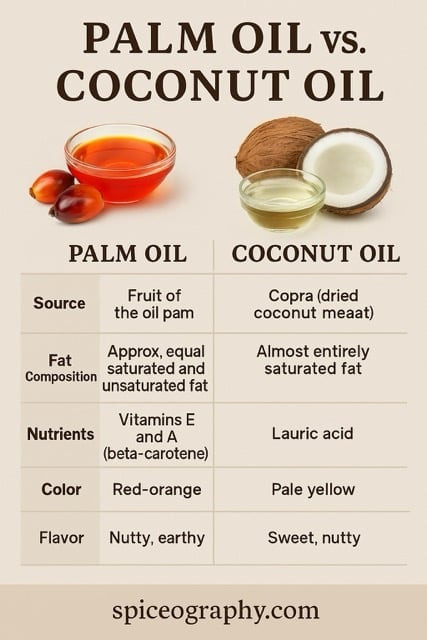
| Feature | Palm Oil | Coconut Oil |
|---|---|---|
| Source | Fruit of the oil palm (Elaeis guineensis) | Flesh (copra) of the coconut palm (Cocos nucifera) |
| Color | Deep red-orange (unrefined), golden (refined) | White (solid), clear (melted) |
| Flavor | Nutty, earthy, savory, slightly carrot-like | Sweet, creamy, tropical (neutral if refined) |
| Fat Composition | ~50% saturated, ~50% unsaturated | ~90% saturated |
| Key Nutrients | Vitamin E (tocopherols, tocotrienols), carotenoids (beta-carotene) | Lauric acid (MCT), small vitamin E content |
| Smoke Point | ~450°F (refined), ~300°F (unrefined) | ~400°F (refined), ~350°F (unrefined) |
| Texture | Semi-solid at room temperature | Solid at room temperature |
| Best For | African and Brazilian savory dishes, stews, soups | Baking, frying, desserts, tropical curries |
| Substitution Cautions | Strong color and flavor can overpower | Lacks color and savory depth of palm oil |
| Sustainability Notes | Often linked to deforestation; sustainable options available | Lower yield per acre; labor-intensive production |
How does palm oil differ from coconut oil?
While both oils come from palm fruits, they’re sourced from entirely different trees.
- Palm oil comes from the fleshy red fruit of the oil palm (Elaeis guineensis), a tree native to West Africa but now cultivated extensively in Southeast Asia, especially in Indonesia and Malaysia.
- Coconut oil, on the other hand, comes from the coconut palm (Cocos nucifera). The oil is pressed from copra, the dried white meat inside the coconut shell.
Despite their shared tropical heritage, these oils look, taste, and perform quite differently in the kitchen.
Nutritional differences and health effects
Both oils are high in saturated fat — a key reason they’re solid or semi-solid at room temperature — but the type of fat and its effects on the body vary.
- Palm oil contains a roughly 50-50 balance of saturated and unsaturated fats, making it somewhat more balanced from a nutritional standpoint. It’s often considered a better option for heart health than coconut oil because of this mix.
- Coconut oil is about 90% saturated fat, one of the highest among edible oils. Its primary fatty acid, lauric acid, has a unique dual effect: it can raise both “good” HDL and “bad” LDL cholesterol. While it may benefit HDL levels, the overall heart health picture is still debated.
Palm oil also has a nutritional advantage in its vitamin and antioxidant content. It’s a rich source of:
- Vitamin E, specifically both tocopherols and tocotrienols (two potent forms of the vitamin).
- Carotenoids, including beta-carotene, which gives red palm oil its characteristic color and serves as a precursor to vitamin A. In fact, red palm oil is considered one of the richest natural sources of beta-carotene.
Coconut oil, while lacking in these pigments and vitamins, does have antimicrobial benefits thanks to its medium-chain triglycerides (MCTs), particularly lauric acid, which may support metabolism and immune health.
Color and appearance
This is one of the most striking differences between the two oils.
- Unrefined palm oil is deep reddish-orange, almost glowing, due to its carotenoid content.
- Refined palm oil, often used in processed foods, loses this color during bleaching and deodorizing, turning a pale golden hue.
- Coconut oil is naturally clear when melted and white when solid, with only a faint yellow tint if unrefined.
This difference isn’t just visual — the color of palm oil often imparts a distinct hue to dishes, especially in traditional African stews and Brazilian moquecas.
Flavor and aroma
Flavor is where these oils truly diverge.
- Palm oil has a bold, nutty, and earthy taste, often described as slightly savory with hints of carrot or olive-like grassiness from its carotenoids. Its flavor is unmistakable and deeply tied to regional cuisines that rely on it.
- Coconut oil, in contrast, offers a sweet, nutty, and tropical aroma, with a gentle creaminess that works beautifully in desserts and curries. The refined version of coconut oil, however, has been deodorized, leaving it neutral in taste — ideal for frying or baking when you don’t want coconut flavor to dominate.
Because of these differences, swapping one for the other can dramatically alter a dish’s character.
If your recipe calls for one, can you use the other?
Technically, you can substitute one for the other, but the results may be far from what you expect.
- Substituting palm oil for coconut oil: The biggest issue is the color — that deep red hue can completely change the appearance of a dish (and sometimes the flavor). Its strong nuttiness and earthy undertones also don’t mimic the clean sweetness of coconut oil.
- Substituting coconut oil for palm oil: While you can approximate the color of red palm oil by infusing coconut oil with annatto seeds or paprika, the flavor gap remains wide. Coconut oil simply doesn’t deliver the same savory depth.
If you’re making dishes like African stews (like Nigerian egusi soup) or Brazilian moqueca, skipping palm oil can mean losing a major part of the dish’s identity. Likewise, replacing coconut oil in Thai curries or Caribbean desserts with palm oil can overpower the intended flavor balance.
When should you use palm oil? And when should you use coconut oil?
Each oil shines in different culinary traditions and applications:
Use palm oil for:
- Traditional West African dishes like egusi soup, jollof rice, and banga stew, where its rich, nutty flavor and color are integral.
- Brazilian Bahian cuisine, particularly moqueca de dendê (Bahian fish stew).
- Savory cooking that benefits from depth and color — for example, lentil stews or bean-based soups.
Use coconut oil for:
- Caribbean, Polynesian, and Southeast Asian cooking, where coconut’s sweetness enhances tropical flavors.
- Baking and desserts — unrefined coconut oil adds a mild coconut flavor to cookies, cakes, and energy bars.
- Frying and sautéing, especially with refined coconut oil, which has a higher smoke point and a neutral taste.
- Vegan butter or shortening alternatives, due to its solid state at room temperature.
For more details on how to use it effectively, read Cooking With Coconut Oil: The Dos and Don’ts.
Sustainability and environmental considerations
One major point of comparison that’s often overlooked is environmental impact.
- Palm oil production, particularly in Southeast Asia, has been linked to deforestation and habitat loss, though certified sustainable palm oil (CSPO) initiatives aim to reduce this.
- Coconut oil, while less controversial, also poses sustainability challenges due to limited biodiversity in coconut farming regions and the high labor demands of harvesting.
For eco-conscious consumers, choosing sustainably sourced or certified versions of either oil can make a meaningful difference.
The bottom line
Palm oil and coconut oil may both be tropical in origin, but they serve very different culinary and nutritional roles.
- Palm oil brings bold color, savory depth, and nutrients like carotenoids and vitamin E — perfect for African and Brazilian dishes.
- Coconut oil delivers a milder, sweeter profile with versatility across cuisines, from baking to frying to tropical curries.
Or in short:
- Palm oil = earthy, colorful, savory, and rich.
- Coconut oil = sweet, creamy, and versatile.
Both have a place in your kitchen — just not necessarily in the same recipes.
No products found.
Related posts
- Authentic Palm Oil Uses: Want to learn ways to use this unique ingredient? Here are a few to get you started.
- Palm Oil Vs. Palm Kernel Oil: There are differences. Learn more about these similarly named oils.
- Refined Vs. Unrefined Coconut Oil: We dive into what refining does to the flavor and more.