Spice Comparisons · Comparison
Allspice vs. Nutmeg: Unrelated Spices That Share a Shelf
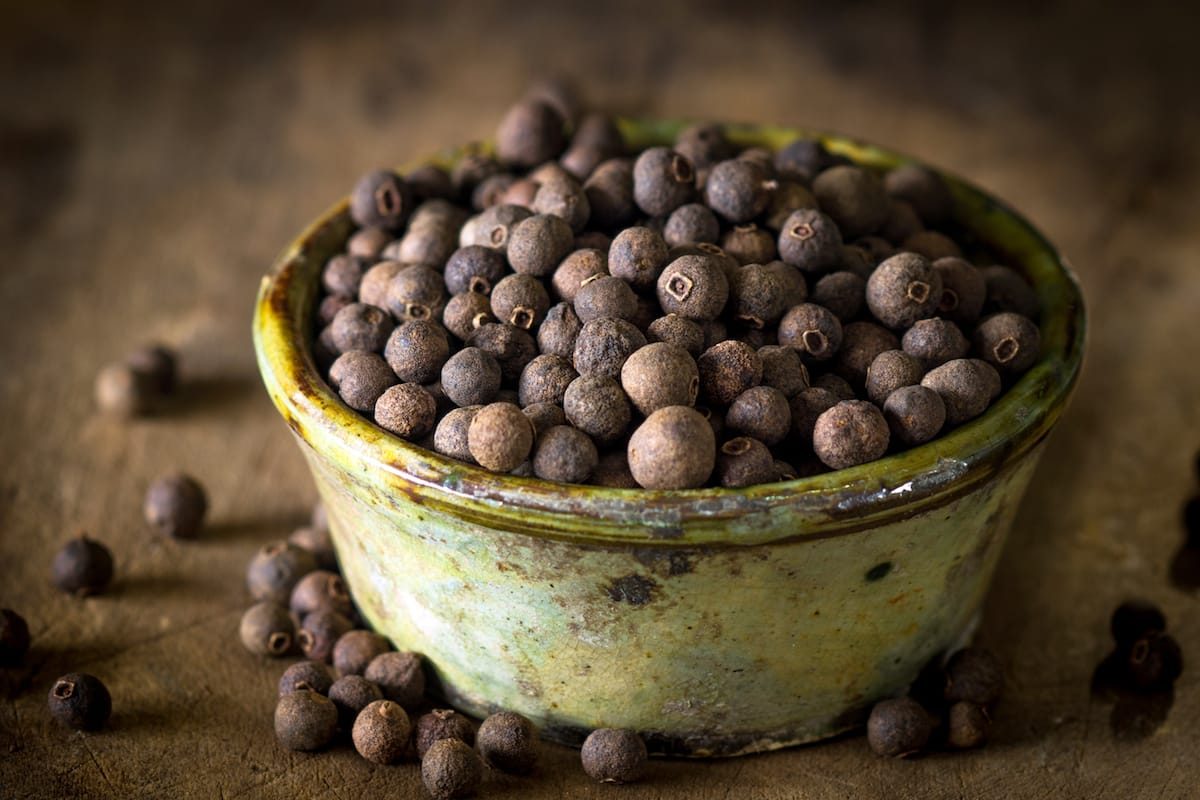
Allspice got its English name because it tastes like cloves, cinnamon and nutmeg rolled into one. Yet allspice and nutmeg are unrelated plants with different chemistry, even if they sit side by side in pumpkin pie spice. Allspice is the dried berry of a myrtle-family tree, and its oil is led by eugenol, the same compound that dominates cloves, so its warmth leans clove-like. Nutmeg is the dried seed kernel of an unrelated tree, sweeter and woodier, and its oil is mostly monoterpenes like pinene and sabinene. They swap more easily in a spice cake than in a dish where either one leads.
Side by side
| Allspice | Nutmeg | |
|---|---|---|
| Species | Pimenta dioica | Myristica fragrans |
| Family | Myrtaceae (myrtle family) | Myristicaceae (nutmeg family) |
| Native range | Southern Mexico to Central America and the Caribbean | Maluku (Banda Islands), Indonesia |
| Part used | The fruit, picked before fully ripe and dried | The dried seed kernel; the red covering around the seed is sold separately as mace |
| Essential oil | About 4.5% for Jamaican allspice (Britannica)1 | 5–15% of the kernel (FAO)2 |
| Main aroma compounds | Eugenol (50–80% of berry oil, PROSEA), with methyl eugenol and myrcene34 | α- and β-pinene and sabinene; aromatic ethers such as myristicin and elemicin make up 2–18% of the oil25 |
| Flavor | Britannica: aromatic and pungent, resembling cloves, cinnamon and nutmeg | Britannica: distinctive pungent fragrance, warm and slightly sweet taste |
| Forms | Whole berries, ground | Whole, ground (grate whole nutmeg as needed) |
| Typical uses | Jerk; broths, gravies and pickling liquids; desserts, fruit cakes and pies | Confectionery, cakes, cookies, dairy dishes such as eggnog; savory vegetable dishes |
| Safety | No regulator sets a concern level for allspice in food (see allspice) | Toxic in large amounts because of myristicin; EU aflatoxin limits apply specifically to nutmeg67 |
| Price | No dated, sourced retail comparison found | No dated, sourced retail comparison found |
The oil figures come from different sources and sample types, so they show that both spices carry a few percent of essential oil, not which one is stronger. The compound rows are the contrast that counts: the two oils are led by different compounds.
Why allspice tastes of cloves and nutmeg doesn’t
Britannica says allspice got its English name because the dried berry tastes like a combination of cloves, cinnamon and nutmeg.1 It gives the reason but not who coined the name or when. We couldn’t trace the common story that 17th-century Englishmen named it.
Of those three, the clove resemblance has the clearest chemical basis. Eugenol makes up 50 to 80 percent of allspice berry oil, according to PROSEA,3 and about 85 to 92 percent of clove oil.8 Nutmeg’s oil is different: FAO names α-pinene, β-pinene and sabinene as its major components,2 and the aromatic ethers, among them myristicin and elemicin, are a minor share.5 None of our sources explain in chemical terms why allspice also reminds people of nutmeg. That part comes down to taste.
That clove note makes allspice taste sharper and more savory. Nutmeg is sweeter and woodier, and turns bitter if you overdo it.
Using them in the kitchen
Together. They often share a blend. McCormick’s pumpkin pie spice lists cinnamon, ginger, nutmeg and allspice, and its apple pie spice lists cinnamon, nutmeg and allspice.910 US rules require ingredients in descending order by weight,11 so cinnamon is the biggest part of both blends, and McCormick’s pumpkin pie spice has no cloves at all.
Allspice. It’s central to Jamaican jerk, where Smithsonian Magazine calls pimento (allspice) and fresh thyme essential ingredients, alongside Scotch bonnet peppers.12 Whole allspice goes into meat broths, gravies and pickling liquids, and ground allspice into desserts, fruit cakes and pies. It also turns up in burgers, meatloaf and rubs for pork or poultry; see spices for hamburgers and spices for pork.
Nutmeg. Grated nutmeg flavors confectionery in small amounts in most countries, and its uses include cakes and cookies and dairy dishes like eggnog, ice cream and milk pudding. McCormick suggests it for scalloped potatoes, glazed carrots and creamed spinach.13 You’ll see claims that nutmeg is traditional in haggis or Middle Eastern lamb dishes. We couldn’t trace them to a source we could open.
Can one stand in for the other?
In sweet baking, pretty well. In a dish where either spice is the lead flavor, less so. The ratios below come from our nutmeg substitutes and allspice substitutes pages and keep their labels: Attributed quotes a named source, and Method is our starting point where no published number exists.
| Swap | Starting amount | Treatment |
|---|---|---|
| Allspice for nutmeg | Equal amount | Attributed (Healthline) |
| Nutmeg alone for allspice | Half as much, then taste | Method |
| Cinnamon, nutmeg and cloves (2:1:1) for allspice | 1:1 for ground allspice | Attributed (The Spice House) |
Allspice in place of nutmeg. Ratio (Attributed): Healthline says to replace nutmeg with an equal amount of allspice.14 Expect the clove note to show, especially in a custard or a béchamel where nutmeg is the only spice. For those, our nutmeg substitutes page ranks mace first.
Nutmeg in place of allspice. By itself, nutmeg misses the clove note. A blend works better. Ratio (Attributed): The Spice House says to mix 2 parts cinnamon, 1 part nutmeg and 1 part ground cloves and use it 1:1 wherever a recipe calls for ground allspice, with a pinch of black pepper for savory dishes.15 Ratio (Method): If nutmeg is all you’ve got, start with half as much as the allspice called for and taste. In jerk, where pimento is essential, nutmeg is a poor stand-in.
Safety
At normal kitchen amounts, neither spice is a concern. The National Capital Poison Center says nutmeg isn’t dangerous when used as recommended.16 Nutmeg differs from allspice in two ways:
- Large doses are toxic. The Tennessee Poison Center says the body converts nutmeg’s myristicin into MMDA, a compound with hallucinogenic properties.6 Sources disagree on how much it takes: the Tennessee Poison Center reports psychogenic effects at 15 to 20 g of ground nutmeg, two to three tablespoons, while the Missouri Poison Center gives 5 to 30 g as the range taken by people using it to get high.617 Both are far beyond anything a recipe calls for.
- Aflatoxin. Nutmeg is one of the few spices named in the EU’s aflatoxin limits.7 Details are on our nutmeg page.
For allspice, see the safety section of our allspice profile.
What isn’t known
- No source explains the nutmeg-like part of allspice’s flavor in chemical terms.
- No dated price comparison.
Related
- Allspice, allspice substitutes, too much allspice
- Nutmeg, nutmeg substitutes, too much nutmeg, fresh vs. ground nutmeg, cooking with nutmeg
- Mace vs. allspice, mace vs. nutmeg, allspice vs. cloves, cinnamon vs. nutmeg
- Pumpkin pie spice, apple pie spice, jerk seasoning
Footnotes
-
“Allspice”, Encyclopaedia Britannica. britannica.com · Reference work ↩ ↩2
-
Production, handling and processing of nutmeg and mace, Section VI: Composition and constituents, FAO. fao.org · Reference work ↩ ↩2 ↩3
-
D. Sulistiarini, Pimenta dioica, Plant Resources of South-East Asia (PROSEA). uses.plantnet-project.org · Reference work ↩ ↩2
-
Andrade Avila, Cruz-Olivares and Pérez-Alonso, “Antioxidant Effect and Medicinal Properties of Allspice Essential Oil”, IntechOpen, 2022. intechopen.com · Peer-reviewed ↩
-
M. Flach and M. Tjeenk Willink, Myristica fragrans, Plant Resources of South-East Asia (PROSEA). uses.plantnet-project.org · Reference work ↩ ↩2
-
Nena Bowman, “Nutmeg, a Potentially Uninvited Holiday Guest?”, Tennessee Poison Center, 2020. vumc.org · Reference work ↩ ↩2 ↩3
-
Commission Regulation (EU) 2023/915, European Commission. eur-lex.europa.eu · Regulator ↩ ↩2
-
Batiha et al., “Syzygium aromaticum L. (Myrtaceae)”, Biomolecules, 2020. mdpi.com · Peer-reviewed ↩
-
McCormick Pumpkin Pie Spice, product page, McCormick. mccormick.com · Merchant ↩
-
McCormick Apple Pie Spice, product page, McCormick. mccormick.com · Merchant ↩
-
21 CFR 101.4, Food; designation of ingredients, eCFR. ecfr.gov · Regulator ↩
-
Vaughn Stafford Gray, “A Brief History of Jamaican Jerk”, Smithsonian Magazine, 2020. smithsonianmag.com · Publication ↩
-
McCormick Ground Nutmeg, product page, McCormick. mccormick.com · Merchant ↩
-
Katey Davidson, “8 Great Substitutes for Nutmeg”, Healthline. healthline.com · Publication ↩
-
Allspice Substitute, The Spice House. thespicehouse.com · Merchant ↩
-
Rose Ann Gould Soloway, “Kitchen surprises and cautions”, National Capital Poison Center. poison.org · Reference work ↩
-
Nutmeg Abuse, Missouri Poison Center. missouripoisoncenter.org · Reference work ↩
Also drawn on
- Pimenta dioica (L.) Merr., Plants of the World Online, Royal Botanic Gardens, Kew. powo.science.kew.org
- Myristica fragrans Houtt., Plants of the World Online, Royal Botanic Gardens, Kew. powo.science.kew.org
- Nutmeg (Britannica Editors, updated 17 Aug 2026), Encyclopaedia Britannica. britannica.com
- Production, handling and processing of nutmeg and mace and their culinary uses, Section III: Post harvest handling, FAO. fao.org
- Production, handling and processing of nutmeg and mace and their culinary uses, Section VII: Utilization of products, FAO. fao.org