Spices · Dish guide
The Best Spices for Steak: Salt, Pepper and the Rubs Worth Adding
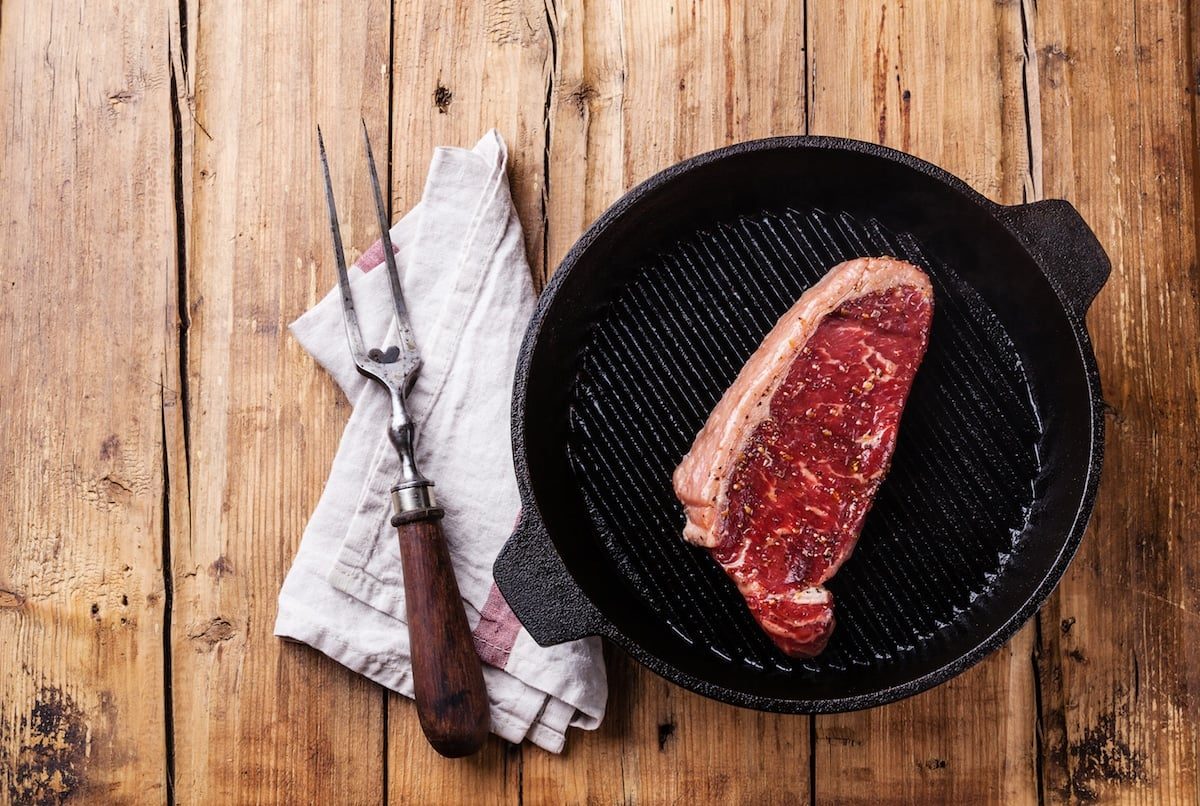
Argentines eat a lot of grilled beef, and they put little on their steaks besides salt and pepper, with chimichurri as the big exception.1 That’s a good model. Salt and black pepper do most of the work, as long as the salt goes on ahead and the pepper is freshly ground. Past that baseline, Mexican-style rubs for skirt and flank steak bring in garlic, cumin, paprika, oregano and dried chiles, and a shaker of Montreal steak seasoning covers several bases at once (just don’t salt on top of it). Below: when each one goes on, and how the named recipes use them.
At a glance
| Seasoning | Job on the steak | Notes |
|---|---|---|
| Salt | Seasons the meat; applied ahead, it is drawn out and reabsorbed | Kosher salt preferred for salting meat2 |
| Black pepper | Pungency, from piperine | Grind just before use34 |
| Garlic or garlic powder | Savory, sulfurous depth | Fresh garlic burns fast over high heat5 |
| Cumin | Earthy warmth in Mexican-style rubs | A background note in the two rubs below67 |
| Paprika and oregano | Color, mild pepper flavor, herbal note | Both in Jinich’s skirt steak rub6 |
| Ancho or pasilla | Mild, sweet-smoky chile flavor | The base of Bayless’s carne asada rub78 |
| Montreal steak seasoning | Coarse salt, pepper, garlic and more in one shaker | Recipes for it disagree91011 |
| Chimichurri | Herb and vinegar sauce after cooking | Parsley, garlic, oregano, chile1 |
Salt: the one seasoning a steak can’t skip
America’s Test Kitchen explains that salt on raw meat draws juices to the surface and dissolves in them to form a brine, which the meat eventually reabsorbs.2 ATK reaches for kosher salt here, and notes that salting won’t get in the way of a well-browned crust on steaks, chops or roasts, since it adds no moisture to the outside. That page doesn’t give a timing for steak. Pati Jinich’s skirt steak recipe lets the rubbed steaks sit anywhere from a few minutes to 2 hours, in the fridge if it’s longer than half an hour.6
You’ll hear that coarse salt is better on steak because its crystals dissolve and absorb more slowly. We found no source that measures this. What ATK does say is that sea salt is best used as a finishing salt,12 so big flakes scattered over sliced steak right before serving add crunch. See cooking with kosher salt, cooking with sea salt, fleur de sel and Maldon salt.
Black pepper: grind it fresh
For the best flavor, ATK says to grind your own peppercorns right before you need them.3 Coarsely cracked pepper gives you the crunch and visible specks of a pepper crust; see cracked vs. ground black pepper.
Ground spices don’t fare well under intense heat,13 and a hard sear is about as intense as it gets. Some cooks pepper the steak after searing for that reason. If a crust does turn bitter, see too much pepper.
Garlic: powder in the rub, fresh garlic late
Fresh minced garlic that goes into a very hot pan too early can burn fast and turn acrid and bitter, ATK says.5 So fresh garlic is a poor fit for a rub that goes straight into a smoking-hot skillet, though Bayless does use 4 cloves of chopped garlic in his grilled carne asada rub.7 Crushed cloves in the basting butter near the end are a common alternative.
Garlic powder spreads evenly in a dry rub. ATK found that garlic powder straight from the jar hasn’t developed its full flavor, and recommends hydrating it in a little water first.14 See garlic powder vs. garlic.
Cumin, paprika and oregano: two Mexican-style rubs
Two named recipes show the pattern. Pati Jinich’s dry rub for skirt steak is a light mix of sweet paprika and dried oregano with a smaller pinch of ground cumin, plus freshly ground black pepper and kosher or coarse sea salt, and the steaks get seared in butter.6 Rick Bayless’s grilled red-chile steak, a carne asada made with flank steak, builds its rub on a generous amount of ground ancho, with chopped garlic, brown sugar, black pepper and salt, and just a little cumin and Mexican oregano.7
In both, cumin stays in the background. Bayless says strip steak, rib-eye or chuck steak can stand in for the flank.7 You may read that cumin helps build a crust on grilled steak; we found no source that tests it. See cumin uses and too much cumin.
Dried chiles: ancho and pasilla
The Chile Pepper Institute describes ancho, a dried poblano, as sweet and smoky with hints of dried fruit, at 1,000 to 2,000 Scoville heat units, and says it pairs well with meats.8 It rates pasilla’s heat as mild.15 Bayless’s rub uses a third of a cup of ancho powder on a single flank steak.7 Skirt steak is the fajita cut. We couldn’t find out whether chile rubs are traditional on hanger steak. See ancho powder and pasilla powder.
Montreal steak seasoning
Montreal steak spice is a salt-based shaker blend, and what goes in it depends on who you ask:
| Source | What it names |
|---|---|
| McCormick Grill Mates label | Coarse salt, spices (including black pepper and red pepper), garlic, onion, sunflower oil, natural flavor, extractives of paprika11 |
| CBC News, on the must-haves | Coriander seed, mustard seed, peppercorns, dried garlic and onion, paprika, salt, some heat9 |
| Atlas Obscura | Pepper and garlic, with coriander and dill10 |
The McCormick label doesn’t name coriander or dill. Both may be hiding under “spices,” but the label doesn’t say. Its directions call for 1 tablespoon per pound of beef, pork or seafood before grilling or broiling, and one 1/4-teaspoon serving carries 250 mg of sodium.11 It’s salt-based, so don’t salt the steak separately. See coriander and dill seed vs. dill weed.
Chimichurri: seasoning after the grill
Chimichurri is a sauce of Argentine origin, and in Argentina, fresh parsley, garlic, oregano and chiles form its base. Francis Mallmann’s version in Saveur is heavy on fresh herbs, with chopped parsley and nearly as much fresh oregano, loosened with olive oil and red wine vinegar, and Saveur says it pairs beautifully with steak.16 See oregano uses and parsley.
Doneness
Federal guidance says to cook beef steaks, roasts and chops to at least 145°F, measured with a food thermometer, with a 3-minute rest.17 Jinich’s timing, about 4 minutes on one side and 2 to 3 on the other for medium, followed by a 3- to 4-minute rest, is for a skirt steak about 1/2 inch thick.6 Check thicker cuts with a thermometer.
Related
- BBQ spices and charcoal seasoning
- Spices for hamburgers
- Best spices for tuna steak
- Seasoned salt and Worcestershire powder
- The master list of herbs and spices
Footnotes
-
Ismay Atkins, “Chimichurri”, Encyclopaedia Britannica. britannica.com · Reference work ↩ ↩2
-
“Salting Meat”, America’s Test Kitchen (Cook’s Illustrated). americastestkitchen.com · Publication ↩ ↩2
-
“Savory Spices”, America’s Test Kitchen. americastestkitchen.com · Publication ↩ ↩2
-
Britannica Editors, “Black pepper”, Encyclopaedia Britannica. britannica.com · Reference work ↩
-
Liz Bomze, “Why You Should Wait to Add Garlic”, America’s Test Kitchen, 2023. americastestkitchen.com · Publication ↩ ↩2
-
Pati Jinich, “Dry Rub Skirt Steak”, patijinich.com, 2016. patijinich.com · Publication ↩ ↩2 ↩3 ↩4 ↩5
-
Rick Bayless, “Grilled Red-Chile Steak (Carne Asada)”, from Mexican Everyday (2005), via Iowa Public Radio. iowapublicradio.org · Publication ↩ ↩2 ↩3 ↩4 ↩5 ↩6
-
Ancho recipe card, Chile Pepper Institute, New Mexico State University. cpi.nmsu.edu · Reference work ↩ ↩2
-
Elias Abboud, “‘Tis the seasoning: What’s behind Montreal steak spice”, CBC News, 2019. cbc.ca · Publication ↩ ↩2
-
Anne Ewbank, “Montreal Steak Spice”, Atlas Obscura. atlasobscura.com · Publication ↩ ↩2
-
McCormick Grill Mates Montreal Steak Seasoning, ingredients and directions, via ShopRite product listing. shoprite.com · Merchant ↩ ↩2 ↩3
-
“Salt Types and Measurements”, America’s Test Kitchen. americastestkitchen.com · Publication ↩
-
Marco Rossi, “How To Improvise Instant Pot Seasoning Without Burning Your Spices”, Tasting Table, 2023. tastingtable.com · Publication ↩
-
Carolyn Grillo, “For Great Garlic Bread, Hydrate Your Garlic Powder First”, America’s Test Kitchen, 2021. americastestkitchen.com · Publication ↩
-
Pasilla recipe card, Chile Pepper Institute, New Mexico State University. cpi.nmsu.edu · Reference work ↩
-
Francis Mallmann, “Chimichurri”, Saveur. saveur.com · Publication ↩
-
“Cook to a Safe Minimum Internal Temperature”, FoodSafety.gov, U.S. Department of Health and Human Services. foodsafety.gov · Regulator ↩