Blog · Storage
Can You Freeze Thyme? Methods, Storage Time and What the Research Shows
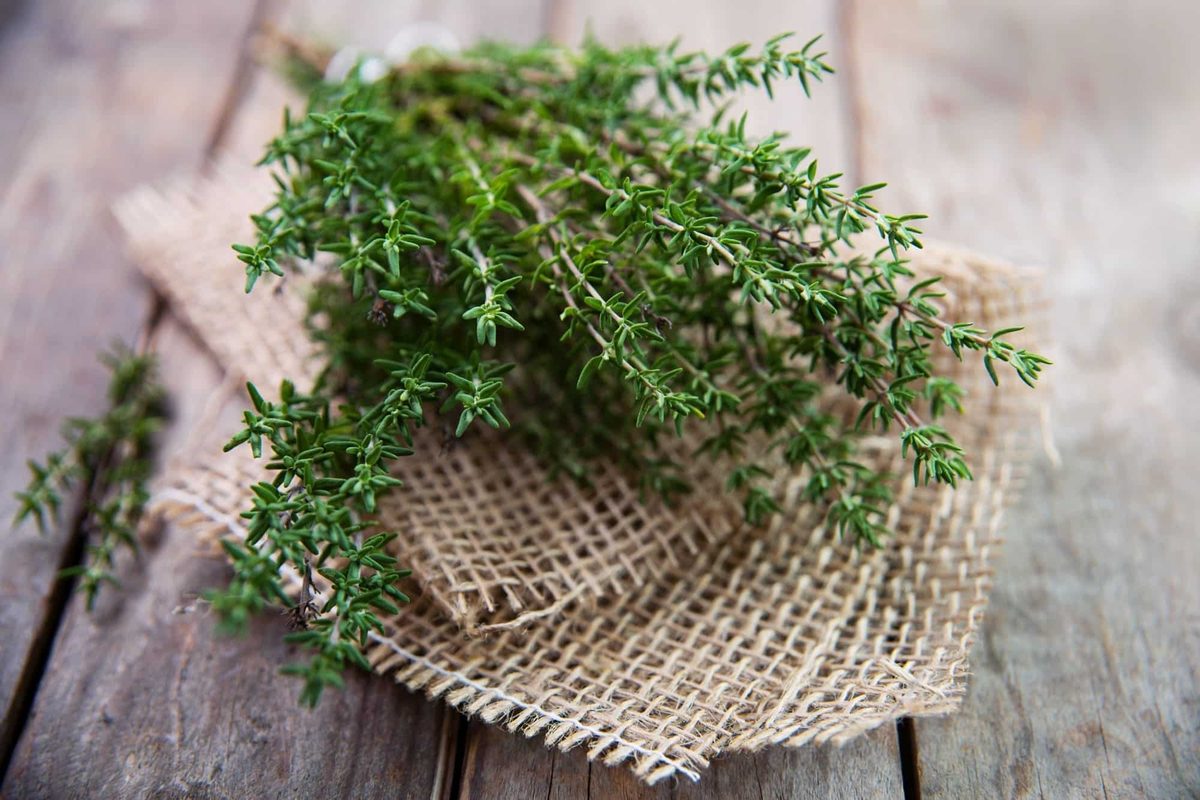
Thyme is an easy herb to freeze. You don’t even have to strip the leaves: it freezes fine right on the stem,1 the frozen leaves rub right off, and it’s one of the sturdy herbs that make the best herb ice cubes.2 In a nine-month storage study, frozen thyme lost the least essential oil of three preservation methods, and air-dried thyme lost the most.3 For the best quality, use it within 3 to 6 months, dropped straight into braises and soups.4
At a glance
| Question | Short answer |
|---|---|
| Can it be frozen? | Yes, as sprigs or as leaves. |
| Best methods | Sprigs tray-frozen then bagged; washed sprigs straight into freezer bags; or chopped leaves in ice cube trays under water or oil. |
| Blanch first? | No source recommends blanching thyme. |
| Freezer temperature | 0°F or below.45 |
| How long | For best quality, 3 to 6 months (Ohio State). Other figures below. |
| Thaw first? | No. Add it frozen to cooked dishes. |
| Oil cubes | Keep them frozen; once thawed, refrigerate and use within 4 days.6 |
How to freeze thyme
Prep it. Rinse the sprigs, then pat or spin them dry. Freeze thyme at peak freshness. You can leave the leaves on the stems, since Penn State says thyme freezes fine on the stem.1 Frozen leaves rub right off.
About blanching. Some guides tell you to blanch thyme for a minute before freezing. We found no source that recommends it. Penn State only mentions blanching for larger herbs like basil, for 15 seconds.1 The USDA freezing fact sheet describes blanching as a step for vegetables, whose enzymes freezing only slows.7
Method 1: bag the sprigs. Put washed herbs in airtight freezer bags and freeze them. Press out as much air as you can before sealing. Air reaching the surface of frozen food is what causes freezer burn.7 Sprigs bagged this way can freeze into a clump, so use small bags.
Method 2: tray-freeze. Spread well-drained sprigs in a single layer on a tray, freeze until firm, then move them to labeled bags or containers. They stay separate, so you can take out one sprig at a time.
Method 3: ice cubes. America’s Test Kitchen chops the herbs, puts 2 tablespoons in each well of an ice cube tray, covers them with water or oil, freezes them, then keeps the cubes in a zipper-lock freezer bag. ATK suggests oil cubes to start a sauté and water cubes for pan sauces, soups and stews.2 Herbs frozen in oil hold their color better than herbs frozen plain, though herbs in cubes cook unevenly as the cube melts.1
Method 4: thyme butter. You can mix chopped thyme into softened butter, roll it into a log in plastic wrap, freeze it, and slice off what you need. We found no extension or regulatory guidance on freezing herb butter, so we can’t give you a storage time. Keep it frozen, and refrigerate any portion you thaw.
Label and date everything. Penn State suggests double-wrapping strong-smelling herbs in foil or using airtight glass jars so the smell doesn’t spread through the freezer.
How long frozen thyme keeps
| Source | What it covers | Figure |
|---|---|---|
| Ohio State University Extension4 | Frozen herbs, best quality | Use within 3 to 6 months; may be safe after a year or longer |
| Usai et al., 20093 | Thyme frozen and held at -18°C, tested every 3 months | Smallest essential oil loss of the three methods over 9 months; no shelf-life figure |
| Colorado State University Extension5 | Frozen vegetables in general, at 0°F or below | High quality for 12 to 18 months; no figure given for herbs |
| USDA freezing fact sheet7 | Frozen food in general | Safe almost indefinitely; storage times are for quality only |
You’ll often see “use within six months” for frozen thyme, which matches the top of Ohio State’s range for herbs in general. None of these figures came from measuring the flavor of frozen thyme.
What the research shows
Researchers in Sardinia split fresh thyme and rosemary into batches that were air-dried, frozen or freeze-dried, stored them for nine months, and analyzed the volatile oil every three months. The frozen herbs were packed in polyethylene bags and kept in the dark at -18°C.
- For thyme, essential oil yield dropped most in the air-dried samples, and the frozen samples lost the least.
- The authors concluded that freezing was the best way to stabilize both herbs, and called the results preliminary.3
The report names the compounds that changed but gives no yield figures, and no one tasted anything. So it backs up the idea that freezing holds thyme’s aroma oil better than drying, but it won’t tell you how long frozen thyme stays good or how it tastes next to fresh.
Freezing still changes the leaf. The water in the leaves expands as it freezes, and herbs change in texture after being frozen and thawed.
Food safety
Thyme in oil. Low-acid foods like herbs, stored in oil, sit in an oxygen-free environment. Oregon State explains that these mixtures have to be stored correctly to prevent botulism, caused by Clostridium botulinum, a bacterium found in soil, water and air. Its rule for homemade herbs in oil: refrigerate and use within 4 days, or freeze for the long term.6 A 2011 review concluded that freezing is the safest recommendation for home-prepared herbs in oil.8 Don’t store herbs in oil at room temperature.1
ATK notes you can thaw oil cubes and drizzle them over food. That’s fine for a flatbread or a finished dish if you thaw the cube in the fridge and use it within the 4-day limit.6 Just don’t leave thawed thyme oil sitting out.
After thawing. Freezing at 0°F inactivates bacteria, yeasts and molds, but once thawed they can wake back up.7 Ohio State says to handle thawed herbs with normal food-safety care. We found no source for how long thawed thyme keeps in the fridge. If you need to thaw it, the safe ways are in the fridge, in cold water, or in the microwave.
Using frozen thyme
- Add it frozen, in the same amount you’d use fresh.1
- Cook with it. Ohio State lists soups, stews, sauces and other cooked dishes as the best uses for frozen herbs. LSU AgCenter groups thyme with the sturdier herbs that handle heat, so frozen sprigs can go in at the start of a braise or soup.
- Oil cubes suit dishes that start with oil in the pan.
- Not as a garnish. Thawed herbs are limp and generally unappealing on a plate.
See cooking with thyme and thyme uses.
Refrigerate, freeze or dry?
- Refrigerator, for short-term use. America’s Test Kitchen keeps fresh thyme in its original packaging or an open zipper-lock bag in the fridge. See how to store thyme.
- Freezer, for months. In the Sardinian study it held more of the oil than drying did.
- Drying. A real option for thyme. ATK lists thyme among the hardier herbs that dry well, and in its fresh-versus-dried tasting, dried thyme did reasonably well in long-cooked dishes.9 See fresh thyme vs. dried.
Not yet measured
- A storage time for frozen thyme based on flavor. The one study we found reports oil trends without figures.
- How long thawed thyme, or fresh thyme, keeps in the fridge.
- A safe storage time for frozen herb butter.
- Whether ice cubes, oil or dry-pack freezing keeps thyme best.
Related
- Thyme
- How to store thyme
- Fresh thyme vs. dried
- Thyme substitutes
- Too much thyme?
- Can you freeze rosemary?
- Can you freeze oregano?
- Can you freeze parsley?
Footnotes
-
Freezing Herbs, Penn State Extension. extension.psu.edu · Reference work ↩ ↩2 ↩3 ↩4 ↩5 ↩6
-
Everyone Should Have Herb Ice Cubes in Their Freezer, America’s Test Kitchen. americastestkitchen.com · Publication ↩ ↩2
-
Usai et al., Italian Journal of Food Science, 2009. iris.uniss.it · Peer-reviewed ↩ ↩2 ↩3
-
Preserving Herbs: Freezing and Drying (HYG-5360), Ohio State University Extension. ohioline.osu.edu · Reference work ↩ ↩2 ↩3
-
Preserve Smart: Freezing Herbs, Colorado State University Extension. apps.chhs.colostate.edu · Reference work ↩ ↩2
-
Herbs and Vegetables in Oil (SP 50-701), Oregon State University Extension Service. extension.oregonstate.edu · Reference work ↩ ↩2 ↩3
-
Focus on Freezing, USDA fact sheet (copy hosted by the North Carolina Department of Agriculture). ncagr.gov · Regulator ↩ ↩2 ↩3 ↩4
-
Nummer et al., Food Protection Trends, 2011. foodprotection.org · Peer-reviewed ↩
-
Science: Substituting Dried Herbs for Fresh, America’s Test Kitchen. americastestkitchen.com · Publication ↩
Also drawn on
- Flavorful Herbs, LSU AgCenter. lsuagcenter.com
- When You Should Actually Use Dried Herbs (and Which Ones to Avoid) (Danielle Lapierre, 27 Apr 2022), America's Test Kitchen. americastestkitchen.com
- Our Guide to Fresh Herbs (Liz Bomze, 29 May 2019), America's Test Kitchen. americastestkitchen.com
- Preserving Herbs and Vegetables (Julie Garden-Robinson, Food Wise, August 2015), NDSU Extension. ag.ndsu.edu