Spices · Profile
Cedar Berries: The American Junipers Sold Under a Cedar Name
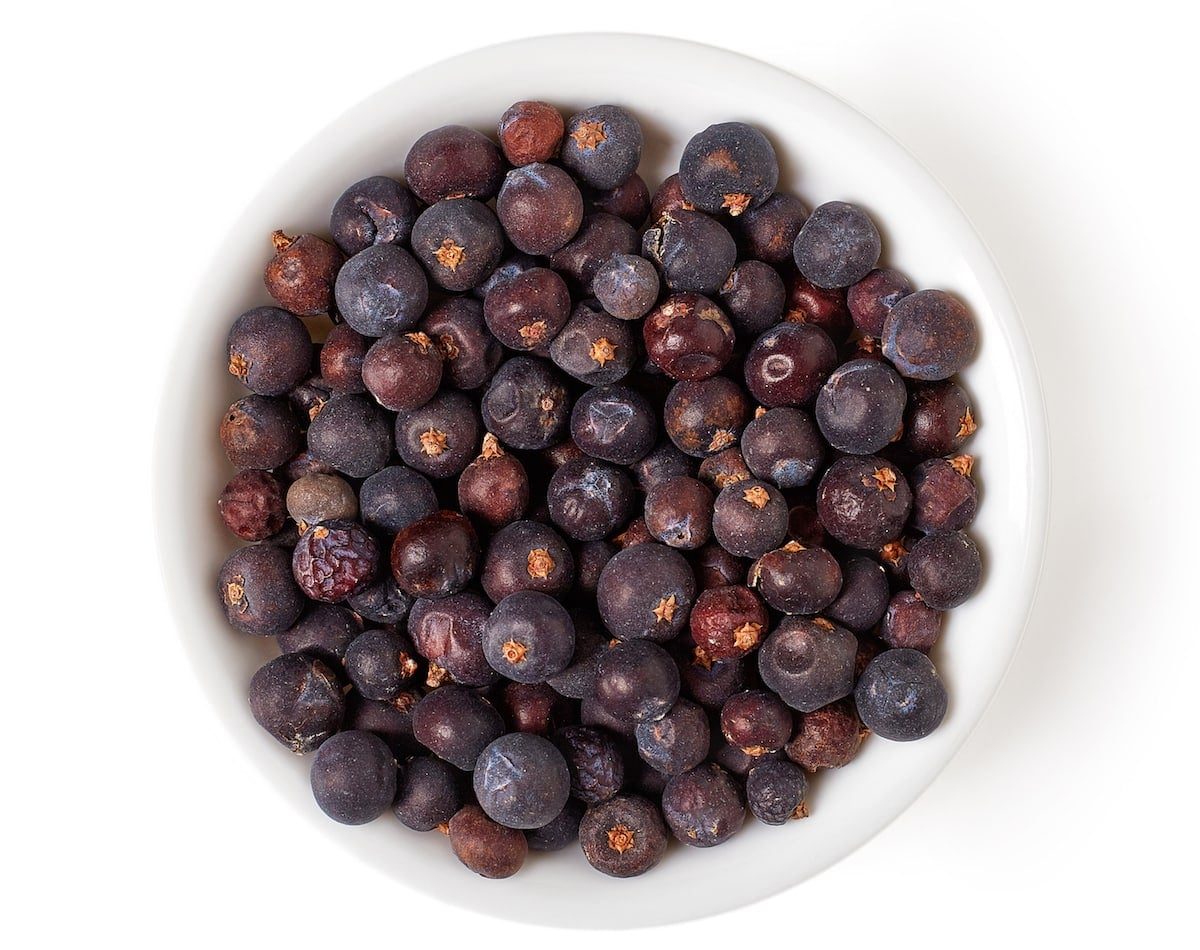
Despite the name, “cedar berries” don’t come from cedars. They’re the berry-like cones of American junipers that have “cedar” in their common names: eastern redcedar (Juniperus virginiana) in the East, and in the Southwest, one-seed juniper (Juniperus monosperma), also called New Mexico cedar. Southwestern cooks ate them whole or ground them into flour for bread. They’re relatives of the juniper berries that flavor gin, but those come from a different species, Juniperus communis, and the FDA’s food lists name only that one.
At a glance
| Botanical names | Juniperus virginiana L. (eastern redcedar); Juniperus monosperma (one-seed juniper, New Mexico cedar) |
| Plant family | Cupressaceae, the cypress family |
| Part used | The berry-like female cones |
| Native range | J. virginiana: southeastern Canada to the central and eastern U.S. and Coahuila, Mexico; J. monosperma: New Mexico, Arizona, southern Colorado, western Texas and Oklahoma |
| Forms sold | Whole dried berries |
| Main producing countries | No production figures found |
| U.S. food status | Not on the FDA’s lists of spices, essential oils and extracts, or natural flavorings; those lists name only J. communis juniper berries123 |
What cedar berries are
Juniper is a big genus, about 60 to 70 species of aromatic evergreen trees and shrubs, and their cones, known as berries, flavor gin and other drinks.
Eastern redcedar goes by a lot of local names, among them cedar tree, juniper, savin, evergreen and Virginia red cedar. Its female cones are dark blue or bluish purple, waxy and berry-like, 0.4 to 0.7 cm long, with one to three seeds each, and they ripen from September through October.4 The Forest Service describes them as small, fleshy, berry-like cones of 3 to 8 mm.5 Birds and mammals eat them, and the cedar waxwing is one of their biggest fans.
One-seed juniper, the “New Mexico cedar” of the Southwest, has juicy, berry-like cones that ripen dark blue to purple or brownish, usually with one seed each.
Flavor
We couldn’t find a published description of how eastern redcedar or one-seed juniper berries taste as a seasoning, or any study comparing them with common juniper. The USDA notes that eastern redcedar’s fruits and young branches contain an aromatic oil.4 If you cook with them, taste a berry first. Ratio (Method): Start with less than a recipe written for J. communis calls for.
Origin and history
J. virginiana is native from southeastern Canada through the central and eastern United States, with an outlier in Coahuila, Mexico. The Forest Service describes it in every state east of the 100th meridian, and calls it a well-known invader of the prairie region, mainly because fires get suppressed.5
The USDA plant guide records medicinal and ceremonial uses by many Plains and Northwest peoples:4
- The Blackfeet made a tea from the berries to stop vomiting.
- The Cheyenne, Flathead, Nez Perce, Kutenai and Sioux used its boughs and cones against colds and fevers.
- The Gros Ventres ate whole berries for asthma, and the Crows drank a tea to check diarrhea.
- The tree was burned in sweat lodges and purification rites.
These are records of traditional practice, not evidence the remedies work.
In the Southwest, one-seed juniper “berries” were eaten whole or ground into flour for bread. The Santa Fe Botanical Garden says the berries fed Ancestral Puebloans when other food was scarce, and juniper ashes are still an ingredient in many Pueblo recipes.6
Eastern redcedar wood goes into furniture, interior paneling, novelties and fence posts, and the tree supplies cedarwood oil for fragrances. A distilled oil from the tree has been listed as a reagent in the U.S. Pharmacopoeia since 1916.4
How cedar berries are used
The best-documented food use is the Southwestern one: berries eaten whole or ground into flour. Past that, we found no recipe source for cedar berries specifically. The practical move is to treat them like juniper, crushed and added to game, pork or braises, and start small. See juniper berries for those uses, which are documented for J. communis, not for cedar berries. Black pepper and allspice make natural partners, just as they do with juniper.
Buying and quality
We found no grading standard for cedar berries. Since the name covers more than one juniper, buy from a seller who gives the botanical name. Look for whole, plump, blue to purple berries with a resinous smell. That’s a practical guide, not a standard.
Storage
We found no published shelf-life figure. Keep whole berries sealed, away from heat and light, and crush them just before you use them.
Safety and regulation
U.S. food status. The FDA’s list of essential oils and natural extractives generally recognized as safe includes “Juniper (berries)” only as Juniperus communis.1 Neither eastern redcedar nor one-seed juniper shows up there, on the FDA’s list of spices and natural seasonings, or on its list of approved natural flavoring substances.123 We also found no FDA statement that addresses cedar berries by name, either way.
European guidance covers a different species. The European Medicines Agency’s monograph on juniper berries is for J. communis only. It doesn’t recommend medicinal use during pregnancy and breastfeeding, because there isn’t enough data.7 Katzer, writing about common juniper, mentions the abortive action of the related Juniperus sabina (savin).8 We found no regulator or review that assesses the safety of eastern redcedar or one-seed juniper berries as food.
Health claims. You’ll see claims that cedar berries are rich in vitamin C, flavonoids or glycosides, that they work as a diuretic for blood pressure, treat measles or viral infections, preserve food, or cause miscarriage. We couldn’t trace any of those to a credible source for these species, so we don’t repeat them. The traditional uses above are history, not medical advice.
Substitutes and comparisons
- Cedar berries vs. juniper berries
- Juniper berries
- Juniper berries substitutes
- Allspice berries vs. juniper berries
Footnotes
-
21 CFR 182.20, Essential oils, oleoresins (solvent-free), and natural extractives, U.S. Food and Drug Administration. ecfr.gov · Regulator ↩ ↩2 ↩3
-
21 CFR 182.10, Spices and other natural seasonings and flavorings, U.S. Food and Drug Administration. ecfr.gov · Regulator ↩ ↩2
-
21 CFR 172.510, Natural flavoring substances and natural substances used in conjunction with flavors, U.S. Food and Drug Administration. ecfr.gov · Regulator ↩ ↩2
-
Stevens, Kaiser and Dozier, “Eastern Red Cedar, Juniperus virginiana,” Plant Guide, USDA Natural Resources Conservation Service, 2000. plants.sc.egov.usda.gov · Regulator ↩ ↩2 ↩3 ↩4
-
Anderson, “Juniperus virginiana,” Fire Effects Information System, USDA Forest Service, 2003. fs.usda.gov · Regulator ↩ ↩2
-
Susan Bruneni, “Plant of the Month: Juniperus monosperma,” Santa Fe Botanical Garden, 2011. visitsfbg.org · Reference work ↩
-
European Union herbal monograph on Juniperus communis L., pseudo-fructus, Revision 1, European Medicines Agency, 2023. ema.europa.eu · Regulator ↩
-
Gernot Katzer, “Juniper (Juniperus communis L.),” Gernot Katzer’s Spice Pages. gernot-katzers-spice-pages.com · Reference work ↩
Also drawn on
- Juniperus virginiana L., Plants of the World Online, Royal Botanic Gardens, Kew. powo.science.kew.org
- Juniperus virginiana L., Eastern Redcedar, Silvics of North America (Edwin R. Lawson), USDA Forest Service. srs.fs.usda.gov
- Juniperus monosperma, Fire Effects Information System (Johnson, 2002), USDA Forest Service, Rocky Mountain Research Station. fs.usda.gov
- Juniper, Encyclopaedia Britannica. britannica.com