Cooking · Dish guide
Good Seasonings for Turkey Burgers: Savory Boosters, Aromatics and Spices
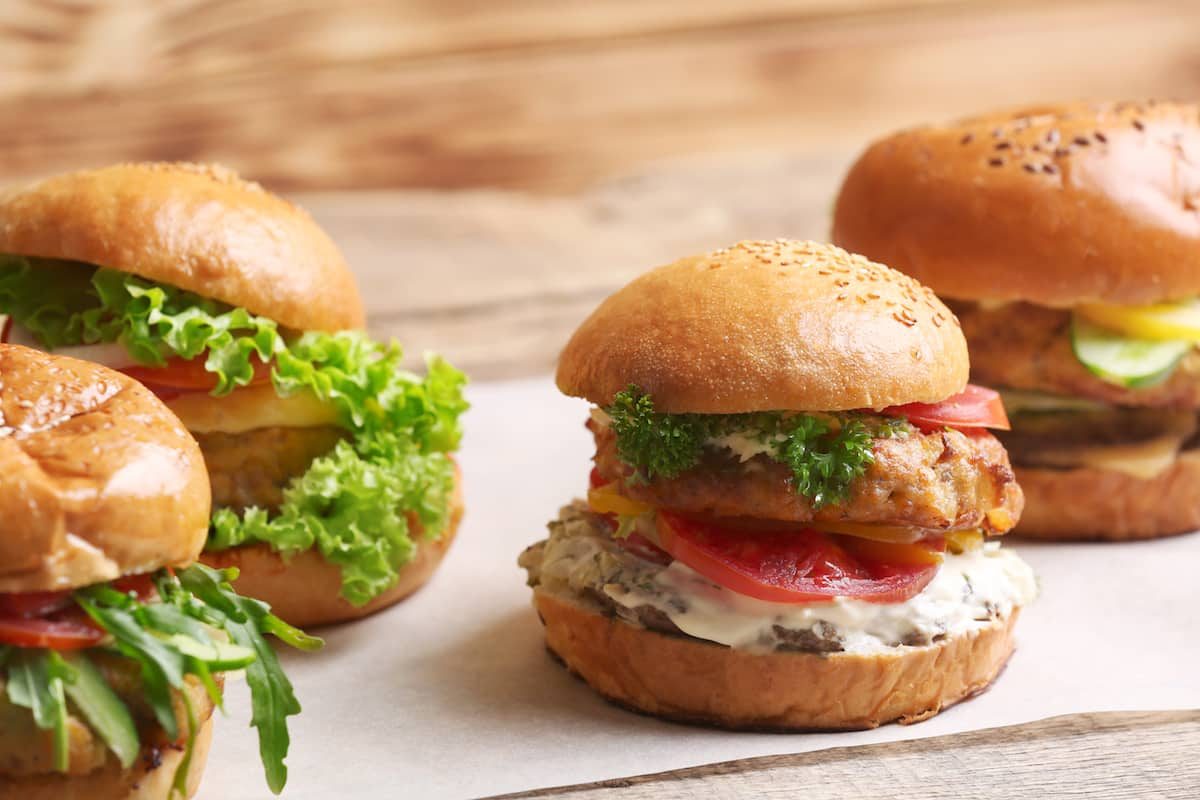
Turkey burgers have a reputation for being dry and bland. The fix for bland is savoriness: soy sauce, Parmesan and Worcestershire sauce all add it, and the two sauces bring a little liquid too. America’s Test Kitchen has an answer for dry that goes beyond “turkey is lean,” and it’s in the recipe notes below. One thing to settle before you start: FSIS sets 165°F as the safe minimum for ground poultry.1
At a glance
| Seasoning | Job | In which recipe |
|---|---|---|
| Salt | Seasoning; the base everything else builds on | Rutgers, ATK23 |
| Soy sauce | Salt plus savory (umami) depth | ATK, 1 1/2 Tbsp per pound3 |
| Parmesan | Savory depth | ATK, 3 Tbsp per pound3 |
| Worcestershire sauce | Tangy, savory, adds liquid | Illinois Extension, 1 Tbsp per pound4 |
| MSG | Pure umami | None of the three; optional |
| Onion | Sweet, savory base | Illinois and Rutgers, cooked first42 |
| Garlic or garlic powder | Savory depth | Rutgers, mashed with the salt2 |
| Black pepper | Seasoning | All three342 |
| Dijon mustard | Sharp, tangy | None of the three; in the mix or on the bun |
| Smoked paprika | Smoke and red color | None of the three; optional |
Three turkey burger recipes side by side
| ATK Skillet Turkey Burgers (Annie Petito)3 | University of Illinois Extension4 | Rutgers Cooperative Extension2 | |
|---|---|---|---|
| Turkey | 1 lb 93 percent lean | 1 lb ground turkey | 1 lb ground turkey |
| Savory boosters | 1 1/2 Tbsp soy sauce, 3 Tbsp grated Parmesan | 1 Tbsp Worcestershire sauce | None |
| Aromatics | None | 1/4 cup onion, sautéed | 1 large onion, cooked about 15 minutes; 1 garlic clove mashed with the salt |
| Salt and pepper | 1/8 tsp table salt, 1/4 tsp pepper | 1/8 tsp pepper, no added salt | 1/2 tsp salt, 1/2 tsp black pepper |
| Texture helpers | Melted butter, panko, gelatin, baking soda | 1 egg | None |
| Done at | 160°F | 165°F | 165°F or more |
These are each publisher’s own recipe, not a house standard. ATK points out that ground turkey actually holds more water than ground beef, about 71 percent against 66 percent, but cooking it through squeezes most of that moisture out as the proteins contract. Its recipe adds melted butter to make up for turkey’s leanness, plus panko to keep the texture loose and gelatin and baking soda to help the meat hold its juices.5
The savory boosters
Salt and soy sauce
Salt is the starting point. ATK’s recipe uses only 1/8 teaspoon of table salt because the 1 1/2 tablespoons of soy sauce supply much of it.3 Soy sauce is made from fermented soybeans, wheat, yeast and salt, and it tastes mainly salty and savory. ATK’s recipe developer added soy sauce and Parmesan to boost savoriness without burying turkey’s slightly gamey taste.5 If you’re using both salt and soy sauce, go easy on the salt; the FDA’s Daily Value for sodium is less than 2,300 mg a day.6 See table salt and soy sauce powder.
Parmesan and MSG
Umami is the savory or meaty taste, and cheese is one of the foods that has it naturally. The FDA notes that glutamate occurs naturally in foods like tomatoes and cheeses and is chemically the same as the glutamate in MSG.7 ATK uses 3 tablespoons of grated Parmesan per pound of turkey.3
MSG is the direct route. The FDA considers it generally recognized as safe, and notes that some sensitive people report short-term, mild symptoms like headache or flushing after eating 3 grams or more without food.7 None of the three recipes uses it, so there’s no named amount. Start with a small pinch per pound and taste a test patty. See cooking with MSG and MSG vs. salt.
Worcestershire sauce
The Illinois Extension recipe uses 1 tablespoon of Worcestershire sauce per pound, mixed in with the egg and cooked onion.4 Three dried Worcestershire products we checked list a vinegar base with molasses, corn syrup, salt, tamarind and spices.8910 It adds tang and savoriness along with a little liquid. See Worcestershire powder.
Aromatics and spices
Onion and garlic
Both extension recipes cook the onion before it goes into the meat: Illinois sautés 1/4 cup until soft, and Rutgers cooks a whole chopped onion for about 15 minutes.4 Rutgers mashes a garlic clove with the salt into a paste before mixing it in.2 Onion powder and garlic powder spread evenly through ground meat and let you skip the precooking. See onion powder and garlic powder vs. garlic.
Dijon mustard
Dijon mustard is made only from black or brown mustard seed,11 and white (yellow) mustard seed is less intensely flavored than brown.12 Yellow mustard seed goes into traditional hot dog mustard.13 That fits the usual sense that Dijon tastes sharper than American yellow mustard, though we found no side-by-side tasting. Mix a teaspoon or two into the meat or spread it on the bun. Neither idea comes from a named turkey burger recipe, so taste and adjust. See mustard powder.
Smoked paprika
Spain’s Pimentón de la Vera, the best-known smoked paprika, comes in sweet, bittersweet and hot versions, and its specification describes a smoky, intense and penetrating flavor and aroma.14 Sweet smoked paprika adds smoke and a red-brown color without much heat. See smoked paprika.
Others to try
Black pepper is in all three recipes. Chili powder is built on dried chiles, usually ancho, with oregano, cumin and garlic, according to Saveur,15 so it brings cumin along with it. Cumin, basil and oregano are reasonable additions to taste. See chili powder, cumin and spices for hamburgers.
How hot to cook a turkey burger
Sources disagree on the finishing temperature:
| Source | Temperature |
|---|---|
| USDA FSIS safe minimum, ground poultry | 165°F1 |
| University of Illinois Extension recipe | 165°F4 |
| Rutgers Cooperative Extension recipe | 165°F or more2 |
| America’s Test Kitchen recipe and article | 160°F53 |
The FSIS figure is the federal safe minimum for all ground poultry, so use 165°F, checked with an instant-read thermometer in the center of the patty. ATK’s lower number is its own recipe target, not a safety standard.
Related
Footnotes
-
“Safe Minimum Internal Temperature Chart”, USDA Food Safety and Inspection Service, updated 2025. fsis.usda.gov · Regulator ↩ ↩2
-
“Baked turkey burgers”, Rutgers Cooperative Extension, 2015. extension.rutgers.edu · Reference work ↩ ↩2 ↩3 ↩4 ↩5 ↩6 ↩7
-
Annie Petito, “Skillet Turkey Burgers”, America’s Test Kitchen, 2019. americastestkitchen.com · Publication ↩ ↩2 ↩3 ↩4 ↩5 ↩6 ↩7 ↩8
-
“Turkey Burgers”, Eat. Move. Save., University of Illinois Extension. eat-move-save.extension.illinois.edu · Reference work ↩ ↩2 ↩3 ↩4 ↩5 ↩6 ↩7
-
Emily Rahravan, “This Recipe Will Change Your Mind About Turkey Burgers”, America’s Test Kitchen, 2023. americastestkitchen.com · Publication ↩ ↩2 ↩3
-
“Questions and Answers on Monosodium glutamate (MSG)”, US FDA. fda.gov · Regulator ↩ ↩2
-
“Worcestershire Sauce Powder”, Spice Jungle. spicejungle.com · Merchant ↩
-
“Worcestershire”, World Spice Merchants. worldspice.com · Merchant ↩
-
“Worcestershire Sauce Powder, H518”, Woodland Foods. shop.woodlandfoods.com · Merchant ↩
-
William Sertl, “Avez-Vous du Vrai Poupon?”, Saveur, 2007. saveur.com · Publication ↩
-
“White mustard”, Encyclopaedia Britannica. britannica.com · Reference work ↩
-
“Mustard”, Government of Saskatchewan, Ministry of Agriculture. saskatchewan.ca · Regulator ↩
-
Pimentón de la Vera PDO product specification. assets.publishing.service.gov.uk · Regulator ↩
-
“Chili Powder”, Saveur, 2009. saveur.com · Publication ↩
Also drawn on
- Soy sauce (Gregory Lewis McNamee, last updated 2 Oct 2026), Encyclopaedia Britannica. britannica.com
- Umami (revised by Meg Matthias; last updated 18 Sep 2026), Encyclopaedia Britannica. britannica.com
- When the mustard shortage hits, make your own (Sandra Gutierrez G., 30 Jul 2022), Popular Science. popsci.com