Spice Substitutes · Substitutes
Kosher Salt Substitutes: Which Salt to Use, and How Much, by Brand and Job
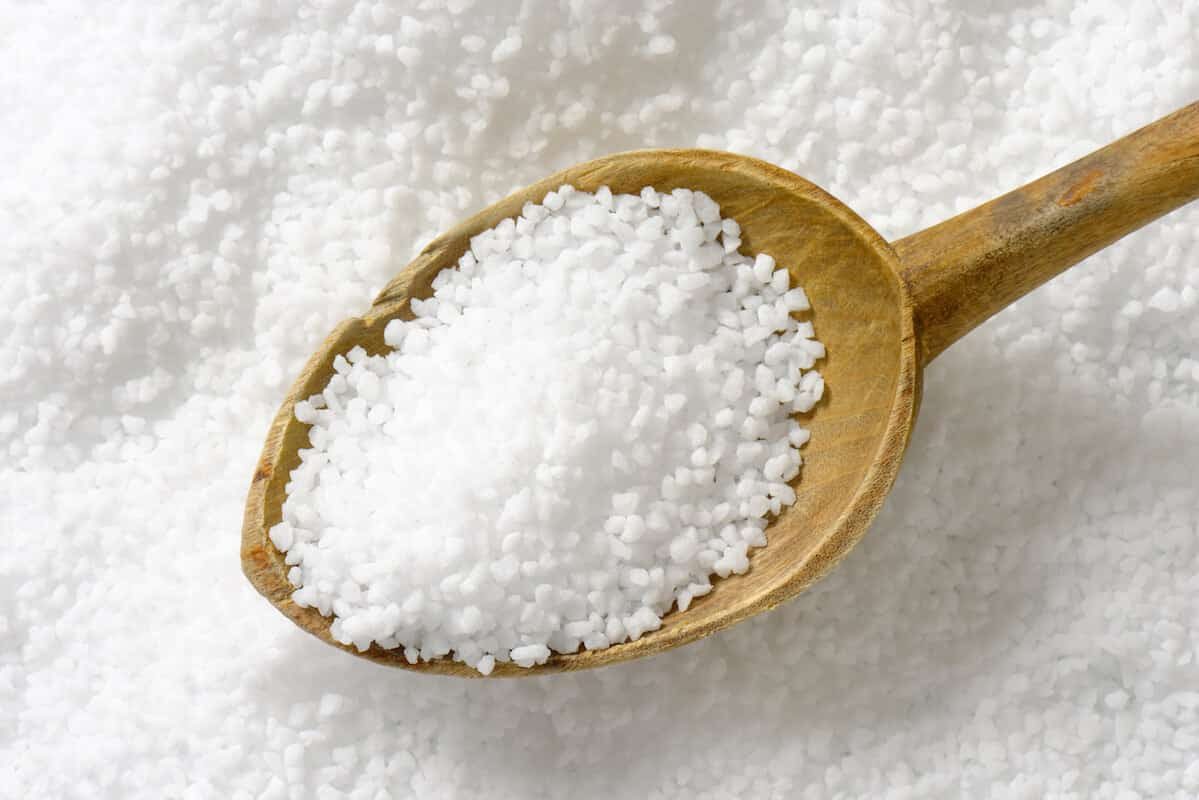
Out of kosher salt? Any food-grade salt will do, because salt is the same compound whatever its source.1 In America’s Test Kitchen’s test, broths seasoned with equal weights of the two big kosher brands tasted exactly the same.2 The real problem is the spoon: a teaspoon of Morton kosher salt weighs 4.8 grams and a teaspoon of Diamond Crystal 2.8 grams, so how much substitute you need depends on which kosher salt the recipe had in mind. Weigh it if you can, or start low, since salt is easy to add and hard to take out.
Quick answer
| What kosher salt is doing | Best substitute | Starting amount, per 1 teaspoon kosher salt | Treatment |
|---|---|---|---|
| Measured into a recipe that gives grams | Any food-grade salt | The same weight | Computed |
| Measured by the spoon, Morton kosher called for | Table salt, fine sea salt or pickling salt | ⅔ teaspoon, then taste | Disputed |
| Measured by the spoon, Diamond Crystal or an unnamed brand called for | Table salt, fine sea salt or pickling salt | A scant ½ teaspoon, then taste | Disputed |
| Recipe written for Diamond Crystal, you have Morton | Morton kosher | A generous ½ teaspoon, then taste | Disputed |
| Recipe written for Morton, you have Diamond Crystal | Diamond Crystal | 1⅓ teaspoons, then taste | Disputed |
| Seasoning meat or vegetables before cooking | Morton coarse sea salt or coarse Himalayan salt | ⅘ teaspoon per teaspoon of Morton kosher | Attributed / Computed |
| Finishing: crunch on top of the food | A flaky sea salt such as Maldon | By the pinch | Method |
How the ratios on this page are labeled
- Computed: based on a measurable physical relationship.
- Attributed: a named source publishes this ratio. We quote it as theirs.
- Disputed: named sources give different answers to the same swap. You get each one, side by side.
- Method: our starting point, based on how the two compare. Taste and adjust.
Most numbers here are weights: grams per teaspoon measured by ATK or printed on Morton’s labels. The disagreements are between those weights and ATK’s rounder rule of thumb. Every starting point below sits at the lower figure, because salt is easy to add and hard to take out.
Why the brand on the box matters
The two kosher salts are made differently. Diamond Crystal forms hollow, pyramid-shaped crystals in brine that’s heated and stirred in open pans. Morton’s comes from vacuum evaporators and gets pressed through rollers into thin, dense flakes.2 That’s why the same spoon holds such different weights.
Grams per teaspoon
| Salt | Grams per teaspoon | Source |
|---|---|---|
| Table salt | About 6 g (ATK, “regardless of the brand”); 1.5 g per ¼ teaspoon on Morton’s iodized label | 23 |
| Morton kosher | 4.8 g (ATK); 1.2 g per ¼ teaspoon on Morton’s label | 24 |
| Diamond Crystal kosher | 2.8 g (ATK) | 2 |
| Morton fine sea salt | 1.4 g per ¼ teaspoon on Morton’s label (about 5.6 g per teaspoon) | 5 |
| Morton coarse Himalayan pink salt | 1.5 g per ¼ teaspoon on Morton’s label (about 6 g per teaspoon) | 6 |
ATK’s 2022 article rounds the two kosher figures to about 5 grams and 3 grams.7 We couldn’t get Diamond Crystal’s own figure from its maker.
Volume swaps: the sources disagree
| Swap for 1 teaspoon of table salt | Morton kosher | Diamond Crystal | Source |
|---|---|---|---|
| ATK’s rule of thumb | 1½ teaspoons | 2 teaspoons | 17 |
| Morton’s conversion chart (Morton products only) | 1¼ teaspoons | not covered | 8 |
| Computed from ATK’s own gram weights (6.0 ÷ 4.8 and 6.0 ÷ 2.8) | 1¼ teaspoons | about 2⅛ teaspoons | 2 |
ATK’s own weights agree with Morton’s chart on Morton (1¼), not with ATK’s rule (1½). We’re showing you the disagreement instead of picking a winner. If a recipe gives salt in grams, weigh it. ATK also recommends weighing salt instead of measuring it by volume.7
If kosher salt is measured into a recipe
In doughs, batters, sauces, soups and brines the crystals dissolve, so their shape stops mattering and only the amount of salt counts.
1. Any salt, by weight
Ratio (Computed): Use the same weight. The Codex standard for food-grade salt requires at least 97% sodium chloride on a dry basis, whether the salt comes from the sea, rock deposits or brine,9 so equal weights of food-grade salts carry close to the same amount of salt. It’s the only swap here with no guesswork.
2. Table salt, fine sea salt or pickling salt, by the spoon
These are the fine salts most kitchens have. Morton’s chart treats its table salt, fine sea salt and canning and pickling salt as equal by volume, teaspoon for teaspoon, and says the chart applies when swapping one Morton product for another.8 Oklahoma State University Extension also notes that table salt has the same crystal size as canning and pickling salt.10 Morton’s own labels put its fine sea salt a little lighter than its table salt, 1.4 grams against 1.5 grams per ¼ teaspoon.
Table salt usually has an anticaking agent, and iodized table salt has iodine. Morton’s iodized label lists calcium silicate, dextrose and potassium iodide.3 Neither changes the taste. ATK’s tasters couldn’t tell iodized from noniodized salt.1
Ratio (Disputed): Flip the table above around to start from kosher salt, and you get these amounts of fine salt per teaspoon of kosher salt:
| Per 1 teaspoon kosher salt called for | ATK’s rule of thumb | Morton’s chart | ATK’s gram weights |
|---|---|---|---|
| Morton kosher | ⅔ teaspoon | ⅘ teaspoon | ⅘ teaspoon |
| Diamond Crystal | ½ teaspoon | not covered | about ½ teaspoon less a pinch |
Start with ⅔ teaspoon of fine salt for each teaspoon of Morton, and a scant ½ teaspoon for each teaspoon of Diamond Crystal. If the recipe just says “kosher salt” and doesn’t name a brand, go with the Diamond Crystal figure. It’s the lower one, and you can add the rest after tasting. These are starting points, not measured equivalents.
3. The other kosher brand
ATK says that if a recipe was written for Diamond Crystal and you’re using Morton, cut the volume by 25%. ATK’s own gram weights (2.8 ÷ 4.8) imply a cut of about 40%.2
Ratio (Disputed): For each teaspoon of Diamond Crystal, ATK’s rule gives ¾ teaspoon of Morton and its weights give a little under ⅗ teaspoon. Start with a generous ½ teaspoon of Morton. Going the other way, ATK’s 25% figure works out to 1⅓ teaspoons of Diamond Crystal per teaspoon of Morton, and the weights to about 1¾. Start at 1⅓.
If kosher salt is seasoning food before it cooks
Salting a steak, a chicken or a tray of vegetables before cooking is the classic kosher-salt job. Big crystals are easy to pinch and easy to see on the surface, though we didn’t find anyone who’s tested whether that makes a real difference. Morton suggests its kosher salt for brining poultry and for grilled meats.4 What you want here is another coarse salt.
1. Coarse sea salt
Ratio (Attributed): Morton’s chart treats a teaspoon of its coarse sea salt as equal to a teaspoon of its table salt, and so to 1¼ teaspoons of its kosher salt.8 That works out to ⅘ teaspoon of Morton coarse sea salt per teaspoon of Morton kosher. It only covers Morton’s products. Other coarse sea salts vary, and we found no published weight for them. With another brand, start with about half the volume and add more.
2. Coarse Himalayan pink salt
Himalayan pink salt is mined rock salt, tinted pink.
Ratio (Computed): Morton’s labels give 1.5 grams per ¼ teaspoon for its coarse Himalayan salt and 1.2 grams for its kosher salt,64 so ⅘ teaspoon of the Himalayan salt matches the salt in a teaspoon of Morton kosher. Morton’s chart, which treats its Himalayan salt as equal to table salt by the teaspoon, gives the same answer.8 Against Diamond Crystal’s 2.8 grams, use a scant ½ teaspoon. That holds for Morton’s coarse Himalayan salt. Other brands grind differently.
3. Table salt, if nothing coarse is on hand
Ratio (Method): Use the fine-salt figures above (⅔ teaspoon per teaspoon of Morton, a scant ½ teaspoon per teaspoon of Diamond Crystal) and sprinkle from a height so it spreads. Fine grains are harder to see on the food, so it’s easier to overdo.
If kosher salt is finishing a dish
Some cooks scatter kosher salt over food just before serving, for crunch. ATK’s tasters preferred Diamond Crystal’s “delicate and fleeting crunch” to Morton’s harder grains.2 For this job ATK recommends sea salts, as finishing salts.1
- Flaky sea salt, such as Maldon.
- Fleur de sel. The Guérande specification allows up to 12% moisture, so it’s damp, not crisp.11
- Coarse sea salt or coarse Himalayan salt, for a harder crunch.
Ratio (Method): By the pinch, to taste. Nobody measures finishing salt precisely.
If kosher salt is going into a brine or pickle
For pickles, the National Center for Home Food Preservation recommends canning or pickling salt, and says flake salt isn’t recommended because its density varies.12 Kosher salt isn’t automatically additive-free, either. Morton’s lists yellow prussiate of soda as an anticaking agent, while ATK reports Diamond Crystal has none.42 For a poultry or pork brine, any of the fine salts above works at the Disputed amounts given. For canning and fermented pickles, where the amount of salt matters for safety, see pickling salt substitutes, which covers Oklahoma State’s method of converting by weight.10
Notes for every swap
- Sodium. Table salt, kosher salt and most sea salts are all about 40% sodium. A teaspoon of kosher salt holds less sodium only because fewer of its bigger crystals fit in the spoon.13 Swapping salts doesn’t change how much sodium a dish has unless you change how much salt you use.
- Iodine. Kosher salt usually isn’t iodized.14 Swapping in iodized table salt adds iodine. Sea salt or Himalayan salt doesn’t.
- Dissolving. Tufts notes that kosher salt is much coarser than table salt and dissolves more slowly.15 A fine substitute dissolves faster, which helps in quick doughs and dressings.
What isn’t known
- We couldn’t get Diamond Crystal’s own grams-per-teaspoon figure from its maker, so its column rests on ATK’s measurement alone.
- ATK’s rule of thumb and ATK’s own weights disagree for Morton kosher salt, and we didn’t find anyone who’s published which one ATK’s recipes were developed with.
- We found no published weight per teaspoon for coarse sea salts in general, for Maldon or for fleur de sel. Swaps involving them are starting points.
- No sensory test compares kosher salt with any substitute as a surface seasoning for meat.
Related
- Kosher salt and cooking with kosher salt
- Kosher salt vs. table salt, kosher salt vs. sea salt and kosher salt vs. Himalayan salt
- Pickling salt vs. kosher salt, Maldon salt vs. kosher salt and fleur de sel vs. kosher salt
- Table salt, sea salt, pickling salt, Himalayan salt, Maldon sea salt and fleur de sel
- Sea salt substitutes, pickling salt substitutes and the best salt for cooking
- Overdid it? See too much salt.
Footnotes
-
Salt Types and Measurements, America’s Test Kitchen. americastestkitchen.com · Publication ↩ ↩2 ↩3 ↩4
-
Kate Shannon Levine, The Best Kosher Salt, America’s Test Kitchen, 2019. americastestkitchen.com · Publication ↩ ↩2 ↩3 ↩4 ↩5 ↩6 ↩7 ↩8 ↩9
-
Morton Iodized Table Salt, product page, Morton Salt. mortonsalt.com · Merchant ↩ ↩2
-
Morton Kosher Salt Flakes, product page, Morton Salt. mortonsalt.com · Merchant ↩ ↩2 ↩3 ↩4
-
Morton Fine Sea Salt, product page, Morton Salt. mortonsalt.com · Merchant ↩
-
Morton Coarse Himalayan Pink Salt, product page, Morton Salt. mortonsalt.com · Merchant ↩ ↩2
-
Eden Faithfull, The Wrong Brand of Kosher Salt Could Ruin Your Dinner, America’s Test Kitchen, 2022. americastestkitchen.com · Publication ↩ ↩2 ↩3
-
Salt Conversion Chart, Morton Salt. mortonsalt.com · Merchant ↩ ↩2 ↩3 ↩4
-
Standard for Food Grade Salt, CXS 150-1985 (rev. 2012), Codex Alimentarius. services.bis.gov.in · Standard ↩
-
Canning and Pickling Salt, Oklahoma State University Extension, 2026. extension.okstate.edu · Reference work ↩ ↩2
-
Cahier des charges de l’IGP Sel de Guérande / Fleur de sel de Guérande, French Ministry of Agriculture, 2025. info.agriculture.gouv.fr · Regulator ↩
-
Salts Used in Pickling, National Center for Home Food Preservation. nchfp.uga.edu · Reference work ↩
-
Sodium Sources: Where Does All That Sodium Come From?, American Heart Association, 2025. heart.org · Reference work ↩
-
Iodine: Fact Sheet for Health Professionals, NIH Office of Dietary Supplements. ods.od.nih.gov · Regulator ↩
-
What’s the difference between kosher salt and other salt?, Tufts Health & Nutrition Letter, 2013 (updated 2019). nutritionletter.tufts.edu · Publication ↩