Spice Substitutes · Substitutes
Mace Substitutes, and Why Nobody Agrees on How Much Nutmeg to Use
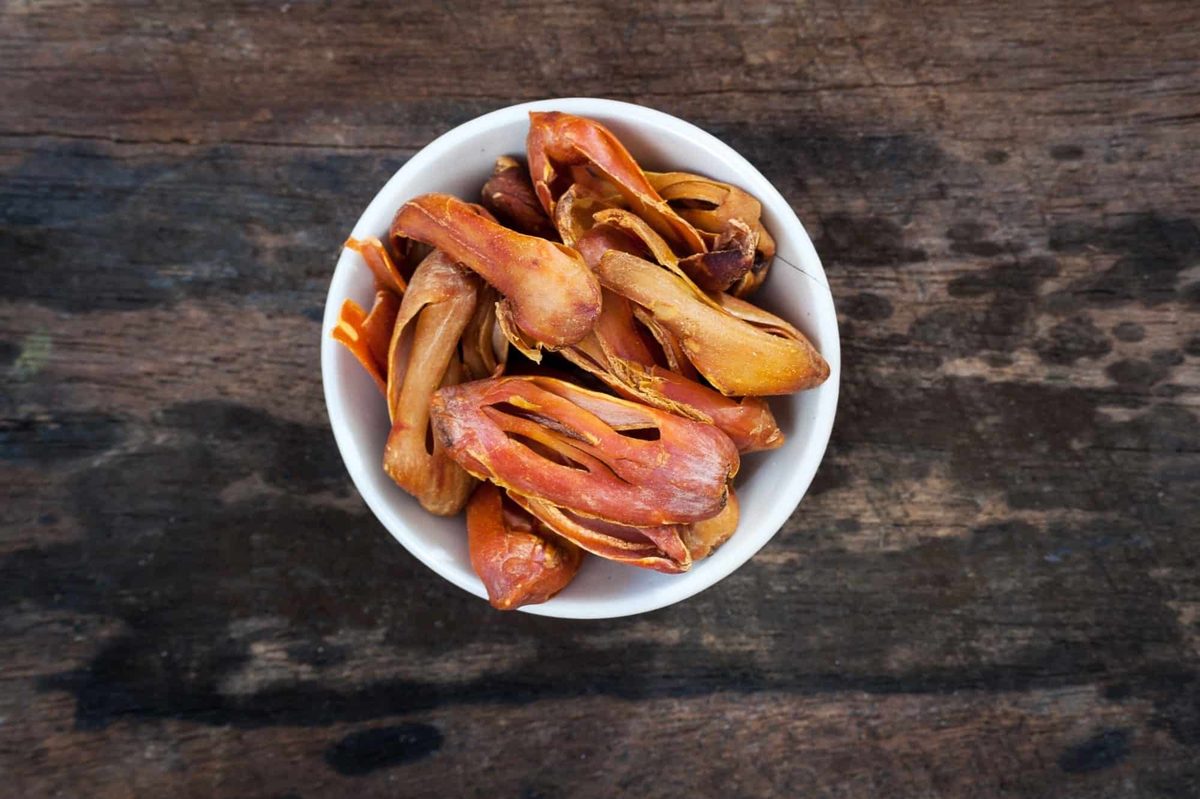
Out of mace? Use nutmeg. The two come from the same fruit: mace is the red, lacy covering wrapped partly around the seed, and the seed inside becomes nutmeg.1 The catch is how much. The sources we found disagree on whether you need more nutmeg than mace or less, so we’ll show you both sides and give you a place to start.
Quick answer
| What mace is doing | Best substitute | Starting amount, per 1 part mace | Treatment |
|---|---|---|---|
| Seasoning a pale sauce, potted meat, seafood or other savory dish | Nutmeg | 1 part, then add to taste (up to 2) | Disputed |
| Warm spice in cakes, doughnuts, fruit pies or custard | Nutmeg | 1 part, then add to taste (up to 2) | Disputed |
| Warm spice in baking, when you have no nutmeg | Allspice | 1/2 part | Attributed |
| Whole blades in a pickle, stock or poaching liquid | A small piece of whole nutmeg | One chip or a few gratings | Method |
| One spice among many in a curry or spiced dish | Garam masala | 1/2 part, savory dishes only | Method |
How the ratios on this page are labeled
- Computed: based on a measurable physical relationship.
- Attributed: a named source publishes this ratio. We quote it as theirs.
- Disputed: named sources give different answers to the same swap. You get each one, side by side, plus a cautious starting point.
- Method: our starting point, based on how the two compare. Taste and adjust.
One figure here comes from a kitchen test (America’s Test Kitchen’s). The rest are merchants’ guidance.
What mace brings to a dish
Sources list mace’s uses differently. Britannica names sauces, pickles, and meat and fish dishes. PROSEA says it’s best in savory dishes, pickles and ketchups. FAO lists sweet foods, cakes, doughnuts and fruit pies, and says mace is especially used to season seafood.234
Its flavor overlaps with nutmeg’s, but it isn’t the same. The Spice House describes mace as more piquant and a bit less sweet than nutmeg.5
If mace is seasoning a savory dish or a baked good
1. Nutmeg
America’s Test Kitchen says nutmeg and mace taste similar. How much to use is where it gets tricky, because the sources point in opposite directions. America’s Test Kitchen says mace is much stronger than nutmeg.6 McCormick says nutmeg has a slightly more intense flavor and fragrance than mace.7
Ratio (Disputed):
| Source | Nutmeg for 1 teaspoon mace | Basis |
|---|---|---|
| America’s Test Kitchen6 | 2 teaspoons (“double the amount”) | Derived from its tests in the other direction: 1/2 teaspoon mace best replaced 1 teaspoon nutmeg in a Bundt cake and a béchamel |
| McCormick7 | Less than the mace amount: “reduce the recipe amount considerably and add more if needed” | Guidance; its example line pairs 1/4 teaspoon mace with 1/4 teaspoon nutmeg, so it gives no clear figure |
The Spice House doesn’t give a figure for this direction, though it calls mace “a touch sharper” than nutmeg.5
Starting point: Use the same amount of nutmeg as mace, taste, and add more, up to double, if the dish seems flat. If you can’t taste as you go, as in a cake batter, stick with the same amount.
In savory dishes, expect a small difference. In America’s Test Kitchen’s béchamel, a few tasters found the nutmeg version slightly more peppery.6 Nutmeg is also darker and can show up as specks in a white sauce, so grate it very finely.
2. Allspice
Allspice got its name because it tastes like a combination of cloves, cinnamon and nutmeg. Its oil is mostly eugenol,8 so it adds a clove note that mace doesn’t have. McCormick says allspice has a peppery sweetness similar to mace but a much stronger flavor.
Ratio (Attributed): McCormick says to use half as much allspice as mace and add more as needed.7
3. Cinnamon
Cinnamon brings warmth and sweetness but not mace’s aroma. McCormick’s mace page lists cinnamon only as a spice that pairs well with mace, not a replacement.7 Its cinnamon page groups mace with nutmeg and allspice as “more powerful” spices than cinnamon.9
Ratio (Method): McCormick rates mace the more powerful of the two, so start with an equal amount of cinnamon and taste. Sweet dishes only.
4. Pumpkin pie spice
McCormick’s blend lists cinnamon, ginger, nutmeg and allspice, in that order.10 You get some nutmeg, but cinnamon leads.
Ratio (Method): Start with half as much as the mace called for, since the cinnamon and ginger will take over, then taste. Sweet dishes only.
If whole mace blades are steeping in a liquid
Whole blades go into pickling liquids, stocks and poaching syrups and get lifted out before serving.
Ratio (Method): Use a small chip broken off a whole nutmeg, or a few gratings, per blade, and taste the liquid before adding more. Strain it out at the end.
If mace is one spice among many
1. Garam masala
Great British Chefs counts mace among the spices commonly used in garam masala, and says recipes vary widely by region and by cook.11 Plenty of blends have none, so check the label.
Ratio (Method): Start with half as much garam masala as the mace called for, in savory dishes only, since it brings cumin, pepper and other spices along.
2. Ginger or cardamom, as a last resort
Ginger and cardamom add warmth, not mace’s flavor.
Ratio (Method): Start with a small pinch, about a quarter of the mace amount, and taste.
A note on safety
Recipe amounts are safe, and that goes for every swap above. Mace carries the same aromatic ethers as nutmeg, in a higher share of its oil,12 and PROSEA attributes nutmeg’s hallucinogenic properties to safrole, myristicin and elemicin.3 The National Capital Poison Center advises keeping nutmeg and its relative mace out of children’s reach.13 We didn’t find a poison-center dose figure for mace itself. For nutmeg, the Tennessee Poison Center cites 15 to 20 g of ground nutmeg as the dose at which psychogenic effects have been reported, and the Missouri Poison Center gives 5 to 30 g as the range people take to get high.1415 See too much nutmeg for the full picture.
What isn’t known
- America’s Test Kitchen’s tests ran in one direction only (mace replacing nutmeg), in one cake and one sauce.
- America’s Test Kitchen and McCormick disagree on which spice is stronger, so even the direction of the adjustment is unsettled.
Related
- Mace, nutmeg and mace vs. nutmeg
- Nutmeg substitutes, allspice substitutes
- Mace vs. allspice, allspice, cinnamon, pumpkin pie spice, garam masala
- Cooking with mace, fresh vs. ground nutmeg, how to store nutmeg
Footnotes
-
Production, handling and processing of nutmeg and mace, Introduction, FAO. fao.org · Reference work ↩
-
“Mace”, Encyclopaedia Britannica. britannica.com · Reference work ↩
-
M. Flach and M. Tjeenk Willink, Myristica fragrans, Plant Resources of South-East Asia (PROSEA). uses.plantnet-project.org · Reference work ↩ ↩2
-
Production, handling and processing of nutmeg and mace, Section VII: Utilization of products, FAO. fao.org · Reference work ↩
-
“Mace Spice Explained”, The Spice House, 2024. thespicehouse.com · Merchant ↩ ↩2
-
“Substutions for Mace”, America’s Test Kitchen. americastestkitchen.com · Publication ↩ ↩2 ↩3
-
McCormick Kitchens, “What is Mace: Uses, Substitutes and Recipes”, McCormick, 2025. mccormick.com · Merchant ↩ ↩2 ↩3 ↩4
-
D. Sulistiarini, Pimenta dioica, Plant Resources of South-East Asia (PROSEA). uses.plantnet-project.org · Reference work ↩
-
McCormick Kitchens, “About Cinnamon: Uses, Pairings and Recipes”, McCormick, 2025. mccormick.com · Merchant ↩
-
McCormick Pumpkin Pie Spice product page, McCormick & Company. mccormick.com · Merchant ↩
-
“How to make garam masala”, Great British Chefs. greatbritishchefs.com · Publication ↩
-
Production, handling and processing of nutmeg and mace, Section VI: Composition and constituents, FAO. fao.org · Reference work ↩
-
Rose Ann Gould Soloway, “Kitchen surprises and cautions”, National Capital Poison Center. poison.org · Reference work ↩
-
Nena Bowman, “Nutmeg, a Potentially Uninvited Holiday Guest?”, Tennessee Poison Center, 2020. vumc.org · Reference work ↩
-
“Nutmeg Abuse”, Missouri Poison Center, 2022 (updated 2026). missouripoisoncenter.org · Reference work ↩
Also drawn on
- Production, handling and processing of nutmeg and mace and their culinary uses (G.B. Marcelle, 1995), Section I: The plant and the environment, FAO Regional Office for Latin America and the Caribbean. fao.org
- Allspice (Britannica Editors, updated 3 Sep 2026), Encyclopaedia Britannica. britannica.com