Spices · Profile
Malabar Pepper: India’s Protected Black Pepper, Its Grades and Flavor
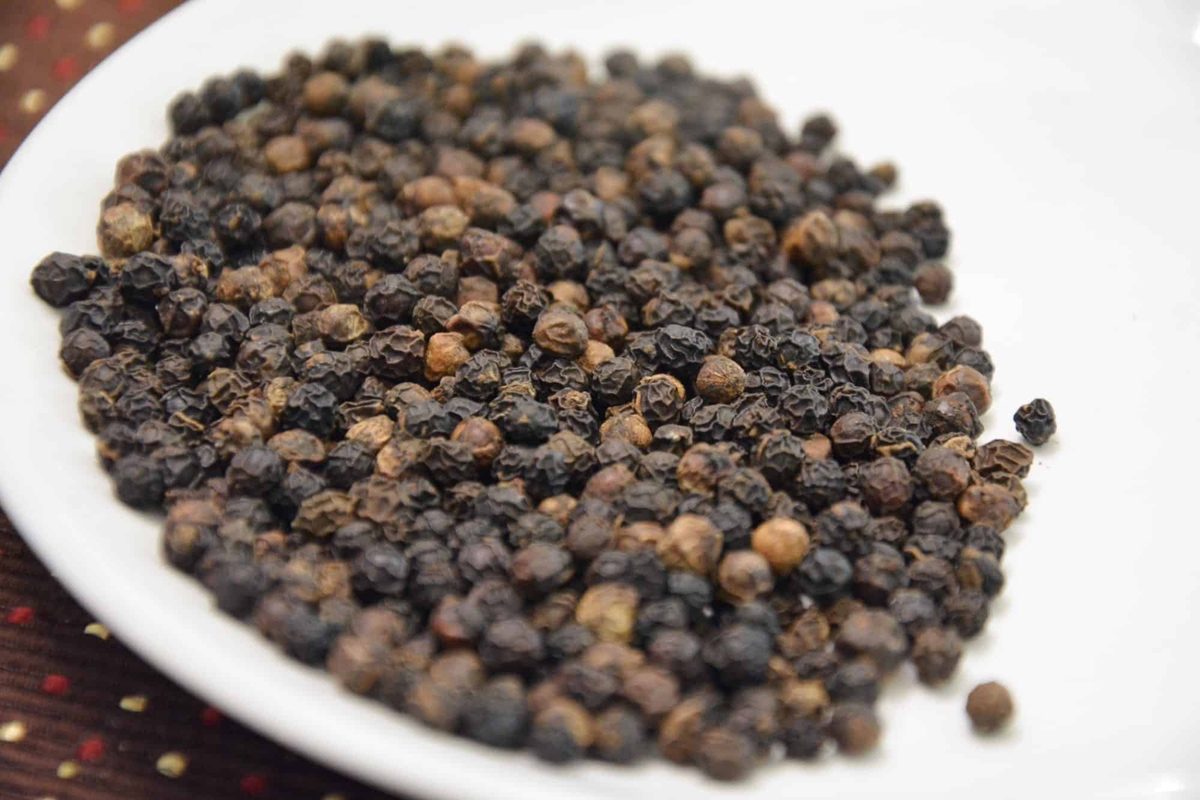
Malabar pepper comes from India’s southwest coast, the region where the pepper vine grows wild. It’s black pepper, Piper nigrum, and the name means two things. In the trade, Malabar is the regular Indian grade of black pepper, while Tellicherry is a special, larger-berried product.1 And since 2008 “Malabar Pepper” has been a registered geographical indication in India, held by the Spices Board and covering pepper from Kerala, Karnataka and Tamil Nadu.2 Below: how the grades work, what to look for on a label, and how to use it.
At a glance
| Botanical name | Piper nigrum L. |
| Plant family | Piperaceae |
| Native range | The Western Ghats of Kerala, per Kew’s species profile; sources differ, see black pepper3 |
| Protected name | “Malabar Pepper,” Indian GI application No. 49, filed 13 February 2006, certificate dated 21 January 2008, held by the Spices Board24 |
| GI area | Kerala, Karnataka and Tamil Nadu2 |
| Trade grades | Malabar (regular black pepper) and Tellicherry (larger berries), per Katzer; grade names such as Malabar Garbled No. 1 in use15 |
| Indian pepper output | 104,751 tonnes in 2024-25 (all pepper, final figure)6 |
| Main pungent compound | Piperine |
Measured values
19 figures, sourced| Measure | Value | Scope | Source |
|---|---|---|---|
| Bulk density, minimum Limit | 550 g/L | Codex CXS 326-2017, whole black pepper, Grade I | fao.org |
| Bulk density, minimum Limit | 500 g/L | Codex CXS 326-2017, whole black pepper, Grade II | fao.org |
| Bulk density, minimum Limit | 400 g/L | Codex CXS 326-2017, whole black pepper, Grade III | fao.org |
| Light berries, maximum Limit | 2.0 % | Codex CXS 326-2017, whole black pepper, Grade I | fao.org |
| Light berries, maximum Limit | 5.0 % | Codex CXS 326-2017, whole black pepper, Grade II | fao.org |
| Light berries, maximum Limit | 10.0 % | Codex CXS 326-2017, whole black pepper, Grade III | fao.org |
| Moisture, maximum Limit | 12.0 % | Codex CXS 326-2017, whole black pepper, Grade I | fao.org |
| Moisture, maximum Limit | 12.0 % | Codex CXS 326-2017, whole black pepper, Grade II | fao.org |
| Moisture, maximum Limit | 13.0 % | Codex CXS 326-2017, whole black pepper, Grade III | fao.org |
| Volatile oil, minimum Limit | 2.0 mL/100 g dry basis | Codex CXS 326-2017, whole black pepper, Grade I | fao.org |
| Volatile oil, minimum Limit | 1.5 mL/100 g dry basis | Codex CXS 326-2017, whole black pepper, Grade II | fao.org |
| Volatile oil, minimum Limit | 1.0 mL/100 g dry basis | Codex CXS 326-2017, whole black pepper, Grade III | fao.org |
| Piperine, minimum Limit | 3.5 % dry basis | Codex CXS 326-2017, whole black pepper, Grade I | fao.org |
| Piperine, minimum Limit | 3.0 % dry basis | Codex CXS 326-2017, whole black pepper, Grade II | fao.org |
| Piperine, minimum Limit | 2.0 % dry basis | Codex CXS 326-2017, whole black pepper, Grade III | fao.org |
| Essential oil: monoterpene hydrocarbons | up to 80 % of the essential oil | black pepper in general, per Katzer's Spice Pages | gernot-katzers-spice-pages.com |
| Vitamin K Nutrient | 164 µg per 100 g | USDA FoodData Central, ground black pepper (all origins) | fdc.nal.usda.gov |
| Aflatoxin B1, maximum Limit | 5.0 µg/kg | EU Regulation 2023/915, pepper | eur-lex.europa.eu |
| Total aflatoxins, maximum Limit | 10.0 µg/kg | EU Regulation 2023/915, pepper | eur-lex.europa.eu |
Each figure is quoted as its source states it, with the samples or standard it applies to. Where sources differ, both are shown; nothing is averaged. All measured values
Malabar and Tellicherry
People often mix these two names up, and the sources use them in slightly different ways:
| Source | What it says |
|---|---|
| Katzer’s Spice Pages | “The most important Indian grades are Malabar and Tellicherry”; the Malabar grade is regular black pepper with a slightly greenish hue, while Tellicherry is a special product with larger corns1 |
| Katzer’s Spice Pages | In the past, Malabar pepper was also traded under names such as Goa or Alleppey (now Alappuzha)1 |
| AramcoWorld (spice writers quoted) | Ian Hemphill prefers Malabar Garbled No. 1, which the article calls the highest grade; another writer quoted, Reshii, asks for Malabar Garbled Extra Bold5 |
| Indian Geographical Indications Registry | “Malabar Pepper” is a registered GI covering Kerala, Karnataka and Tamil Nadu2 |
India’s grade names come from the Pepper Grading and Marking Rules of 1969, which a 2002 export-inspection document still cites.7 The Bureau of Indian Standards dropped the grading of whole black pepper from its specification in its 2010 revision, IS 1798:2010.8 We couldn’t open the 1969 rules themselves, so we can’t give you the official sieve sizes for each Malabar and Tellicherry grade.
You’ll often read that Tellicherry peppercorns are the best 10% of the Malabar crop. None of the sources we checked gives that figure. Katzer describes Tellicherry pepper as a special product with corns larger than typical black pepper, made only in India.1 See Tellicherry pepper.
Flavor
Good Malabar pepper smells strongly of pepper, with woody, citrus and floral notes, and it bites. Katzer describes Indian black peppers, especially the Tellicherry grade, as very aromatic and pungent.1
- Heat comes from piperine, the alkaloid-like compound behind pepper’s pungency.
- Aroma comes from the essential oil, which in black pepper is mostly (up to 80%) monoterpene hydrocarbons such as sabinene, β-pinene and limonene, according to Katzer.1
You’ll often hear that white pepper lacks these notes because its outer layer has been removed. Katzer puts it a bit differently: black and green peppercorns are more aromatic than white, but white pepper is the most pungent of the three.1 See white vs. black pepper.
Origin and history
Where pepper comes from. Kew’s species profile says black pepper is native to the Western Ghats of Kerala,3 and Katzer calls it native to Malabar, on the western coast of South India.1 Other sources draw the native range differently; the black pepper page lays out the disagreement. The name Malabar Coast has long been used for the southern part of India’s western coast, roughly from Goa southward, and today covers most of Kerala and the coastal region of Karnataka.
Trade. AramcoWorld recounts that the Moroccan traveler Ibn Battuta called Malabar “pepper country” and described merchants from China, Java, Sri Lanka, the Maldives, Yemen and Persia gathering in the harbor of Kozhikode.5 In Europe, the Venetians and Genoese became the main distributors of pepper in the Middle Ages, and Vasco da Gama reached India by sailing around Africa at the end of the 15th century. The Portuguese then set up several trading posts on the Malabar Coast, and pepper often served as a medium of exchange.
What we couldn’t confirm. A few claims you’ll often see about Malabar pepper didn’t turn up in any source we checked: that the name Malabar dates from about 1000 CE, that a pound of pepper was worth a pound of gold, that all of Europe’s pepper came through North Africa until the 16th century, and that pepper was used to preserve meat or mask spoiled meat. We’ve left them out.
Production and price
India’s Spices Board reports pepper production of 104,751 tonnes in 2024-25 (final) and an advance estimate of 93,716 tonnes for 2025-26.6 Those figures cover all Indian pepper, not just pepper sold as Malabar. We didn’t find a figure for how much is traded under the Malabar GI.
For a dated price point, the Spices Board’s market page listed garbled pepper at Kochi (Cochin) at an average of Rs 725 per kg, and ungarbled at Rs 705 per kg, on 8 October 2026.9 That’s a wholesale price in India on one day, not a retail price.
How to use it
Use Malabar pepper as your everyday black pepper.
- In Indian cooking, whole in tempering oil, or ground into spice mixes such as garam masala.
- At the table, freshly ground over steak, eggs, salads and soups.
- Cracked, for crusts; see cracked vs. ground black pepper.
Most cooks find ground pepper loses its aroma faster than whole peppercorns, so the usual advice is to buy whole and grind as you go. If a dish ends up too hot, see too much pepper.
Buying and quality
Codex sets three grades for whole black pepper, wherever it’s from:10
| Requirement | Grade I | Grade II | Grade III |
|---|---|---|---|
| Bulk density, minimum (g/L) | 550 | 500 | 400 |
| Light berries, maximum (%) | 2.0 | 5.0 | 10.0 |
| Moisture, maximum (%) | 12.0 | 12.0 | 13.0 |
| Volatile oil, minimum (mL/100 g dry basis) | 2.0 | 1.5 | 1.0 |
| Piperine, minimum (% dry basis) | 3.5 | 3.0 | 2.0 |
Retail jars rarely list these values. A full grade name (like MG1, Malabar Garbled No. 1), a stated origin, and berries that look uniform and dark with little dust tell you more than the word “Malabar” alone.
Storage
Keep whole peppercorns airtight, dark and cool. We didn’t find a shelf-life figure for whole or ground black pepper from a regulator or standards body.
Nutrition and health
Kew notes that black peppercorns show up as remedies in Ayurveda, Siddha and Unani medicine,3 and Britannica that pepper has a limited medicinal use as a carminative, to relieve gas.11 Neither is evidence that pepper treats heart disease, inflammation or insomnia, and we didn’t find a review backing those claims.
USDA’s entry for ground black pepper (all origins) lists 164 µg of vitamin K per 100 g and a tablespoon as 6.9 g. That works out to about 11 µg of vitamin K per tablespoon, roughly 9% of the Daily Value, and about 0.67 mg of iron, roughly 4% of the Daily Value.1213 Normal seasoning amounts give you much less.
Safety
EU law caps aflatoxin B1 at 5.0 µg/kg and total aflatoxins at 10.0 µg/kg in pepper, black and white included.14 For Salmonella outbreaks linked to black pepper, see black pepper.
Comparisons and related pages
- Other named peppers: Tellicherry pepper, Lampong pepper, Kampot pepper
- Tellicherry vs. black pepper
- The same vine: black pepper, green peppercorns, white peppercorns
- Black pepper substitutes
Footnotes
-
Black Pepper (Piper nigrum), Gernot Katzer’s Spice Pages. gernot-katzers-spice-pages.com · Reference work ↩ ↩2 ↩3 ↩4 ↩5 ↩6 ↩7 ↩8 ↩9
-
GI Application No. 49: Malabar Pepper (application details), Geographical Indications Registry, Intellectual Property India. search.ipindia.gov.in · Regulator ↩ ↩2 ↩3 ↩4
-
Piper nigrum L., Plants of the World Online. powo.science.kew.org · Reference work ↩ ↩2 ↩3
-
List of Geographical Indication (GI) Tags Registered for Spices (as of 15/09/2026), Spices Board India, Ministry of Commerce and Industry. indianspices.com · Regulator ↩
-
Jeff Koehler, “Spice Migrations: Pepper”, 2021, AramcoWorld. aramcoworld.com · Publication ↩ ↩2 ↩3
-
Spice wise area and production in India, 2021-22 to 2025-26, Spices Board India, Ministry of Commerce and Industry. indianspices.com · Regulator ↩ ↩2
-
Certification of Black Pepper, 2002, Export Inspection Council of India, Ministry of Commerce. eicindia.gov.in · Regulator ↩
-
IS 1798:2010, Black Pepper, Whole and Ground, Specification, Bureau of Indian Standards (via Public.Resource.Org). law.resource.org · Standard ↩
-
Current Market Price of Key Spices (pepper, Cochin; last updated 08-Oct-2026), Spices Board India, Ministry of Commerce and Industry. indianspices.com · Regulator ↩
-
Standard for Black, White and Green Peppers, CXS 326-2017, Codex Alimentarius Commission, FAO/WHO. fao.org · Standard ↩
-
Black pepper (Britannica Editors, revised by Sohini Dasgupta, updated 11 Sep 2026), Encyclopaedia Britannica. britannica.com · Reference work ↩
-
Spices, pepper, black (FDC 170931), USDA FoodData Central. fdc.nal.usda.gov · Regulator ↩
-
Daily Value on the Nutrition and Supplement Facts Labels, U.S. Food and Drug Administration. fda.gov · Regulator ↩
-
Commission Regulation (EU) 2023/915, EUR-Lex. eur-lex.europa.eu · Regulator ↩
Also drawn on
- Malabar Coast (Britannica Editors, revised by Shabnam Dohutia, updated 31 Aug 2026), Encyclopaedia Britannica. britannica.com