Spice Substitutes · Substitutes
Marjoram Substitutes, Ranked by the Job the Herb Is Doing
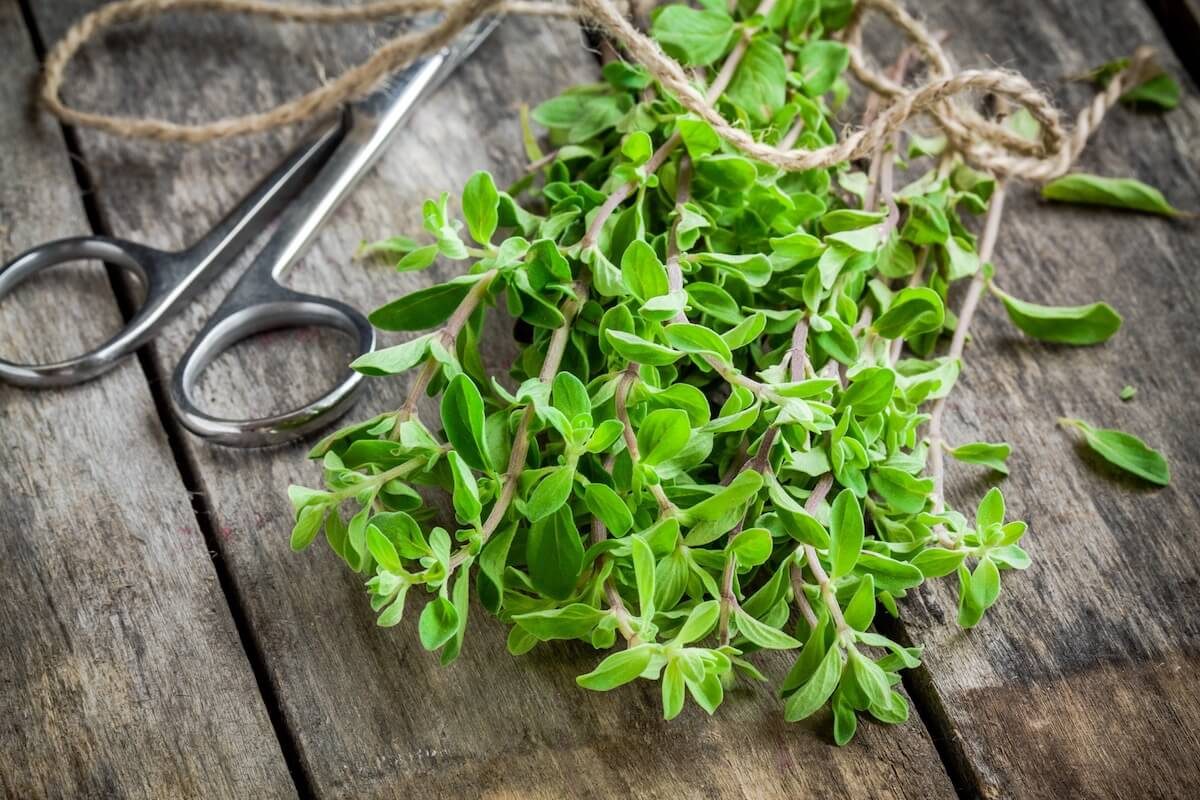
Out of marjoram? Oregano is the closest swap; use about half as much. Thyme, savory and a few herb blends work too; like oregano, they’re a little stronger or sharper than marjoram, so start with less and taste. What you’re replacing is a delicate, citrusy, piney-tasting herb, milder and sweeter than oregano, as The Spice House puts it.1 And if a blend is going into a stuffing or rub anyway, poultry seasoning or herbes de Provence may already have marjoram in it.
Quick answer
| What marjoram is doing | Best substitute | Starting amount, per 1 part marjoram | Treatment |
|---|---|---|---|
| The main herb in a meat, bean or tomato dish | Oregano | 1/2 part | Attributed |
| A background herb in a long-cooked dish | Thyme | 3/4 part, then taste | Method |
| Seasoning beans, sausages or stuffing | Summer savory | 1/2 part, then taste | Method |
| One herb among several in a rub or stuffing | Poultry seasoning or herbes de Provence | 1 part, then taste | Method |
| A fresh herb added at the end | Fresh basil | 1 part, then taste | Method |
| Pork or poultry, where a strong herb is welcome | Sage | 1/4 part, then taste | Method |
| Recipe wants fresh marjoram, you have dried (or the reverse) | Dried marjoram | 1 teaspoon dried per 1 tablespoon fresh | Computed |
How the ratios on this page are labeled
Every ratio carries one of four labels.
- Computed: based on a measurable physical relationship.
- Attributed: a named source publishes this ratio. We quote it as theirs.
- Disputed: named sources give different answers to the same swap. You get each one, side by side.
- Method: our starting point, based on how the two compare. Taste and adjust.
Why the relatives work, and where they don’t
Oregano, thyme and savory share carvacrol and thymol, the compounds that lead one type of marjoram oil, and some plants sold as marjoram are carvacrol-rich themselves.2 What they don’t have is the sweet note credited to another marjoram compound, cis-sabinene hydrate, and they taste sharper.
If marjoram is the main herb
1. Oregano
Oregano is the closest relative. Both are Origanum species, and oregano is also called wild marjoram. The Spice House calls oregano the closest substitute.1
Where it falls short: oregano is sharper and less sweet. Britannica describes its warm, pungent taste,3 and The Spice House calls its flavor “much more pungent.”1
Ratio (Attributed): The Spice House says to use about half as much oregano as marjoram.1 It doesn’t say whether that’s for fresh or dried herbs, so use the same form the recipe calls for.
The University of Delaware’s extension service puts marjoram, oregano, thyme and savory in the same medium-strength group of herbs.4 That doesn’t contradict The Spice House’s figure, but it’s a good reason to taste before you add the rest.
2. Thyme
Thyme shares carvacrol and thymol with oregano and the carvacrol type of marjoram,52 and The Spice House lists it as a marjoram substitute.1 It holds up well in long cooking. In America’s Test Kitchen’s testing, dried thyme, rosemary and sage held up reasonably well in dishes cooked for more than 20 minutes with plenty of liquid.6
Where it falls short: thyme is more savory and less floral than marjoram.
Ratio (Method): Start with about three-quarters as much thyme as marjoram, taste, and add more.
If marjoram is seasoning beans, sausages or stuffing
Summer savory
Summer savory is on The Spice House’s list.1 Its oil carries the same carvacrol and thymol, in amounts that vary a lot between studies.7
Where it falls short: it’s sharper and more peppery than marjoram.
Ratio (Method): Start with about half as much savory as marjoram and add to taste.
If marjoram is one herb among several
Poultry seasoning or herbes de Provence
If marjoram is part of a mix for a stuffing, rub or roast, a blend that already contains it makes an easy swap. McCormick Culinary’s poultry seasoning lists thyme, sage, marjoram, rosemary, black pepper and nutmeg,8 and Bell’s Seasoning is described as a salt-free blend of rosemary, oregano, sage, ginger, marjoram, thyme and pepper.9 The Takeout lists marjoram among the herbs in commercial herbes de Provence blends,10 and The Spice House’s own herbes de Provence recipe includes it.11
Where it falls short: you get the other herbs too, and sage or rosemary can take over a delicate dish.
Ratio (Method): Start with the same amount of blend as marjoram and taste.
Za’atar, with care
Za’atar can stand in for marjoram’s herbal note in Middle Eastern dishes. The University of California Master Food Preservers note that marjoram often goes into the blend in place of, or along with, oregano, alongside sumac, thyme and sesame.12 It also brings sesame and sumac’s sourness, so it only suits dishes where those belong. Check the label for salt.
Ratio (Method): Start with half as much za’atar as marjoram and taste.
If marjoram is a fresh herb added at the end
Fresh basil
Sweet basil is on The Spice House’s list.1 Its chemistry is different.13 What basil shares with fresh marjoram is a soft, sweet, green character. LSU AgCenter counts basil among the delicate herbs best added in the last minute or two of cooking.14
Ratio (Method): Use about the same amount of fresh basil as fresh marjoram, added at the end, and taste.
If you want a stronger herb: sage
Sage is on The Spice House’s list,1 but go carefully. The University of Delaware puts sage among its strong herbs, and warns that the flavor can be extremely objectionable if you use too much.4 It suits pork, poultry and stuffing better than tomato sauces or eggs.
Ratio (Method): Start with about a quarter as much sage as marjoram, taste, and add more only if you need it.
Fresh and dried marjoram
If all you’re missing is the right form of marjoram, swap forms, not herbs.
Ratio (Computed): LSU AgCenter’s rule is one tablespoon of finely cut fresh herbs to one teaspoon of crumbled dried herbs.14 America’s Test Kitchen tested the swap and found that 1 part dried herb to 3 parts fresh came closest to equal strength.6 Penn State Extension puts the dried amount at about a quarter to a third of the fresh.15 These figures are for herbs in general, not marjoram on its own. ATK’s testing found the swap worked best in long-cooked dishes with a good amount of liquid.6
What isn’t known
- The Spice House’s half-as-much figure for oregano doesn’t say how it was reached or whether it’s for fresh or dried herbs.
- You’ll often read that dried oregano is the most potent of the three forms (fresh oregano, dried oregano, marjoram) and should be used at a third. We found no source for that.
Related
- Marjoram, marjoram vs. oregano, marjoram uses and cooking with marjoram
- Oregano, thyme, summer savory, sage and basil
- Poultry seasoning, herbes de Provence and za’atar
- Dried herbs vs. fresh and how to dry marjoram
Footnotes
-
“Marjoram Substitute”, The Spice House, 2018. thespicehouse.com · Merchant ↩ ↩2 ↩3 ↩4 ↩5 ↩6 ↩7 ↩8
-
Kakouri et al., “Origanum majorana Essential Oil: A Review of Its Chemical Profile and Pesticide Activity”, Life, 2022. mdpi.com · Peer-reviewed ↩ ↩2
-
Anoushka Pant, “Oregano”, Encyclopaedia Britannica, 2026. britannica.com · Reference work ↩
-
“Using Herbs and Spices”, University of Delaware Cooperative Extension, 2025. udel.edu · Reference work ↩ ↩2
-
S.H. Widodo, Thymus vulgaris, Plant Resources of South-East Asia (PROSEA). uses.plantnet-project.org · Reference work ↩
-
“Science: Substituting Dried Herbs for Fresh”, America’s Test Kitchen. americastestkitchen.com · Publication ↩ ↩2 ↩3
-
Fierascu et al., “Phytochemical Profile and Biological Activities of Satureja hortensis L.: A Review of the Last Decade”, Molecules, 2018. mdpi.com · Peer-reviewed ↩
-
Poultry Seasoning, 12 oz, McCormick Culinary (product page). mccormick.com · Merchant ↩
-
Aimee Tucker, “Bell’s Seasoning: A New England Thanksgiving Classic”, Yankee Magazine, 2021. newengland.com · Publication ↩
-
Leah Kaplan, “What Is Herbs De Provence, Really?”, The Takeout, 2025. thetakeout.com · Publication ↩
-
“Herbes De Provence Substitute”, The Spice House, 2017. thespicehouse.com · Merchant ↩
-
“Za’atar Spice Blend”, UC Cooperative Extension Master Food Preservers of El Dorado County. ccfruitandnuts.ucanr.edu · Reference work ↩
-
“Basil”, Encyclopaedia Britannica. britannica.com · Reference work ↩
-
“Flavorful Herbs”, LSU AgCenter. lsuagcenter.com · Reference work ↩ ↩2
-
Stacy Reed, “Preserving Herbs by Drying”, Penn State Extension, 2024. extension.psu.edu · Reference work ↩
Also drawn on
- Origanum majorana L., Plants of the World Online, Royal Botanic Gardens, Kew. powo.science.kew.org