Spice Comparisons · Comparison
Onion Salt vs. Onion Powder: One Is Onion, the Other Is Mostly Salt
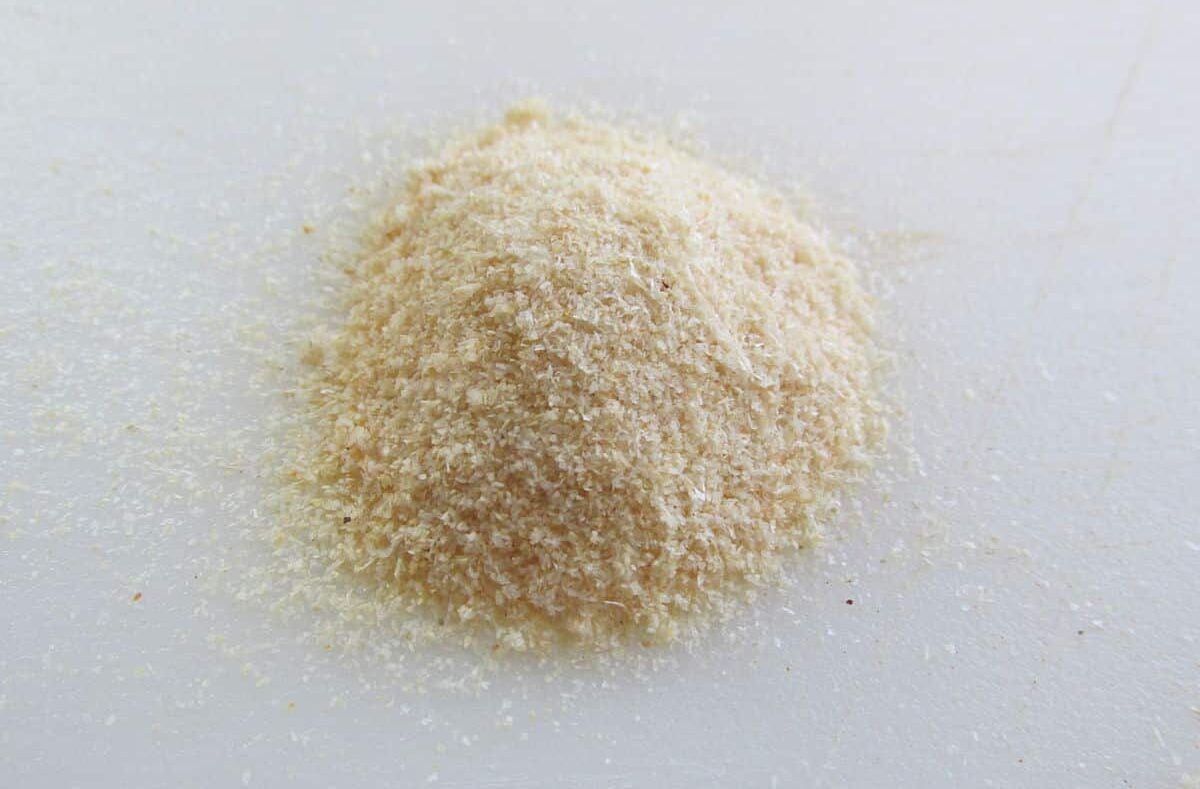
Onion powder seasons a dish with onion. Onion salt seasons it with salt that tastes of onion, and it’s mostly salt: McCormick’s carries 440 mg of sodium per ¼ teaspoon,1 about three-quarters of the 590 mg in the same measure of Morton’s iodized table salt.2 Plain onion powder has almost none.3 That changes how you cook with each. With onion salt you can’t add more onion without adding more salt, and a single teaspoon uses up most of a day’s recommended sodium.
Side by side
| Onion powder | Onion salt | |
|---|---|---|
| What it is | Dried, ground onion bulb, Allium cepa | Salt, onion, an anticaking agent (sodium silicoaluminate) and extractives of onion (McCormick label)1 |
| Onions used | Mostly white, high-solids varieties bred for drying4 | Same kind of dried onion, as the minor ingredient1 |
| Salt to onion | None added | No label states it; McCormick’s lists salt first1 |
| Sodium, per ¼ teaspoon | About 0.4 mg (USDA generic onion powder; our arithmetic)3 | McCormick 440 mg1 |
| For comparison | Morton iodized table salt, 590 mg per ¼ teaspoon2 | |
| One teaspoon weighs | 2.4 g (USDA)3 | No published figure found |
| Equal to one small onion | 1 teaspoon (NDSU); NMSU differs (below)56 | 1 1/3 teaspoons (NDSU)5 |
| Flavor | Onion only: sweet, rounded, a little toasted | Salt first, then cooked onion; McCormick calls it savory and toasty1 |
| Typical uses | Rubs, blends, dips, dressings, sauces, anywhere you want onion without changing the salt | In place of some of a recipe’s salt: McCormick suggests soups, stews and burgers1 |
| Price | No dated, sourced comparison found | No dated, sourced comparison found |
The two sodium figures have different scopes. The onion powder number is USDA’s generic analysis, 73 mg of sodium per 100 g at 2.4 g per teaspoon,3 which by our math is under 2 mg per teaspoon. The onion salt number is one brand’s Nutrition Facts label.1 Other brands may differ, so check your own jar.
The real difference: salt
By our math from McCormick’s label, one teaspoon of its onion salt carries about 1,760 mg of sodium.1 The FDA’s Daily Value for sodium is less than 2,300 mg a day,7 and the World Health Organization recommends adults stay below 2,000 mg.8 A teaspoon of onion salt uses up most of either.
Table salt itself is only about 40% sodium,9 so no blend of salt and onion can be more than 40% sodium. The “at least 50 percent” figure you’ll sometimes see for onion salt can’t be right.
What that means in the kitchen:
- You can’t add onion without adding salt. If a dish needs more onion, more onion salt means more salt too. Onion powder lets you set the two separately.
- Onion salt replaces salt, not onion. Use it where a recipe calls for salt, and cut the plain salt to match.
Can one stand in for the other?
Yes, as long as you account for the salt. Ratios are labeled Computed (a measurable basis), Attributed (a named source’s figure), Disputed (sources disagree) or Method (no published number; a starting point).
Onion powder in place of onion salt
| Part of the swap | Per 1 teaspoon onion salt | Treatment |
|---|---|---|
| Salt | 3/4 teaspoon table salt | Computed from sodium labels: 1,760 mg against Morton’s 2,360 mg per teaspoon12 |
| Onion | 1/2 to 3/4 teaspoon onion powder | Attributed: NDSU treats 1 1/3 tsp onion salt and 1 tsp onion powder as equal to the same small onion, which works out to 3/4 tsp (our arithmetic)5 |
The salt figure matches sodium, not flavor, and only holds for those two labels. NDSU’s chart is an onion equivalent, not a recipe for the blend, so it may give you more onion than your jar did. Start at 1/2 teaspoon of powder and taste. More options are on onion salt substitutes.
Onion salt in place of onion powder
Onion (Attributed): 1 1/3 teaspoons of onion salt per teaspoon of onion powder, by NDSU’s chart.5
Salt (Computed): Those 1 1/3 teaspoons of McCormick onion salt carry about 2,350 mg of sodium, almost exactly the 2,360 mg in a teaspoon of Morton table salt.12 Take 1 teaspoon of salt out of the recipe. If the recipe doesn’t have that much to remove, use less onion salt and live with a milder onion flavor. See onion powder substitutes.
Against fresh onion
Both often get measured against an onion. For onion powder, two extension guides disagree:
| Source | Onion powder | Fresh onion |
|---|---|---|
| NDSU Extension, FN1985 | 1 tsp | 1 small onion, or 1/4 cup chopped |
| NMSU Extension, E-1316 | 1 Tbsp | 1 medium onion, chopped, or 4 Tbsp fresh chopped onion |
These are round-number kitchen rules, not flavor measurements. Start with the lower figure, 1 teaspoon of powder per small onion, then taste. For onion salt, NDSU gives 1 1/3 teaspoons per small onion.5 If you swap fresh onion in for onion salt, add plain salt back. For more, see onion powder vs. onion.
Which to use where
- Onion powder for spice rubs and blends where you set the salt separately; for dips, dressings, gravies and sauces; and for any dish that’s already salty, like one with soy sauce, cheese or cured meat.
- Onion salt as the salt in a simple dish: fries, popcorn, roasted vegetables, eggs, or the soups, stews and burgers McCormick suggests.1
- Neither in a hot, dry pan. Ground spices don’t do well under intense heat.10 Add them with liquid or after the other aromatics.
Health: it’s the sodium
WHO names raised blood pressure as the main health effect of high-sodium diets, and lists cardiovascular diseases, gastric cancer, obesity, osteoporosis, Ménière’s disease and kidney disease among the associated risks.8 Onion powder adds almost no sodium;3 onion salt adds three-quarters as much as table salt, spoon for spoon.12 If you’re watching sodium, onion powder plus a measured amount of salt gives you control that a premixed jar can’t.
Neither is a meaningful source of nutrients at seasoning amounts, and nothing we reviewed shows either one treats or prevents any condition.
What isn’t known
- No onion salt label we read gives its salt-to-onion ratio.
- We only checked one brand’s onion salt (McCormick) for sodium.
- We didn’t find a published weight per teaspoon for onion salt, so the comparisons here are by volume.
Related
- Onion powder, onion salt and onion powder vs. onion
- Onion powder substitutes and onion salt substitutes
- Garlic powder vs. garlic salt, celery salt and seasoned salt
- Table salt and too much salt
Footnotes
-
McCormick Onion Salt, label ingredients, Nutrition Facts and description as listed by Stop & Shop. stopandshop.com · Merchant ↩ ↩2 ↩3 ↩4 ↩5 ↩6 ↩7 ↩8 ↩9 ↩10 ↩11 ↩12 ↩13
-
Morton Iodized Table Salt, Nutrition Facts, Morton Salt. mortonsalt.com · Merchant ↩ ↩2 ↩3 ↩4 ↩5
-
Spices, onion powder (FDC ID 171327), USDA FoodData Central. fdc.nal.usda.gov · Regulator ↩ ↩2 ↩3 ↩4 ↩5
-
Onions for Dehydration, Oregon Vegetables, Oregon State University, 2010. horticulture.oregonstate.edu · Reference work ↩
-
Julie Garden-Robinson, Ingredient Substitutions (FN198), NDSU Extension, 2018. ksre.ksu.edu · Reference work ↩ ↩2 ↩3 ↩4 ↩5 ↩6
-
In a Pinch Ingredient Substitution (E-131), NMSU Cooperative Extension, 2016. pubs.nmsu.edu · Reference work ↩ ↩2
-
Sodium in Your Diet, U.S. Food and Drug Administration. fda.gov · Regulator ↩
-
Sodium reduction, World Health Organization fact sheet. who.int · Regulator ↩ ↩2
-
Sodium Sources: Where Does All That Sodium Come From?, American Heart Association, 2025. heart.org · Reference work ↩
-
Marco Rossi, How To Improvise Instant Pot Seasoning Without Burning Your Spices, Tasting Table, 2023. tastingtable.com · Publication ↩
Also drawn on
- Allium cepa L., Plants of the World Online, Royal Botanic Gardens, Kew. powo.science.kew.org