Spice Substitutes · Substitutes
Oregano Substitutes, Ranked by the Job Oregano Is Doing
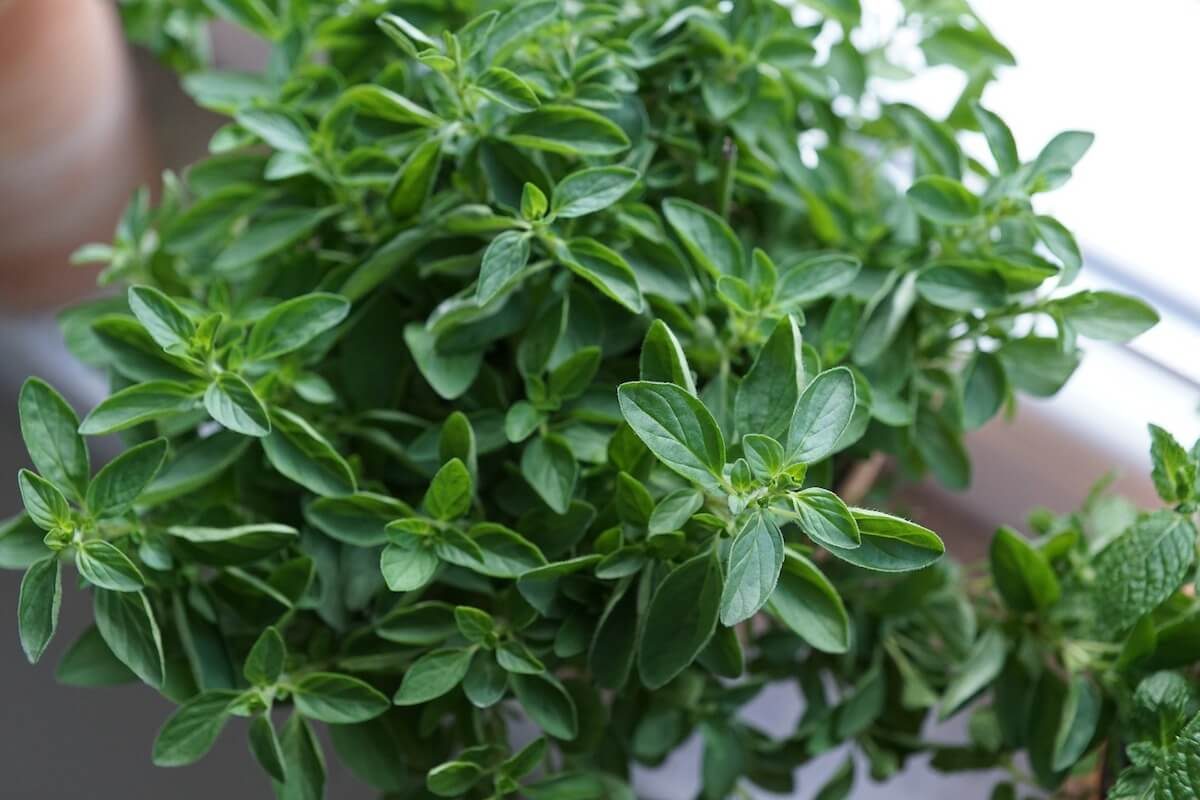
Reached for the oregano and found an empty jar? You’ve got good options, and there’s a fair chance one is already in your cabinet. Marjoram is the closest match, a gentler, sweeter cousin. Basil works in tomato sauce and on pizza, Mexican oregano in chili and beans, and thyme in a long-cooked stew. What you’re replacing is oregano’s warm, resinous bite, and the best stand-in depends on the dish you’re making.
Quick answer
| What oregano is doing | Best substitute | Starting amount, per 1 part oregano | Treatment |
|---|---|---|---|
| Lead herb in tomato sauce, pizza or Greek dishes | Marjoram | 1 part, then up to 1 1/2 parts | Method |
| Same job, basil is what you have | Basil, fresh or dried | 1 part | Attributed |
| Mexican dishes, chili, beans | Mexican oregano | 3/4 part, then taste | Method |
| Background herb in a long-cooked stew or braise | Thyme | 1/2 part dried, 1 part fresh | Method |
| One herb among several | Italian seasoning | 1 part | Method |
| Recipe calls for fresh, you have dried (or the reverse) | The other form of oregano | 1 part dried per 3 parts fresh | Computed |
How the ratios on this page are labeled
Every ratio here carries one of four labels.
- Computed: it rests on a measurable physical relationship, like converting dried herbs to fresh.
- Attributed: a named source publishes this ratio, and we quote it as theirs.
- Disputed: named sources give different answers for the same swap. You get each one, side by side.
- Method: our starting point, based on how the two compare. Taste and adjust.
If oregano is the lead herb in a tomato sauce, pizza or Greek dish
This is when oregano is the herb you’d name if someone asked what’s in the sauce. You’re after its warm, resinous bite, and a generic green note won’t cover for it.
1. Marjoram
Marjoram is in the same genus as oregano and the closest in flavor, just sweeter and softer. Watch the labels: “wild marjoram” and “European marjoram” are other names for oregano itself. If it’s going into a long simmer, add marjoram in the last 45 minutes.1
Ratio (Method): Marjoram is a bit milder than oregano, so use more when you swap.2 Start with the same amount, taste near the end, and add up to half as much again.
2. Basil
Basil is the swap for tomato sauce and pizza, where its sweetness sits well and the dish still reads as Italian. It’s a weaker fit for a Greek salad or grilled meat, where oregano’s earthy bite is the point. Fresh basil is delicate, so add it at the end of cooking.
Ratio (Attributed): A Couple Cooks says to use equal parts: fresh or dried basil for fresh or dried oregano.3
3. Italian seasoning
Italian seasoning is typically a blend of oregano, parsley, thyme and marjoram, so it already contains oregano. In a tomato sauce or on a pizza, it puts the oregano back, along with its usual companions.
Ratio (Method): Start with the same amount as the oregano and taste. Blends vary, so check the label: one heavy on rosemary or sage will taste stronger.
If oregano is seasoning Mexican food, chili or beans
1. Mexican oregano
Mexican oregano comes from a different plant, but it’s close enough that America’s Test Kitchen’s tasters noticed only minimal differences when they used it in tomato sauce and in mojo-marinated skirt steak. They found it stronger, with a hint of menthol.4
Ratio (Method): Mexican oregano is the stronger of the two, so start with about three quarters of the oregano amount and taste. Going the other way? See Mexican oregano substitutes.
2. Marjoram, thyme or sage
For chili, reach for sage, marjoram or thyme. Dried marjoram also works in place of dried oregano in Mexican-style dishes. You’ll find a starting amount under each herb’s own heading.
If oregano is a background herb in a long-cooked dish
In a bean pot, stew or braise, oregano is one warm note among several, and it has time to mellow. Hardy herbs are happy here. In ATK’s tests, dried oregano, rosemary, sage and thyme held up reasonably well in dishes with fairly long cooking (more than 20 minutes) and a good amount of liquid.5
1. Thyme
By chemistry, thyme is the closest match: it shares oregano’s two main flavor compounds, thymol and carvacrol.6
Ratio (Method): Dried thyme is much stronger than dried oregano, so some cooks use thyme only as a fresh substitute.3 Fresh for fresh, start with the same amount. Dried for dried, start with about half and taste after 20 minutes of cooking.
2. Sage
Sage is a stronger herb than oregano and tastes like itself, not like oregano. Use it where its own flavor suits the dish, like beans, pork or a hearty soup.
Ratio (Method): Sage is the stronger herb, so start with about half the oregano amount. Dried sage is fine here; it’s one of the dried herbs worth having.
Other herbs sometimes suggested
Parsley, tarragon or dill can work in a pinch. They add a fresh green note, but they won’t taste like oregano.
Ratio (Method): Use them fresh, at the end of cooking, starting with the same amount as the oregano.
Fresh, dried and ground oregano
Fresh to dried (Computed): The sources agree on about 1 part dried to 3 parts fresh.
| Source | Fresh | Dried |
|---|---|---|
| America’s Test Kitchen, tasting test | 3 parts | 1 part5 |
| The Spice House (oregano) | 1 tablespoon | 1 teaspoon2 |
| A Couple Cooks (oregano) | 1 tablespoon | 1 teaspoon3 |
| NDSU Extension (herbs in general) | 1 tablespoon | 1 teaspoon7 |
| LSU AgCenter (herbs in general) | 1 tablespoon | 1 teaspoon8 |
| University of Delaware (herbs in general) | 2 to 3 teaspoons | 3/4 to 1 teaspoon1 |
Dried to ground (Disputed): For powdered herbs, the extension services are a factor of two apart.
| Source | 1 tablespoon fresh equals |
|---|---|
| NDSU Extension | 1/2 teaspoon ground7 |
| Penn State Extension | 1/4 teaspoon powdered9 |
Neither figure is specific to oregano. If you’re using ground oregano in place of crumbled, start with the lower one, 1/4 teaspoon per tablespoon of fresh, and add more to taste.
What isn’t known
- You’ll often see a rule to use three parts marjoram for every two parts oregano. We couldn’t find a source for it.
- We also couldn’t trace the claim that English and French thyme are the varieties to use in place of oregano.
Related
- Oregano, oregano uses, cooking with oregano and fresh vs. dried oregano
- Marjoram and marjoram vs. oregano
- Mexican oregano, Mexican oregano vs. oregano and Mexican oregano substitutes
- Thyme, oregano vs. thyme, basil, basil vs. oregano and sage
- Italian seasoning and good spices for pizza
- Too much oregano? How to fix the dish
Footnotes
-
“Using Herbs and Spices”, University of Delaware Cooperative Extension, 2025. udel.edu · Reference work ↩ ↩2
-
“The 8 Best Oregano Substitutes”, The Spice House, 2018. thespicehouse.com · Merchant ↩ ↩2
-
Sonja Overhiser, “Best Oregano Substitute”, A Couple Cooks, 2026. acouplecooks.com · Publication ↩ ↩2 ↩3
-
“Oregano: Mediterranean and Mexican”, America’s Test Kitchen. americastestkitchen.com · Publication ↩
-
“Science: Substituting Dried Herbs for Fresh”, America’s Test Kitchen. americastestkitchen.com · Publication ↩ ↩2
-
S.H. Widodo, Thymus vulgaris, Plant Resources of South-East Asia (PROSEA). uses.plantnet-project.org · Reference work ↩
-
Julie Garden-Robinson, Ingredient Substitutions (FN198), NDSU Extension, 2018. ksre.ksu.edu · Reference work ↩ ↩2
-
“Flavorful Herbs”, LSU AgCenter. lsuagcenter.com · Reference work ↩
-
Stacy Reed, “Preserving Herbs by Drying”, Penn State Extension, 2024. extension.psu.edu · Reference work ↩
Also drawn on
- Oregano, by Anoushka Pant (updated 1 Oct 2026), Encyclopaedia Britannica. britannica.com
- A Recent Insight Regarding the Phytochemistry and Bioactivity of Origanum vulgare L. Essential Oil (Lombrea et al., Int J Mol Sci 21(24):9653, 2020), International Journal of Molecular Sciences (MDPI). mdpi.com
- When You Should Actually Use Dried Herbs (and Which Ones to Avoid) (Danielle Lapierre, 27 Apr 2022), America's Test Kitchen. americastestkitchen.com
- Origanum majorana Essential Oil: A Review of Its Chemical Profile and Pesticide Activity (Kakouri et al., Life 12(12):1982, 2022), Life (MDPI). mdpi.com
- Lippia graveolens (PROSEA), H.C. Ong & M. Brink, Plant Resources of South-East Asia, via Pl@ntUse. uses.plantnet-project.org