Spices · Profile
Orris Root: The Iris Rhizome Behind Violet-Scented Perfumes and Gin
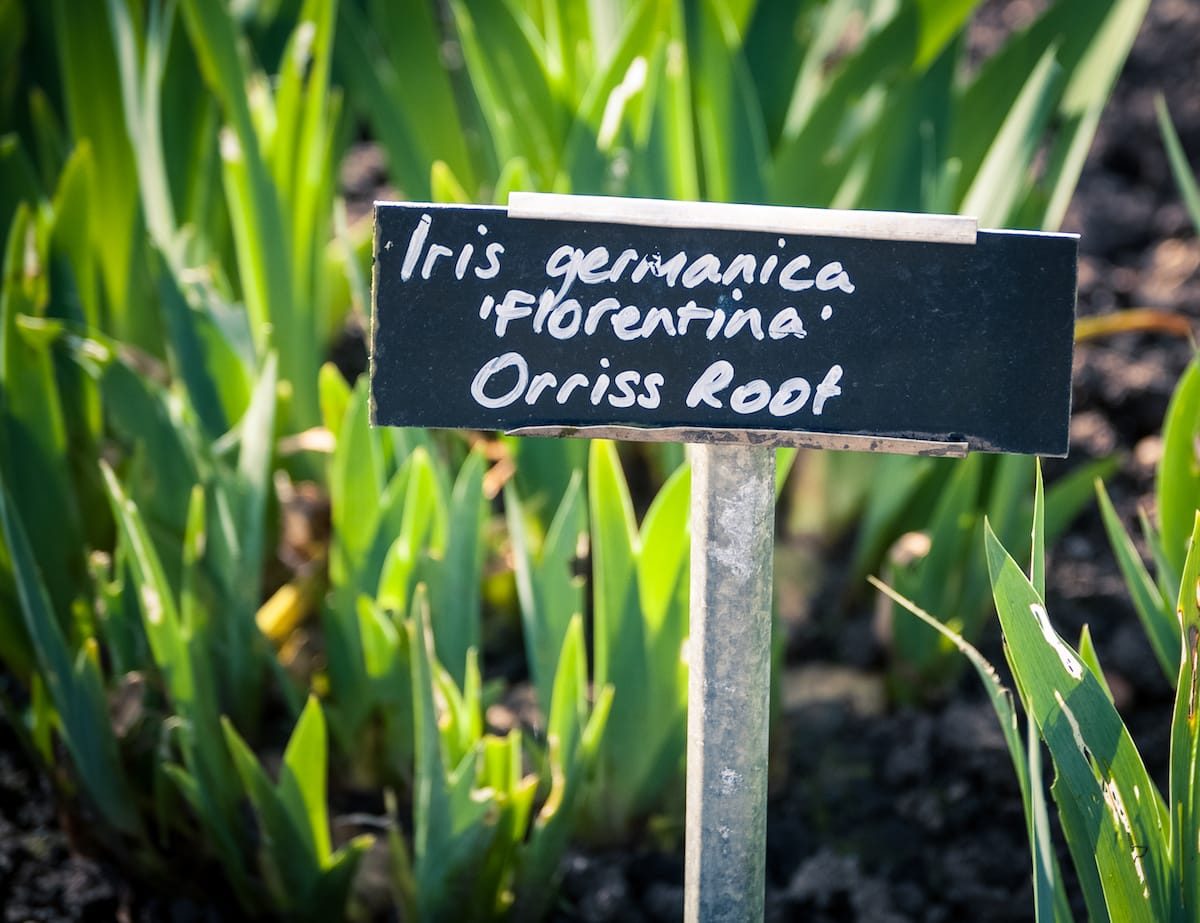
A freshly harvested orris rhizome doesn’t smell of violets. That scent only shows up slowly, as the dried, stored root ages, and traditional storage runs up to 3 to 4 years.1 Orris root is that aged rhizome, and perfumers care about it far more than cooks do: its oil and absolute are among the costliest materials in perfumery. Its use in food has declined over the risk of allergic reactions,2 but you’ll still find it as a botanical in gin.
At a glance
| Plants | Irises sold as orris: Iris germanica (including var. florentina) and I. pallida, as named in the US flavoring regulation3 |
| Plant family | Iridaceae (iris family) |
| Part used | The rhizome, dried and aged |
| Key aroma compounds | Irones, which form from iridals as the stored rhizome oxidizes1 |
| Aroma | Warm and violet-like |
| Where grown | Tuscany (Italy), traditionally; Morocco and China as lower-cost suppliers1 |
| Forms | Dried root; essential oil and absolute for perfumery |
| US status | Listed as a natural flavoring substance, 21 CFR 172.5103 |
Which iris is orris?
The names are a tangle, and sources don’t use them the same way. The US flavoring regulation lists orris root as Iris germanica L., including its variety florentina, and I. pallida.3 Britannica says the oil comes from the rhizomes of the Florentine iris, which it gives as Iris germanica.2
Kew’s Plants of the World Online sorts them differently:
| Name | Kew’s treatment | Native range (Kew) |
|---|---|---|
| Iris × germanica | An accepted hybrid, I. pallida × I. variegata4 | NW Balkan Peninsula4 |
| Iris germanica var. florentina | A synonym of Iris florentina5 | See next row |
| Iris florentina | An accepted species6 | Arabian Peninsula; introduced in Italy, France and elsewhere6 |
| Iris pallida | An accepted species7 | Northern Italy to the NW Balkan Peninsula7 |
All three are rhizomatous plants. You’ll often read that the orris iris is native to the Mediterranean. By Kew’s account, I. pallida and I. × germanica are native to northern Italy and the NW Balkans, and I. florentina to the Arabian Peninsula.
Flavor and aroma, and the compounds behind them
Scent is the whole point of orris. The oil smells warm and violet-like. That note comes from irones, ketones that a 2026 study of Tuscan I. pallida credits with the characteristic violet-like scent.1
Fresh rhizomes don’t smell like this. Irones form when triterpenoids called iridals oxidize, and that happens in storage after harvest. The same study reports traditional storage of up to 3 to 4 years and describes the natural conversion as a very long process of 2 to 3 years. It also notes the crop can stay in the ground up to 4 years before harvest. The authors tested a forced method that held rhizomes in a reactor under controlled temperature and pressure for five weeks.1 A widely repeated figure says the drying takes five years or longer. The study’s numbers are shorter.
How orris tastes is much less documented. We couldn’t find a reference work that describes its taste in food, so we won’t guess.
Origin and history
Orris is a traditional crop in Tuscany. The 2026 study describes I. pallida as a minor perennial crop grown for fragrance in the Pratomagno area near Arezzo and in the Chianti area near Florence. It also says industry now buys cheaper raw material from Morocco and China.1 We found no production statistics.
We couldn’t check claims about orris in ancient Egypt, Greece and Rome, including its mention by Dioscorides and Pliny, against a source we could open, so we’re leaving them out. Nor could we trace dates for its use as a European cooking spice in the 1500s and 1600s, its place in Victorian cosmetics, or its use in any particular named perfume.
How orris root is used
Perfume. This is the main use. The essential oil is described as one of the most expensive in perfumery, and the absolute, the costliest I. pallida product, is used mostly as a base note.1 It also goes into perfumes and lotions more broadly.
Gin. Orris is among the botanicals combined with juniper in gin, alongside angelica and licorice roots, citrus peels and several seed spices. For more on gin’s main flavoring, see juniper berries.
Food. Orris oil was once popular in candies, soft drinks and gelatin desserts, but Britannica says its use in edible goods has declined because of the risk of allergic reactions.2 In the US it’s still on the FDA’s list of natural flavoring substances, with no specific limitation. The general rule is that such substances are used in the minimum quantity needed for their effect.3
Ras el hanout. Orris root is often said to go into some versions of the North African blend ras el hanout. The Oxford Companion to Food lists cumin, coriander, turmeric, ginger, cardamom and nutmeg as standard and doesn’t mention orris.8 We found no reference that documents orris in the blend.
Buying and quality
Good orris comes down to irone content, which depends on how long and how well the rhizome has been stored.1 We found no grade standard or published spec for culinary orris root, and no documented adulteration.
Storage
We found no published shelf-life figure for dried orris root sold for kitchen or craft use. The ageing described above happens in whole stored rhizomes before they’re sold.
Safety and health
Allergy. Britannica puts the decline of orris in foods down to the risk of allergic reactions in some people.2 We didn’t find a regulator’s statement on how common those reactions are.
Traditional medicine. According to Britannica, the oil was once used for bronchitis, edema and liver ailments and still sometimes turns up in traditional medicine.2 That’s a record of past use, not evidence that it works. We found no NIH (NCCIH) page, systematic review or regulator monograph supporting claims that orris root lowers blood pressure, acts as a diuretic, reduces inflammation, treats coughs or bronchitis, or cures bad breath.
Substitutes and comparisons
Footnotes
-
Meucci et al., “Exploring plant-environment interaction in Iris pallida Lam.”, Industrial Crops & Products, 2026. iris.santannapisa.it · Peer-reviewed ↩ ↩2 ↩3 ↩4 ↩5 ↩6 ↩7 ↩8
-
“Orris oil”, Encyclopaedia Britannica. britannica.com · Reference work ↩ ↩2 ↩3 ↩4 ↩5
-
21 CFR 172.510, Natural flavoring substances and natural substances used in conjunction with flavors, FDA. ecfr.gov · Regulator ↩ ↩2 ↩3 ↩4
-
Iris × germanica L., Plants of the World Online, Royal Botanic Gardens, Kew. powo.science.kew.org · Reference work ↩ ↩2
-
Iris × germanica var. florentina (L.) Dykes, Plants of the World Online, Royal Botanic Gardens, Kew. powo.science.kew.org · Reference work ↩
-
Iris florentina L., Plants of the World Online, Royal Botanic Gardens, Kew. powo.science.kew.org · Reference work ↩ ↩2
-
Iris pallida Lam., Plants of the World Online, Royal Botanic Gardens, Kew. powo.science.kew.org · Reference work ↩ ↩2
-
Alan Davidson, “Ras-el-hanout”, The Oxford Companion to Food, 2014. app.ckbk.com · Reference work ↩
Also drawn on
- Gin, Encyclopaedia Britannica. britannica.com