Spice Substitutes · Substitutes
Rosemary Substitutes, Ranked by the Job Rosemary Is Doing
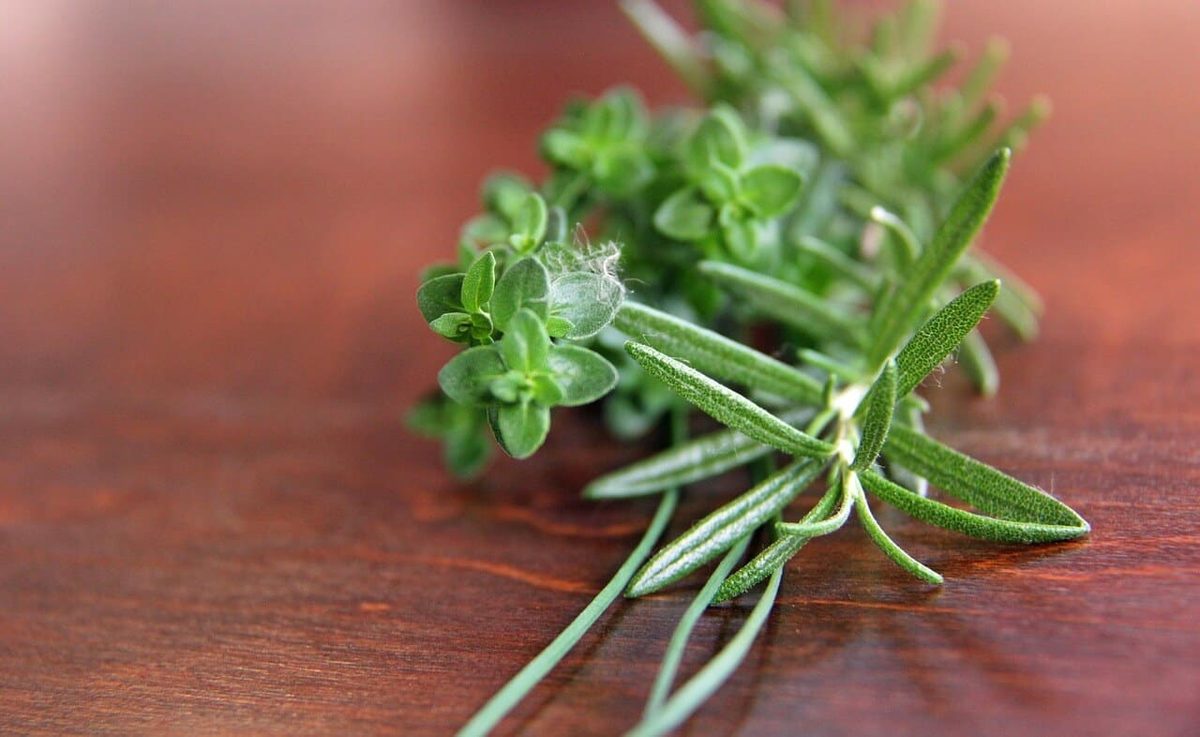
Out of rosemary? If you have dried, use that. It’s the same plant, and it holds up better than most dried herbs in long cooking. Otherwise thyme is the closest all-purpose swap,1 with sage for more punch and bay leaf for a lamb braise. No herb copies rosemary’s pungent, slightly bitter taste exactly, so the right pick depends on what rosemary is doing in your recipe.
Quick answer
| What rosemary is doing | Best substitute | Starting amount, per 1 part rosemary | Treatment |
|---|---|---|---|
| Recipe wants fresh, you have dried | Dried rosemary | 1/3 part (1 teaspoon per tablespoon) | Computed |
| Savory, resinous note in roasts, potatoes and braises | Thyme | 1 part | Attributed |
| Same job, more punch wanted | Sage | 1/2 part | Attributed |
| Seasoning lamb | Thyme, or bay leaf in a braise | 1 part thyme; 1 or 2 bay leaves per pot | Attributed |
| One herb in a dried rub or sauce | Italian seasoning or herbes de Provence | 1 part, dried for dried | Attributed |
| Tomato dishes and marinades | Oregano | 1 part fresh; 1/2 part dried | Attributed |
How the ratios on this page are labeled
Every ratio carries one of these labels.
- Computed: based on a measurable physical relationship, such as fresh to dried.
- Attributed: a named source publishes this ratio. We quote it as theirs.
- Disputed: named sources give different answers to the same swap. You get each one, side by side.
- Method: our starting point, based on how the two compare. Taste and adjust.
If the recipe calls for fresh rosemary and you have dried
Dried rosemary is the closest match, since it’s the same plant. It also holds up better than most dried herbs. In America’s Test Kitchen’s tests, dried rosemary, sage and thyme did reasonably well in dishes with fairly long cooking times (more than 20 minutes) and a good amount of liquid.2 For a garnish or a quick pan sauce, fresh is better. ATK’s tasters preferred fresh herbs in all but one application.2
Ratio (Computed): The sources agree that dried herbs are roughly three times as strong as fresh by volume.
| Source | Fresh | Dried, crumbled | Ground or powdered |
|---|---|---|---|
| NDSU Extension | 1 tablespoon | 1 teaspoon | 1/2 teaspoon3 |
| Penn State Extension | 1 tablespoon | 1 teaspoon | 1/4 teaspoon4 |
| University of Delaware Extension | 2 to 3 teaspoons | 3/4 to 1 teaspoon | not given5 |
| America’s Test Kitchen, tasting test | 3 parts | 1 part | not given2 |
| The Spice House (for rosemary) | 1 tablespoon | 1 teaspoon | not given1 |
| A Couple Cooks (for rosemary in a cooked dish) | 1 tablespoon | 1 teaspoon | not given6 |
Penn State puts the dried amount at about a quarter to a third of the fresh,4 so 1/4 to 1/3 teaspoon of dried per teaspoon of fresh is a fair range. The University of Delaware’s guide says to crush dried herbs first to release some of their oils.5
Ground rosemary (Disputed): NDSU says 1 tablespoon of fresh herbs equals 1/2 teaspoon ground. Penn State says 1/4 teaspoon powdered. That’s a twofold difference.34 Neither is a rosemary measurement, so start with the smaller figure and taste.
If rosemary is the savory, resinous note in a roast or braise
This is rosemary’s usual job: roast chicken, pork or potatoes, a pot of white beans, a long braise. You want a hardy herb that can go in early. America’s Test Kitchen groups rosemary with the hearty herbs that go in early, noting that their flavor compounds are somewhat more heat-stable than those of tender herbs.7
1. Thyme
The Spice House calls thyme the closest all-purpose swap,1 and Tasting Table’s Elizabeth Okosun calls fresh thyme a great substitute.8 Thyme works because it does the same job, a savory herb that survives the oven. It still tastes like thyme.
Ratio (Attributed): The Spice House says to use fresh thyme in the same amount as fresh rosemary.1 A Couple Cooks agrees, equal parts fresh or dried in cooked dishes, while noting that thyme is much milder.6
2. Sage
A Couple Cooks says both have a pine-like flavor,6 and Okosun says sage tastes very similar to rosemary but more intense.8 The University of Delaware’s extension service puts both rosemary and sage in its group of strong herbs.5 The European Medicines Agency lists sage and rosemary among the plants that contain thujone in variable amounts.9 Sausages and stuffings are among sage’s main uses. It suits poultry, pork and beans better than lamb.
Ratio (Attributed): A Couple Cooks says to use half as much fresh or dried sage as rosemary, then adjust to taste.6 Okosun gives no amount.8
3. Thyme and sage together
For chicken, Okosun suggests equal parts thyme and sage, with the thyme taming sage’s strength.8
Ratio (Method): The equal split is Okosun’s.8 Start with the same total volume as the rosemary, half thyme and half sage, and taste.
4. Savory or marjoram
A Couple Cooks says marjoram and savory taste similar to rosemary,6 and the Spice House suggests savory for meat and vegetable dishes.1 Both are gentler. The University of Delaware’s guide puts marjoram and savory among the medium-strength herbs, a step below rosemary.5
Ratio (Method): Start with the same amount as the rosemary and add more if the dish tastes flat.
If rosemary is seasoning lamb
The Spice House calls thyme and bay leaf the top choices for lamb,1 and Okosun names thyme, bay leaves and peppermint for a lamb roast.8 Bay is the one with a real chemical link: 1,8-cineole made up nearly a third of the bay leaf oil in one 2017 analysis,10 and it’s one of the two leading compounds in rosemary oil.11
Ratio (Attributed): The Spice House says to use fresh thyme in the same amount as fresh rosemary, or drop one or two whole bay leaves into slow braises.1
Mint or peppermint: The Spice House suggests mint or peppermint as a bright contrast for grilled lamb.1 It’s a different flavor, not a stand-in. Start with about half the rosemary amount of chopped fresh mint, added at the end.
If rosemary is one herb in a dried rub or sauce
A blend that already contains rosemary puts it back in the dish, along with its usual companions.
- Italian seasoning. The USDA’s federal purchasing specification lists thyme, rosemary, sage, oregano and basil,12 and McCormick’s Italian Seasoning lists rosemary among seven herbs.13 The Spice House calls it a convenient and effective substitute.1
- Herbes de Provence. The French Label Rouge specification for the blend calls for 26 to 27 percent rosemary, with thyme and savory.14
- Poultry seasoning. McCormick Culinary’s version lists thyme, sage, marjoram, rosemary, black pepper and nutmeg.15 Labels list ingredients by weight, largest first,16 so in that blend there’s more thyme, sage and marjoram than rosemary.
Italian seasoning and herbes de Provence ratio (Attributed): A Couple Cooks says to use either one 1:1 for dried rosemary.6
Poultry seasoning ratio (Method): Since rosemary sits near the end of McCormick’s list, the blend will taste mostly of thyme and sage. Start with the same amount and taste. Check any blend’s label for salt.
If rosemary is in a tomato dish or marinade
Oregano
A Couple Cooks says oregano works in anything Mediterranean.6 Oregano has a strong aroma and a warm, pungent taste. Its oil is led by carvacrol and thymol,17 so it has more in common with thyme than with rosemary. Use it where a tomato sauce, pizza or Greek-style marinade would welcome it.
Ratio (Attributed): A Couple Cooks says to use oregano 1:1 for fresh rosemary and half the amount for dried.6 The Spice House says oregano is stronger and slightly bitter, so use a little less, though it gives no number.1 The two agree on the direction.
If you want something milder than rosemary
The Spice House suggests basil where rosemary might overpower a dish, and tarragon for fish or dishes that welcome an anise note.1 Both change the dish’s character; neither imitates rosemary. LSU AgCenter groups basil with the delicate herbs best added in the last minute or two of cooking,18 and tarragon’s leaves have a licorice or anise flavor.
Tarragon ratio (Attributed): A Couple Cooks says it can work in a pinch. Use half as much, fresh or dried.6
Basil ratio (Method): Use fresh basil, about the same amount as the rosemary, stirred in at the end.
What isn’t known
- You’ll sometimes see caraway seed suggested for rosemary in sausage dishes, and marjoram for rosemary in mushroom dishes. We found no source for either.
- Equal parts bay leaf, peppermint and thyme for lamb gets suggested too. The sources above name each herb for lamb, but we found no source for the combination or its proportions.
Related
- Rosemary, dried rosemary vs. fresh and cooking with rosemary
- Rosemary vs. thyme, rosemary vs. sage, tarragon vs. rosemary and rosemary vs. lavender
- Thyme, sage, oregano, marjoram, summer savory and bay leaves
- Italian seasoning, herbes de Provence and poultry seasoning
- Rosemary uses, too much rosemary? how to fix the dish and how to store rosemary
Footnotes
-
“The 8 Best Substitutes for Rosemary”, The Spice House, 2024. thespicehouse.com · Merchant ↩ ↩2 ↩3 ↩4 ↩5 ↩6 ↩7 ↩8 ↩9 ↩10 ↩11
-
“Science: Substituting Dried Herbs for Fresh”, America’s Test Kitchen. americastestkitchen.com · Publication ↩ ↩2 ↩3
-
Julie Garden-Robinson, Ingredient Substitutions (FN198), NDSU Extension, 2018. ksre.ksu.edu · Reference work ↩ ↩2
-
Stacy Reed, “Preserving Herbs by Drying”, Penn State Extension, 2024. extension.psu.edu · Reference work ↩ ↩2 ↩3
-
“Using Herbs and Spices”, University of Delaware Cooperative Extension, 2025. udel.edu · Reference work ↩ ↩2 ↩3 ↩4
-
Sonja Overhiser, “Best Substitute for Rosemary”, A Couple Cooks, 2026. acouplecooks.com · Publication ↩ ↩2 ↩3 ↩4 ↩5 ↩6 ↩7 ↩8 ↩9
-
Liz Bomze, “Our Guide to Fresh Herbs”, America’s Test Kitchen, 2019. americastestkitchen.com · Publication ↩
-
Elizabeth Okosun, “The Absolute Best Substitutes For Rosemary”, Tasting Table, 2023. tastingtable.com · Publication ↩ ↩2 ↩3 ↩4 ↩5 ↩6
-
Public statement on herbal medicinal products containing thujone, European Medicines Agency, 2012. ema.europa.eu · Regulator ↩
-
Caputo et al., “Laurus nobilis: Composition of Essential Oil and Its Biological Activities”, Molecules, 2017. mdpi.com · Peer-reviewed ↩
-
Satyal et al., “Chemotypic Characterization and Biological Activity of Rosmarinus officinalis”, Foods, 2017. mdpi.com · Peer-reviewed ↩
-
Commercial Item Description A-A-20001C, Spices and Spice Blends, USDA Agricultural Marketing Service, 2023. ams.usda.gov · Regulator ↩
-
McCormick Italian Seasoning, 0.75 oz, ingredient listing, Giant Food Stores. giantfoodstores.com · Merchant ↩
-
Label Rouge “Herbes de Provence” (LA 02/03), specification modification request, INAO, 2014. extranet.inao.gouv.fr · Regulator ↩
-
McCormick Culinary Poultry Seasoning, product page, McCormick & Company. mccormick.com · Merchant ↩
-
21 CFR 101.4, Food; designation of ingredients, US Food and Drug Administration. ecfr.gov · Regulator ↩
-
Lombrea et al., “A Recent Insight Regarding the Phytochemistry and Bioactivity of Origanum vulgare L. Essential Oil”, International Journal of Molecular Sciences, 2020. mdpi.com · Peer-reviewed ↩
-
“Flavorful Herbs”, LSU AgCenter. lsuagcenter.com · Reference work ↩
Also drawn on
- Rosemary (revised by Anoushka Pant, updated 4 Sep 2026), Encyclopaedia Britannica. britannica.com
- Salvia officinalis (PROSEA), U.A. Dasuki, Plant Resources of South-East Asia, via Pl@ntUse. uses.plantnet-project.org
- Oregano, by Anoushka Pant (updated 1 Oct 2026), Encyclopaedia Britannica. britannica.com
- Tarragon: French, University of Illinois Extension, Herb Gardening. extension.illinois.edu