Cooking · Uses
Tarragon Uses: Béarnaise, Chicken, Eggs, Vinegar and More
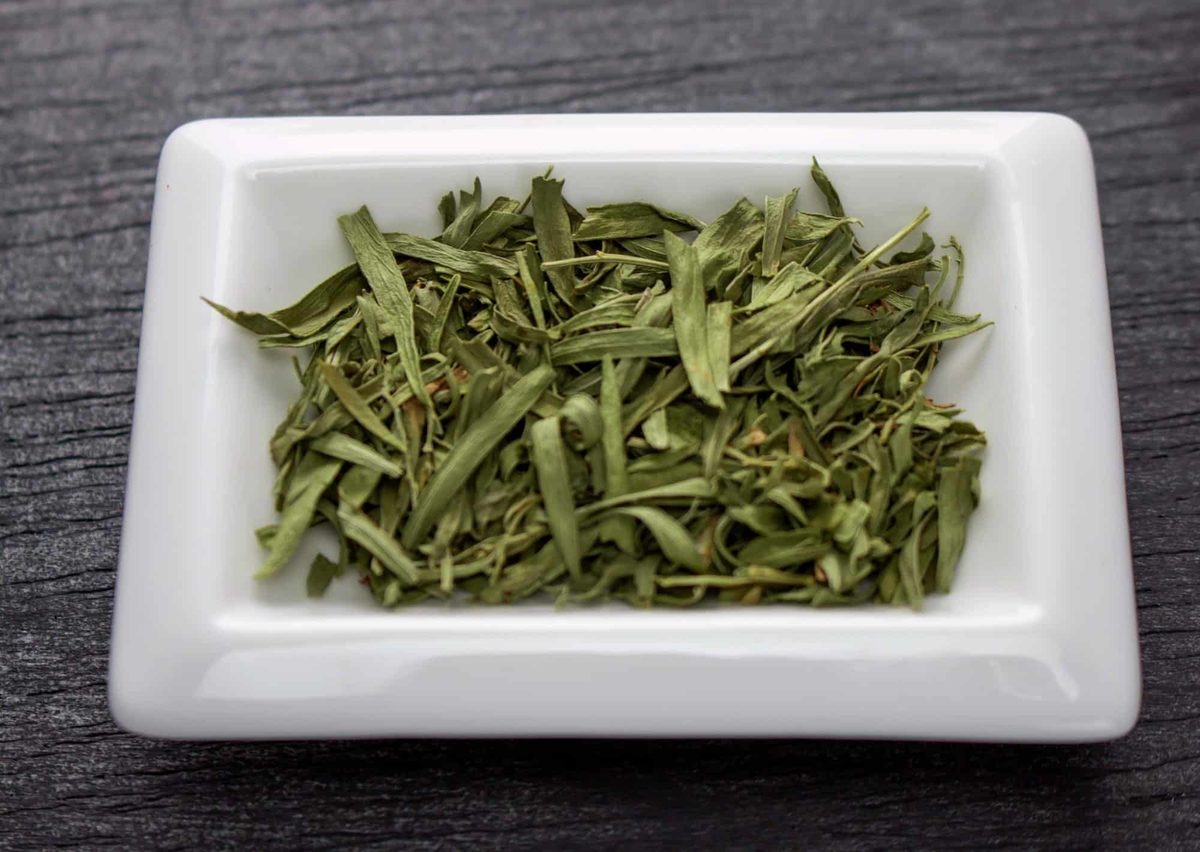
Tarragon is the herb that makes béarnaise taste like béarnaise. Its leaves are sweet and anise-scented with a bittersweet taste, and they’re especially good with chicken, eggs and lobster. That short list covers most of what you’ll use tarragon for, but it also leads in a few less familiar places, like Georgia’s lamb stew chakapuli and a fizzy green soft drink. One thing first: recipes mean fresh French tarragon, not the Russian kind sold on seed racks. For buying, storing and the French versus Russian question in depth, see the tarragon profile.
Before you start: French tarragon, used fresh
Recipes mean French tarragon. Illinois Extension notes that tarragon seed sold on seed racks is Russian tarragon, which lacks French tarragon’s smell and flavor,1 and Gernot Katzer calls Russian tarragon not at all fragrant and slightly bitter.2
Most of the uses below call for the fresh herb. Katzer says dried tarragon usually smells very weak,2 and Illinois Extension says its flavor fades fast when the leaves are dried.1 America’s Test Kitchen (ATK) groups tarragon with basil, chives, dill and parsley as delicate herbs whose flavor compounds are more volatile,3 which is why tarragon usually goes in at or near the end. See dried vs. fresh tarragon.
Tarragon uses at a glance
| Use | How tarragon is used | Named example |
|---|---|---|
| Béarnaise sauce | In the vinegar reduction and stirred in at the end | Saveur: 1 tsp dried plus 3 stems fresh4 |
| Fines herbes | One of the usual four herbs | Pépin’s omelet5 |
| Chicken | In a cream sauce | Pépin: 1 tablespoon turns poulet à la crème into poulet à l’estragon6 |
| Lobster | In the sauce or the salad | Lobster thermidor; lobster roll78 |
| Salads and vinegar | Leaves in salads, or steeped in wine vinegar | PROSEA; Katzer92 |
| Mustard and creamy sauces | Flavoring mustard, mayonnaise and sour cream sauces | Katzer2 |
| Lamb | The main herb in chakapuli | Katzer2 |
| Drinks | Tarragon soda | Tarkhun10 |
Béarnaise
Tarragon is the signature flavoring of sauce béarnaise. Saveur’s recipe shows how it gets there, twice. First you reduce vinegar, white wine, a chopped shallot, 1 teaspoon of dried tarragon, the chopped stems of 3 tarragon sprigs and peppercorns. The reduction gets whisked with 8 egg yolks and 1 cup of melted butter, and then the chopped fresh leaves go in with lemon juice at the end.4 Saving the fresh leaves for last fits ATK’s grouping of tarragon with the delicate, volatile herbs.3 The sauce mostly goes with fried, roasted or broiled meat.
Fines herbes and eggs
The French herb mix fines herbes usually includes parsley, chives, tarragon and chervil, though it varies. Jacques Pépin’s fines herbes omelet uses 1 tablespoon of finely chopped parsley and 1 tablespoon of a mix of chervil, tarragon and chives.5 Eggs are one of tarragon’s three best matches. See fines herbes.
Chicken
Chicken comes first among tarragon’s best matches, and Katzer calls it a great addition to delicate European poultry dishes. The classic is poulet à l’estragon. In Pépin’s version, the cream-sauced chicken of his poulet à la crème becomes poulet à l’estragon with 1 tablespoon of chopped fresh tarragon.6 See good spices for chicken.
Lobster and seafood
Chef Jean-Pierre’s lobster thermidor uses 2 tablespoons of chopped fresh tarragon or thyme.7 Andrew Zimmern’s Maine lobster roll keeps tarragon optional, suggesting some lemon or tarragon if you like.8 See lobster spices.
Salads, vinegar and mustard
Tarragon is most popular in salads and often flavors vinegar, sometimes with capers. Tarragon vinegar is made by adding the herb to wine vinegar, and Colorado State University Extension lists tarragon among the fresh herbs that work in flavored vinegar.11 The step-by-step method and keeping times are on how to store tarragon. Illinois Extension also suggests tarragon in oils, marinades and salads. For oil, Oregon State University Extension says homemade herb-and-oil mixtures have to be refrigerated and used within 4 days, or frozen.12
Katzer notes that in some kitchens tarragon shows up almost only as tarragon-flavored mustard, and that it suits herb sauces built on sour cream, mayonnaise or mushrooms.2
Green goddess dressing. You’ll often read that green goddess gets its color from tarragon. Katie Workman, writing for the Associated Press, says the original reportedly contained mayonnaise, sour cream, parsley, chives, anchovies, lemon juice and vinegar. No tarragon. Her modern recipe does use 2 tablespoons of fresh tarragon leaves.13 So tarragon is a common addition, but not a documented part of the original.
Georgian lamb and tarragon soda
Katzer finds tarragon surprisingly little used in European cooking today, with Georgia the exception: there the herb is often a garnish and sometimes the main flavoring. Katzer’s example is chakapuli, a fairly brothy stew of lamb chops with white wine and water, flavored with plenty of chopped fresh tarragon. Georgia also has a fizzy tarragon soft drink, artificially colored green, Katzer notes.2 A 2011 review says a sweet nonalcoholic tarragon drink is popular in countries including Azerbaijan, Armenia and Georgia.10 Tarragon syrup in cocktails follows the same idea, but we found no named recipe to cite.
Uses we could not confirm
- Bouquet garni. The classic bundle is parsley, thyme and bay leaf, and we found no source that makes tarragon a usual addition. See bouquet garni.
- Salade lyonnaise with tarragon, duck dishes, and poulet au vinaigre as tarragon dishes: no source found.
How much to use
The University of Delaware puts French tarragon in its medium-strength group,14 for which it suggests 1 to 2 teaspoons for 6 servings (Attributed). The named recipes above run from 1 tablespoon of chopped fresh leaves for a whole chicken dish to Pépin’s tablespoon of mixed herbs for an omelet. Went too far? See too much tarragon.
Related
- Tarragon
- Tarragon substitutes
- How to dry tarragon
- Can you freeze tarragon?
- Tarragon vs. thyme
- Tarragon vs. dill
- Chervil
Footnotes
-
“Tarragon: French”, University of Illinois Extension. extension.illinois.edu · Reference work ↩ ↩2
-
Gernot Katzer, “Tarragon”, Gernot Katzer’s Spice Pages. gernot-katzers-spice-pages.com · Reference work ↩ ↩2 ↩3 ↩4 ↩5 ↩6 ↩7
-
“Science: Substituting Dried Herbs for Fresh”, America’s Test Kitchen. americastestkitchen.com · Publication ↩ ↩2
-
“Béarnaise Sauce”, Saveur, 2008. saveur.com · Publication ↩ ↩2
-
Jacques Pépin, “Fine-Herbes Omelet: Conventional and Classic”, KQED (Alfred A. Knopf, 2001). kqed.org · Publication ↩ ↩2
-
Jacques Pépin, “Poulet à la Crème”, The Apprentice: My Life in the Kitchen (2003), via KQED. kqed.org · Publication ↩ ↩2
-
Chef Jean-Pierre, “Lobster Thermidor Recipe”, 2022. chefjeanpierre.com · Publication ↩ ↩2
-
Andrew Zimmern, “Classic Maine Lobster Roll”, 2024. andrewzimmern.com · Publication ↩ ↩2
-
C.C. de Guzman and R.A. Reglos, Artemisia dracunculus, Plant Resources of South-East Asia (PROSEA). uses.plantnet-project.org · Reference work ↩
-
Obolskiy et al., “Artemisia dracunculus L. (Tarragon): A Critical Review of Its Traditional Use, Chemical Composition, Pharmacology, and Safety”, Journal of Agricultural and Food Chemistry, 2011. discovery-pp.ucl.ac.uk · Peer-reviewed ↩ ↩2
-
Grubb, Shackelton and Bunning, “Making Flavored Vinegar” (9.340), Colorado State University Extension, 2021. foodsmartcolorado.colostate.edu · Reference work ↩
-
Carolyn Raab and Margy Woodburn, “Herbs and vegetables in oil” (SP 50-701), Oregon State University Extension Service, 2025. extension.oregonstate.edu · Reference work ↩
-
Katie Workman, “Served to Louis XIII, Green Goddess Dressing has history”, Associated Press, via Daily Hampshire Gazette, 2017. gazettenet.com · Publication ↩
-
Diane Oliver (rev.), “Using Herbs and Spices”, University of Delaware Cooperative Extension, 2025. udel.edu · Reference work ↩
Also drawn on
- Tarragon (Britannica Editors, updated 8 Oct 2026), Encyclopaedia Britannica. britannica.com
- Fines herbes, Encyclopaedia Britannica. britannica.com
- Bouquet garni, Encyclopaedia Britannica. britannica.com