Spices · Profile
Gochugaru: Korean Red Pepper Powder, Its Heat, History and Uses
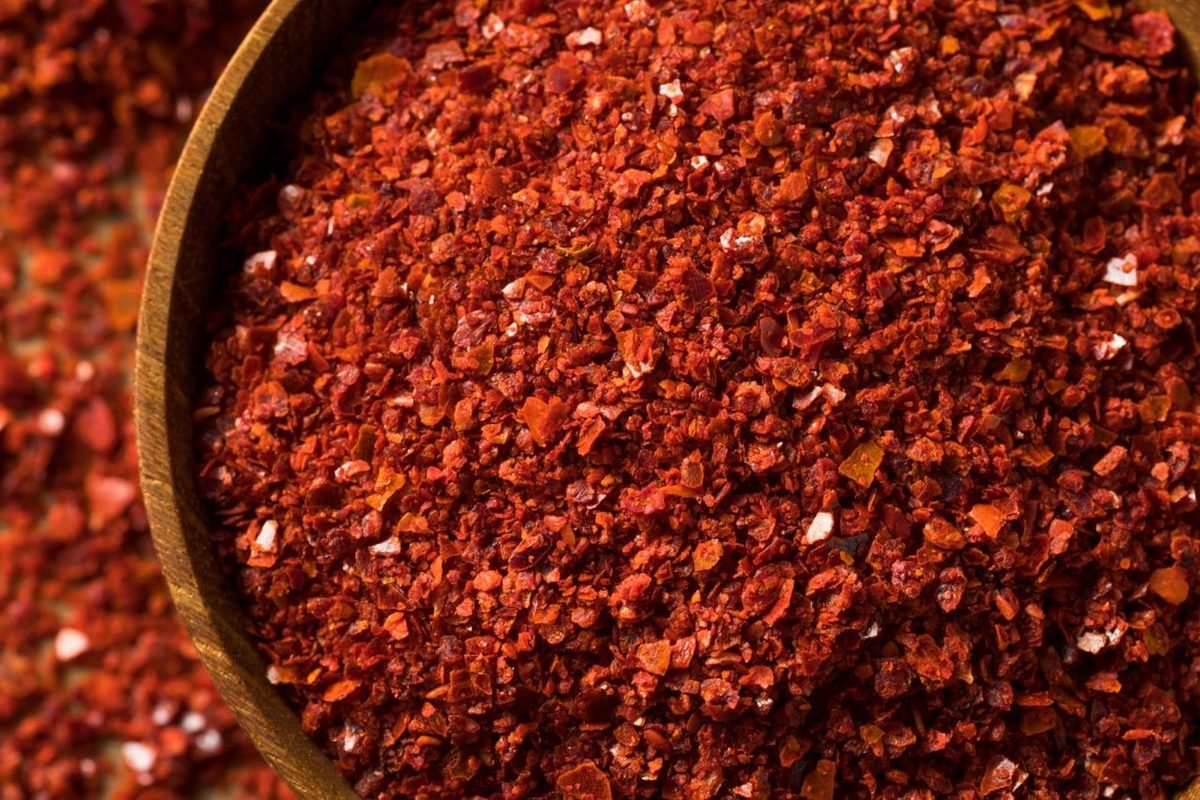
That red in kimchi? It’s gochugaru (고춧가루), Korean red pepper powder: dried red chiles ground to anything from a fine powder to coarse, glossy flakes. It’s also the red in a long list of Korean soups, stews and side dishes. How hot it is depends on whom you ask, since the published figures disagree and measure different things. And when chile, an American plant, reached Korea is still debated: the long-standing answer is around the Japanese invasion of 1592, but not everyone agrees.
At a glance
| What it is | Dried, ground red chile; Codex’s kimchi standard names the species as Capsicum annuum1 |
| Plant family | Solanaceae (nightshade family) |
| Native range of the species | Southern United States to Brazil and the Caribbean; domesticated in Mexico2 |
| Heat compounds | Capsaicinoids, mainly capsaicin and dihydrocapsaicin3 |
| Heat | Disputed; Korean lab studies report 7.0 to 126.1 mg of capsaicinoids per 100 g depending on sample (see table)45 |
| Earliest Korean record of chile | Jibong yuseol, 161467 |
| Key use | Kimchi seasoning |
| Forms sold | Coarse flakes and fine powder |
Measured values
11 figures, sourced| Measure | Value | Scope | Source |
|---|---|---|---|
| Capsaicinoids | 7.0 to 75.9 mg per 100 g | 20 Korean red peppers, analyzed by HPLC (1994 study) | accesson.kr |
| Capsaicinoids | 126.1 mg per 100 g | Commercial red pepper powders bought by variety and district through Korea's NH cooperative (2000 study); highest, 'Chungyang' variety | koreascience.kr |
| Capsaicinoids | 41.7 mg per 100 g | Commercial red pepper powders through Korea's NH cooperative (2000 study); Youngyang district powder | koreascience.kr |
| Carotenoids | 497.6 mg per 100 g | 2000 Korean study; sun-dried (taeyangcho) Youngyang district powder, highest of districts compared | koreascience.kr |
| Heat (Korean gochu) Conventional range | under 1,000 SHU | Kwon et al. abstract; no samples or method statedNot a stated measurement; sources differ (PepperScale gives 1,500 to 10,000 and 4,000 to 8,000 SHU) | agris.fao.org |
| Pungency (Scoville) Conventional range | 1,500 to 10,000 SHU (about) | gochugaru as a category, conventional range as published by PepperScale's gochugaru profile; no samples or method statedSources differ, including PepperScale's own substitutes guide; attributed, not measured | pepperscale.com |
| Pungency (Scoville) Conventional range | 4,000 to 8,000 SHU | gochugaru as a category, conventional range as published by PepperScale's gochugaru substitutes guide; no samples or method statedSources differ; attributed, not measured | pepperscale.com |
| Pungency class: chilli pepper, minimum Limit | 900 SHU | Codex CXS 353-2022 (dried chilli pepper and paprika) | fao.org |
| Ochratoxin A, maximum Limit | 20 µg/kg | EU Regulation 2023/915, dried Capsicum fruits including chilli powder | eur-lex.europa.eu |
| Aflatoxin B1, maximum Limit | 5.0 µg/kg | EU Regulation 2023/915, dried Capsicum fruits including chilli powder | eur-lex.europa.eu |
| Total aflatoxins, maximum Limit | 10.0 µg/kg | EU Regulation 2023/915, dried Capsicum fruits including chilli powder | eur-lex.europa.eu |
Each figure is quoted as its source states it, with the samples or standard it applies to. Where sources differ, both are shown; nothing is averaged. All measured values
What gochugaru is
The word is Korean for chile (gochu) powder (garu). The coarse, flaky grind sits between crushed red pepper flakes and a fine powder like cayenne or paprika. PepperScale likewise describes the texture as between coarse and fine, ground from seedless dried peppers.8
Under the international standard for dried chile (CXS 353-2022), both of those textures are recognized styles: crushed or flaked, and ground or powdered.9
Flavor
Good gochugaru tastes of ripe red pepper first, fruity and faintly sweet, with heat that builds instead of spiking. Some lots have a light smoky or toasty note from drying. We found no sensory study comparing gochugaru with other chiles, so take that as a cook’s description. PepperScale describes it in similar terms, as fruitier than cayenne with a touch of smokiness, and sweet where cayenne is fairly neutral.810
How hot is it?
Published figures for Korean red pepper don’t agree, and they aren’t measuring the same thing:
| Scope | Heat | Source |
|---|---|---|
| Korean gochu as described by Kwon et al. (abstract; no samples or method stated) | Under 1,000 SHU | Journal of Ethnic Foods, 201411 |
| 20 Korean red peppers, analyzed by HPLC (1994 study) | 7.0 to 75.9 mg capsaicinoids per 100 g | Analytical Science and Technology, 19945 |
| Commercial red pepper powders bought by variety and district through Korea’s NH cooperative (2000 study) | Highest: ‘Chungyang’ variety, 126.1 mg per 100 g; Youngyang district powder, 41.7 mg per 100 g | Korean Journal of Food Science and Technology, 20004 |
| Gochugaru as a category (no samples or method stated) | About 1,500 to 10,000 SHU | PepperScale, gochugaru profile8 |
| Gochugaru as a category (no samples or method stated) | 4,000 to 8,000 SHU | PepperScale, gochugaru substitutes guide10 |
How to read this:
- The lab figures are capsaicinoid content, not Scoville units. They’re shown in the units the studies used, and we haven’t converted them. The 2000 study’s English abstract describes ‘Chungyang’ as the variety usually used for soups and pungent dishes, so its figure marks the hot end.4
- Kwon et al.’s “under 1,000” is a stated figure with no sample or method in the abstract, and it sits inside a broader argument that Korean gochu is distinct (see History). We’re reporting it, not adopting it.
- The PepperScale ranges are quoted, not measured. The often-repeated 1,500 to 10,000 SHU range comes from PepperScale’s gochugaru profile, and a narrower 4,000 to 8,000 from its substitutes guide. Neither article says where its range came from, and they don’t agree with each other.810
- Context. The Codex standard for dried chile uses Scoville units as its pungency yardstick: up to 480 for paprika, above 480 and below 900 for hot paprika, and 900 or more for chilli pepper.9 NMSU notes that Scoville scoring depends on tasters and that HPLC, which measures the compounds directly, is the most accurate method.3
Heat varies by variety and lot, so taste a pinch before you use a new bag in a full recipe.
Origin and history
The plant is American. Capsicum annuum is native from the southern United States to Brazil and the Caribbean, and a 2014 study combining four lines of evidence placed its domestication in central-east Mexico.2
How and when it reached Korea is debated.
- The established account. The oldest surviving Korean record of chile is Yi Su-gwang’s Jibong yuseol of 1614.7 It records that namancho came from Japan and was called waegaeja, and the long-standing view is that chile reached the peninsula around the Imjin War, the Japanese invasion that began in 1592.611 A study of the word gochu notes that older texts from 1489 and 1527 use a similar word, gocho, for Sichuan pepper, not chile.7
- The challenge. A 2014 paper by Kwon and colleagues argued that the claim that peppers came to Korea during the Japanese invasion of 1592 is false, citing a Nature paper on peppers spread by birds and stating that Koreans have grown gochu for the last 1,500 years.11
- Where it stands. A September 2026 survey of the debate in Weekly Kyunghyang reports that genetic studies place the genus’s origin in Central and South America, that the native-chile theory is hard to call mainstream, and that the 2022 revision of the Encyclopedia of Korean Culture dates chile’s arrival to the early 17th century.6
You’ll see a claim that Chinese and Korean texts mention chiles as early as 850 CE. We couldn’t trace it to any source, and the 1489 and 1527 references sometimes cited for early dates are about Sichuan pepper.7
Into kimchi. Chile didn’t turn kimchi red overnight. Weekly Kyunghyang reports that recipes for kimchi and gochujang made with chile appear in the 1720s Somun saseol, and that the 1766 Jeungbo sallim gyeongje describes pickling cucumbers with gochugaru and garlic; newer research cited in the same article finds traces of chile in kimchi from the late 17th century.6 The etymology study quotes the writer Seo Yu-gu describing chile made into powder for kimchi or gochujang.7 Kimchi seasoned with gochugaru the way it is today came much later, according to the same survey.6
How it is used
Kimchi. The Codex standard for kimchi describes the product as made with a seasoning mix mainly of red pepper (Capsicum annuum) powder, garlic, ginger, other alliums and radish.1 Kwon and colleagues go further, writing that kimchi and gochujang fermented only with Korean gochu “can be eaten.”11 That’s their opinion, not a tested result.
Elsewhere in Korean cooking:
- Stews and soups, including sundubu jjigae (soft tofu stew) and yukgaejang (spicy beef soup).
- Seasoned vegetables and dipping sauces, where coarse flakes add color and moderate heat.
- Marinades for grilled and stir-fried pork and squid. See Korean BBQ spices and Korean spices.
PepperScale also names jjampong, a spicy noodle soup.8
Gochugaru isn’t the same as gochujang, the fermented chile paste; see gochugaru vs. gochujang.
Buying and quality
- Sun-dried versus machine-dried. Sun-dried chile is called taeyangcho. In the 2000 Korean study, the sun-dried (taeyangcho) Youngyang district powder had the highest carotenoid content of the districts compared (497.6 mg per 100 g).4 That’s one study’s district comparison, not proof that sun-drying always makes better powder, and we found no source for the common claim that most Koreans prefer its flavor. PepperScale notes that machine-dried peppers are more common and cheaper than sun-dried, and that sun-drying is said to matter for color and heat; it reports that view without testing it.8
- Grind and heat. Pick coarse for kimchi and side dishes and fine for smooth sauces, and check the label for mild or hot. PepperScale gives the label terms: maewoon gochugaru for the hottest and deolmaewoon for the milder kind.8
- Color. Bright red with a slight sheen suggests fresher stock; brown or dull powder has faded.
Storage
Lots of people keep gochugaru in the freezer or fridge in an airtight bag to hold its color. We found no shelf-life figure for it from a regulator or standards body, and we couldn’t trace the figures floating around online.
Nutrition and health
We found no USDA FoodData Central entry for gochugaru, and we couldn’t trace the nutrient figures that get passed around for it (for example, that two teaspoons supply 14% of daily vitamin E). Figures for other chile powders describe different products, so we haven’t carried them over.
What the evidence says about capsaicin. The strongest human evidence is about a prescription skin patch, not chile in food. A 2017 Cochrane systematic review found moderate-quality evidence that a high-concentration (8%) capsaicin patch gave moderate pain relief to a minority of people with postherpetic neuralgia.12 None of the sources we reviewed supports claims that gochugaru lowers cholesterol, prevents heart attacks, stops prostate cancer spreading, controls blood sugar or helps prevent ALS. We’re not claiming gochugaru treats or prevents any disease.
Safety
- Mycotoxins (EU). EU law caps ochratoxin A at 20 µg/kg in dried Capsicum fruits, including chilli powder, and sets 5.0 µg/kg for aflatoxin B1 and 10.0 µg/kg for total aflatoxins.13
- Handling. Keep the powder away from your eyes and wash your hands after mixing kimchi seasoning by hand; many cooks wear gloves.
Substitutes and comparisons
- Gochugaru substitutes
- Gochugaru vs. gochujang
- Paprika vs. cayenne, for the two most common stand-ins
- Related chiles: red pepper flakes, paprika, cayenne pepper, chili powder
Footnotes
-
Standard for Kimchi, CXS 223-2001, Codex Alimentarius. fao.org · Standard ↩ ↩2
-
Kraft et al., Multiple lines of evidence for the origin of domesticated chili pepper, PNAS, 2014. escholarship.org · Peer-reviewed ↩ ↩2
-
Bosland and Walker, Measuring Chile Pepper Heat, NMSU Guide H-237, 2010. pubs.nmsu.edu · Reference work ↩ ↩2
-
Choi, Jeon and Park, Comparison of Quality of Red Pepper Powders Produced in Korea, Korean Journal of Food Science and Technology, 2000 (abstract). koreascience.kr · Peer-reviewed ↩ ↩2 ↩3 ↩4
-
Chai et al., Relationships Between the Content and Sensory Evaluation of Pungent Principles in Red Pepper, Analytical Science and Technology, 1994 (abstract). accesson.kr · Peer-reviewed ↩ ↩2
-
Jeong Yong-in, 김치는 언제부터 빨개졌을까 (When did kimchi turn red?), Weekly Kyunghyang, 2026. weekly.khan.co.kr · Publication ↩ ↩2 ↩3 ↩4 ↩5
-
Kim Jong-deok and Ko Byung-hee, A study on the etymology of gochu, Korean Journal of Medical History. koreascience.kr · Peer-reviewed ↩ ↩2 ↩3 ↩4 ↩5
-
Matt Bray, What Is Gochugaru? The Story Behind The Spice, PepperScale, 2023. pepperscale.com · Publication · PepperScale is also owned by Matt Bray, the editor of this site. ↩ ↩2 ↩3 ↩4 ↩5 ↩6 ↩7
-
Standard for Dried or Dehydrated Chilli Pepper and Paprika, CXS 353-2022, Codex Alimentarius. fao.org · Standard ↩ ↩2
-
Matt Bray, What’s A Good Gochugaru Substitute?, PepperScale, 2022. pepperscale.com · Publication · PepperScale is also owned by Matt Bray, the editor of this site. ↩ ↩2 ↩3
-
Kwon, Jang, Yang and Chung, History of Korean gochu, gochujang, and kimchi, Journal of Ethnic Foods, 2014 (abstract). agris.fao.org · Peer-reviewed ↩ ↩2 ↩3 ↩4
-
Derry et al., Topical capsaicin (high concentration) for chronic neuropathic pain in adults, Cochrane Database of Systematic Reviews, 2017. cochrane.org · Peer-reviewed ↩
-
Commission Regulation (EU) 2023/915, EUR-Lex. eur-lex.europa.eu · Regulator ↩
Also drawn on
- Capsicum annuum L., Plants of the World Online, Royal Botanic Gardens, Kew. powo.science.kew.org