Cooking · Profile
Jamaican Spices and Seasonings: Allspice, Scotch Bonnet, Thyme, Ginger and Curry Powder
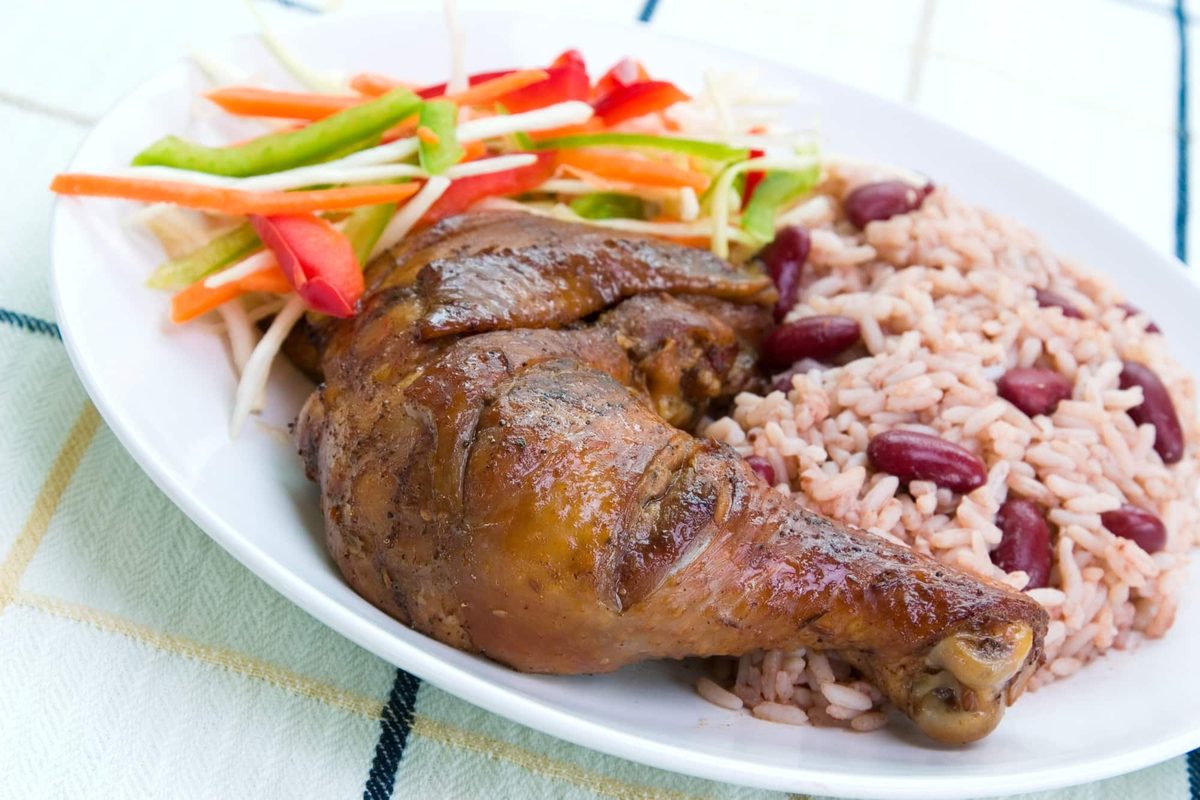
Jamaicans call allspice pimento, and it’s one of the two essential ingredients of jerk, by scholar Carolyn Cooper’s account. Authentic jerk meat is even smoked over pimento wood.1 The other essential is the Scotch bonnet, a very hot chile with a flower-like scent. Fresh thyme, scallions and garlic, ginger and curry powder round out a short list of seasonings used with confidence, and several of them meet in one everyday pot of rice and peas.
At a glance
| Seasoning | What it brings | Signature uses |
|---|---|---|
| Allspice (pimento) | Warm, clove-like aroma, mostly from eugenol2 | Jerk, rice and peas |
| Scotch bonnet | Very high heat with a flowery scent | Jerk paste, rice and peas |
| Thyme | Herbal, savory | Jerk, rice and peas |
| Scallions and garlic | Fresh allium base | Jerk seasoning, rice and peas |
| Ginger | Pungent warmth | Modern jerk recipes |
| Curry powder | Turmeric-led, often with allspice | Curried goat |
Measured values
2 figures, sourced| Measure | Value | Scope | Source |
|---|---|---|---|
| Allspice berry oil: eugenol | 50 to 80 % of the berry oil | scope not stated on source page | uses.plantnet-project.org |
| Heat, Scotch bonnet Conventional range | 100,000 to 500,000 SHU | general rating for the pod type (Dave DeWitt's heat scale, 2008 update)General rating, not a measurement of a particular harvest | fieryfoodscentral.com |
Each figure is quoted as its source states it, with the samples or standard it applies to. Where sources differ, both are shown; nothing is averaged. All measured values
Allspice (pimento)
Allspice is one spice, not a blend. It’s the dried berry of Pimenta dioica, and its names include Jamaican pepper and pimento. The tree is native from southern Mexico through Central America and the Caribbean. It grows elsewhere in the region too, but PROSEA reports that Jamaican pimento is considered the best quality.2 We couldn’t find a figure for how much of the world’s allspice Jamaica produces.
The name comes from the flavor, which resembles a combination of cloves, cinnamon and nutmeg. The main aroma compound is eugenol, 50 to 80% of the berry oil according to PROSEA.2
Scholar Carolyn Cooper, quoted by Smithsonian Magazine, calls allspice one of the two essential ingredients of jerk seasoning, along with Scotch bonnet. Authentic jerk meat is also smoked over pimento wood.1 Whole berries go into the pot for rice and peas. Allspice shows up in escovitch fish too, though we didn’t check that against a recipe source.
See allspice, allspice substitutes, allspice vs. cloves and too much allspice.
Scotch bonnet
The Scotch bonnet belongs to Capsicum chinense. Gernot Katzer names it as that species’ Jamaican representative, alongside the habanero in Cuba and Yucatán, and writes that the extreme heat of these chiles matters in Caribbean cooking. He describes them as very hot, with a typical flower-like scent.3
How hot? Dave DeWitt’s heat scale puts Scotch bonnet in its top band, 100,000 to 500,000 Scoville heat units, right there with the habanero. On the same scale, jalapeño varieties sit at 2,500 to 5,000 (TAM Mild) and 5,000 to 15,000 (Early Jalapeño).4 Those are general ratings for pod types, not readings from any particular harvest. You’ll sometimes hear that Jamaican food is spicier than other New World cuisines, or milder than Indian or Indonesian food. We found no source for either, so we’ve left that comparison out.
Katzer notes that jerk paste uses these chiles. In Cook’s Country’s rice and peas, a whole Scotch bonnet simmers with the rice to scent it.5 See habanero powder, cayenne pepper and red pepper flakes.
Jerk seasoning
Jerk is a way of seasoning, smoking and grilling meat, not just a spice mix. Smithsonian lists Scotch bonnet peppers, scallions, garlic, ginger, pimento, thyme and cinnamon among the ingredients of modern recipes.1 Walkerswood, a Jamaican maker, builds its seasoning on fresh Scotch bonnets, escallion (scallion), pimento and thyme.6 There’s no single recipe. Our jerk seasoning page puts four named ingredient lists side by side, including a USDA specification.
Marinating times vary by recipe. We found no source for a 24-hour minimum, so any figure you see is the cook’s preference, not a rule. See also jerk seasoning substitutes.
Thyme
Fresh thyme goes into jerk and into rice and peas, where Cook’s Country uses ten sprigs.5 It isn’t native to the Caribbean. It’s native to southwestern Europe and southeastern Italy. We found no measure of which herb Jamaicans use most, so we don’t rank it.
See thyme, thyme uses, cooking with thyme and too much thyme.
Rice and peas: the seasonings together
Want to see these flavors in one everyday dish? Try rice and peas. Cook’s Country, which says the dish was brought to Jamaica by enslaved West Africans, simmers red kidney beans and rice in coconut milk and broth with thyme sprigs, sliced scallions, chopped garlic, a whole Scotch bonnet and a quarter teaspoon of whole allspice berries.5
Ginger
Ginger isn’t native to the Americas. Europeans carried it to the West African coast and the Caribbean.7 It’s on Smithsonian’s list of ingredients for modern jerk recipes. Ginger is also the main flavor in ginger beer, and it often goes into sorrel, the hibiscus drink. We didn’t check either of those against a source, or ginger’s place in the cooking of Jamaica’s Chinese community. See ginger, cooking with ginger and is ginger spicy?.
Curry powder
Curry came to Jamaica with Indian indentured workers. The African Caribbean Institute of Jamaica records that more than 36,000 Indians arrived between 1845 and 1917. It credits them with using curry powder to season meats, and with curried goat, now a Jamaican specialty.8
Jamaican curry powder is led by turmeric. On two widely sold labels, turmeric comes first and allspice shows up in both. Grace’s mild powder lists turmeric, salt, garlic and onion, cumin, coriander, black pepper, fenugreek and allspice,9 and Blue Mountain’s lists turmeric, salt, coriander, fenugreek, cumin, allspice, cayenne and garlic.10 Writer Hank Shaw sums up the difference from Indian-style powders as more allspice and more turmeric.11 We found no measure of how its popularity stacks up against jerk seasoning.
See Jamaican curry powder, Jamaican vs. Indian curry powder, curry powder and cooking with curry powder.
Related pages
- Caribbean spices, Haitian spices and Cuban spices
- Bajan seasoning
- Nutmeg, cinnamon and cloves, the spices allspice is said to resemble
- The master list of herbs and spices
Footnotes
-
Vaughn Stafford Gray, “A Brief History of Jamaican Jerk”, Smithsonian Magazine, 2020. smithsonianmag.com · Publication ↩ ↩2 ↩3
-
D. Sulistiarini, Pimenta dioica (PROSEA), Plant Resources of South-East Asia. uses.plantnet-project.org · Reference work ↩ ↩2 ↩3
-
Gernot Katzer, Chiles (Capsicum), Gernot Katzer’s Spice Pages. gernot-katzers-spice-pages.com · Reference work ↩
-
Dave DeWitt, “Heat Scale Updated”, Fiery Foods & Barbecue Central, 2008. fieryfoodscentral.com · Publication ↩
-
Matthew Fairman, “Jamaican Rice and Peas”, Cook’s Country, America’s Test Kitchen, 2021. americastestkitchen.com · Publication ↩ ↩2 ↩3
-
Jerk Seasonings, Walkerswood Caribbean Foods. walkerswood.com · Merchant ↩
-
Jeff Koehler, “Spice Migrations: Ginger”, AramcoWorld, 2021. aramcoworld.com · Publication ↩
-
Rochelle Clarke, “A Brief History of East Indian Heritage in Jamaica”, African Caribbean Institute of Jamaica / Institute of Jamaica. acij-ioj.org.jm · Reference work ↩
-
Grace Jamaican Style Mild Curry Powder, label ingredients via Kroger. kroger.com · Merchant ↩
-
Blue Mountain Country Jamaican Curry Powder, label ingredients via H-E-B. heb.com · Merchant ↩
-
Hank Shaw, “Jamaican Curry Shrimp”, Hunter Angler Gardener Cook, 2022. honest-food.net · Publication ↩
Also drawn on
- Pimenta dioica (L.) Merr., Plants of the World Online, Royal Botanic Gardens, Kew. powo.science.kew.org
- Allspice (Britannica Editors, updated 3 Sep 2026), Encyclopaedia Britannica. britannica.com
- Thymus vulgaris L., Plants of the World Online, Royal Botanic Gardens, Kew. powo.science.kew.org