Herbs · Profile
Safflower: The “False Saffron” Flower, Its Dye, Flavor and Uses
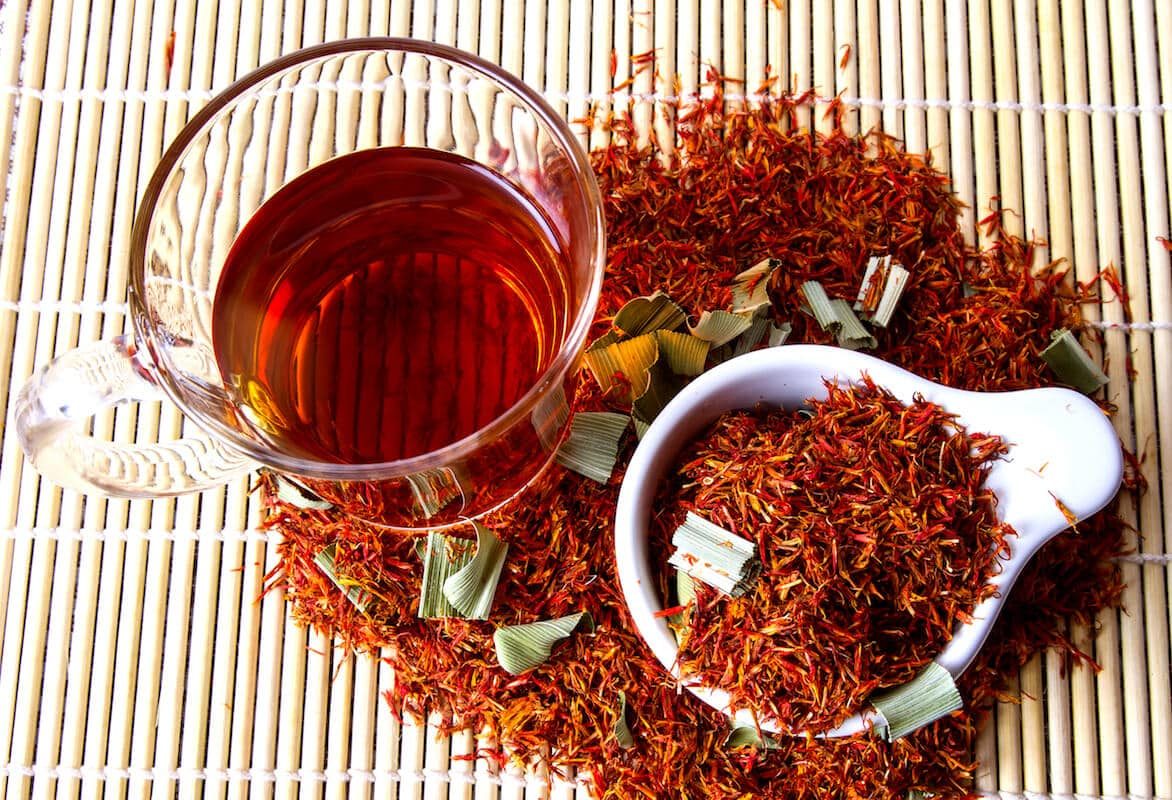
If a bargain “saffron” turns your rice golden but barely smells of anything, safflower is one of the usual suspects. Safflower petals color food yellow to orange, but they taste of very little, and they have a long history as a cheap stand-in for saffron, and as a way to fake it. The plant, Carthamus tinctorius, is an annual in the daisy family grown mostly for the oil in its seeds. What reaches the spice shelf is the dried flower, sold as loose orange-red petals.
At a glance
| Botanical name | Carthamus tinctorius L. |
| Plant family | Asteraceae (daisy family) |
| Part used as a spice | Dried florets (petals); the seeds are pressed for oil |
| Native range | Central and eastern Türkiye to Iran (Kew); see Origin below for other views1 |
| Pigments | Yellow, water-soluble carthamidin and orange-red carthamin2 |
| Flavor | Very weak and herbaceous; no essential oil (Katzer) |
| Main producer | India, per Britannica; no current statistical figure found3 |
| Forms sold | Dried florets; safflower oil |
What safflower is
Safflower grows 0.3 to 1.2 meters tall, with flower heads that can be red, orange, yellow or white. It’s an annual of the temperate biome. Most of the crop is grown for seed. Oil from the seed is the plant’s chief modern use, mainly for soft margarines, salad oil and cooking oil, and the leftover meal goes to livestock feed. The dried florets are the spice and the dye.
Color and flavor
Color
The florets hold two kinds of pigment: a water-soluble yellow, carthamidin, and carthamin, an orange-red dye that was once commercially important.2 Carthamin is a flavonoid-type dye. It was used as a red textile dye until synthetic dyes mostly replaced it.
Flavor
Katzer calls the florets’ flavor very weak and herbaceous, notes that they contain no essential oil, and puts their value as a spice at “nearly nil.”4 You’ll see safflower petals described as tasting of chocolate or tobacco, but we couldn’t find a source for either. What you actually get is color and a faint grassy note, not saffron’s aroma.
Safflower and saffron
Safflower belongs to the daisy family, and saffron comes from a different plant altogether (see saffron). Even so, the dried florets have stood in for saffron, both openly and deceptively.
- “False saffron.” Safflower often goes by false saffron, and many European languages have a name along those lines. French safran bâtard means “bastard saffron.”
- As an open substitute. Safflower is a natural food color that substitutes for saffron, and it sees some use as a poor imitation of saffron in Middle Eastern cooking.
- As an adulterant. Britannica records safflower’s use as an adulterant of saffron, and a 2022 bulletin from the Botanical Adulterants Prevention Program lists safflower among the materials used to fake or bulk out saffron.35 Katzer adds that safflower is often sold as “saffron” to tourists in Hungary and North Africa.4
A rule of thumb, not a test: be suspicious of “saffron” that’s very cheap and gives food color but little aroma. See saffron for how genuine saffron is graded and tested, and safflower vs. saffron for a side-by-side comparison.
Origin and history
Sources disagree on where safflower comes from:
- Kew gives its native range as central and eastern Türkiye to Iran.1
- Britannica calls it native to parts of Asia and Africa.3
- PROSEA says the crop is known only from cultivation and probably originated in the Middle East.2
PROSEA notes that safflower was first grown as a dye crop, and that it’s been identified growing in Egypt around 2000 BCE.2 We couldn’t trace the claims that it was found in the tomb of Amenhotep I, that it appears in manuscripts of Ptolemy II, or that its dye was exported to France, Italy and England in the 18th century to color cheese and sausages.
Production
Britannica says safflower is grown chiefly in India, and names the United States, Australia, Israel, Turkey and Canada as places it’s been introduced.3 PROSEA lists India, the United States, Mexico, Kazakhstan, Ethiopia, Argentina, Australia and China as major producers, and puts world safflower oil output in the mid-1970s at about 630,000 tonnes.2 Neither gives a current figure, and we didn’t open FAO or other official statistics, so we can’t say who leads production today.
How safflower is used
- Coloring rice, bread and pickles. The florets are commonly mixed into rice, bread and pickles to turn them orange.
- Azerbaijan. The florets improve the color of broths, soups and stews, and give a yellowish tint to the broth of piti.
- Middle East. Used as a poor imitation of saffron.
The florets add color, not aroma, so they work when you want a golden rice or broth. They won’t make a paella or risotto taste of saffron. Soak them in warm water first to release the color; the yellow pigment is water-soluble. For more ideas, see safflower uses.
Buying and quality
Look for bright orange-red florets that are dry and intact. The package should say safflower. Anything sold as saffron at a fraction of saffron’s price deserves suspicion. We found no grading standard for culinary safflower.
Storage
We found no published shelf-life figure for safflower florets. Keep them sealed, away from light and heat, and judge them by color.
Safety and health claims
Safflower florets have a place in traditional Chinese medicine. PROSEA records their use in China for illnesses such as cerebral thrombosis, and to induce labor.2 Those are records of traditional use, not evidence that safflower works, and we didn’t open any regulator assessment of safflower florets.
The vitamin, mineral and limonene claims often attached to safflower petals couldn’t be traced. Katzer’s note that the flowers contain no essential oil argues against limonene in particular.4 We make no claim that safflower treats or prevents any condition.
Substitutes and comparisons
- Safflower substitutes
- Safflower vs. saffron
- Saffron substitutes
- Turmeric and annatto seeds, two other spices used mainly for color
Footnotes
-
Carthamus tinctorius L., Plants of the World Online, Royal Botanic Gardens, Kew. powo.science.kew.org · Reference work ↩ ↩2
-
L.P.A. Oyen and B.E. Umali, Carthamus tinctorius, Plant Resources of South-East Asia (PROSEA). uses.plantnet-project.org · Reference work ↩ ↩2 ↩3 ↩4 ↩5 ↩6
-
“Safflower”, Encyclopaedia Britannica. britannica.com · Reference work ↩ ↩2 ↩3 ↩4
-
Gernot Katzer, “Safflower (Carthamus tinctorius L.)”, Gernot Katzer’s Spice Pages. gernot-katzers-spice-pages.com · Reference work ↩ ↩2 ↩3
-
Stephen Daniells, “Adulterants Bulletin highlights ‘multifaceted fraud’ associated with saffron”, NutraIngredients, 2022. nutraingredients.com · Publication ↩
Also drawn on
- Dyeing for Color (Carly Still, 22 January 2015), The Metropolitan Museum of Art. metmuseum.org