Spices · Profile
Celery Flakes: Dried Celery, How to Use It and What to Check on the Label
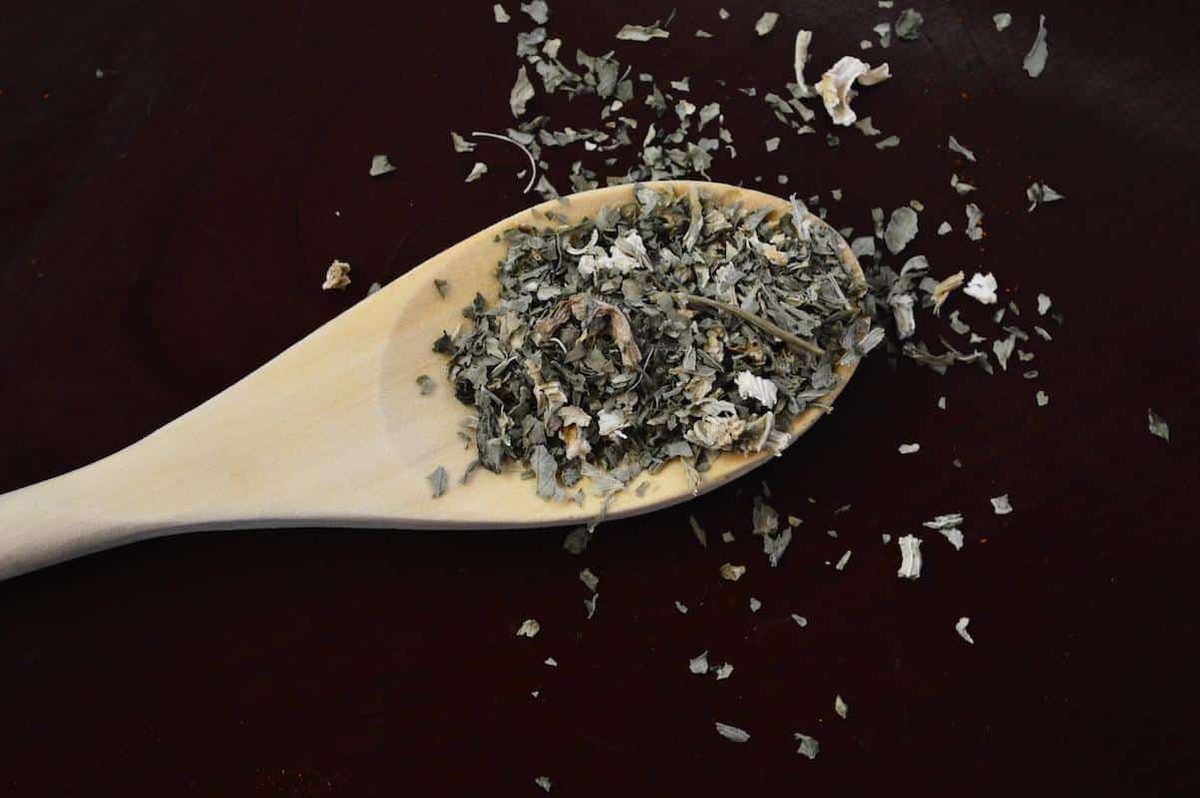
No fresh celery in the fridge? Celery flakes are dried, chopped celery, and they give you a mild celery flavor and a little color with no washing or chopping. By McCormick’s count, two tablespoons of flakes stand in for a quarter cup of chopped fresh celery.1 They work best in soups, stews, braises and stuffing, where there’s enough liquid and time to soften them. Read the label, though: McCormick’s flakes list a sulfiting agent alongside the celery.
At a glance
| Plant | Apium graveolens L. (celery) |
| Plant family | Apiaceae (carrot/parsley family) |
| Part used | Stalks, dried (McCormick); leaf celery is also sold dried and powdered (PROSEA) |
| Native range | Macaronesia to North Africa, Europe to the western Himalaya |
| Key aroma compounds | Phthalides, including sedanenolide and 3-n-butylphthalide2 |
| Ingredients on one label | Celery and sulfiting agent (McCormick)3 |
| Fresh equivalent | 2 tablespoons of flakes for 1/4 cup chopped fresh celery (McCormick’s figure)1 |
| Allergen status | Mandatory allergen labeling in the EU; not one of the nine major US food allergens45 |
What celery flakes are
Celery is a biennial plant of temperate climates. Leaf celery is used as a flavoring either fresh or as a dried powder. Supermarket celery flakes are made from the stalk; McCormick’s start with fresh, whole celery stalks.
Three other celery products sit next to the flakes on the shelf, and each does a different job:
- Celery seeds are sold whole or ground as a spice. The seed is known for its essential oil, about 3% of its dry weight.2
- Celery salt is salt mixed with ground celery seed. McCormick’s lists only “Salt & Celery Seed.”6
- Celery powder is a name used for more than one product. Its own page sorts out which is which.
Flavor and the compounds behind it
Celery flakes taste like a softer version of cooked celery: green, savory and a little bitter. PROSEA credits celery’s signature smell to a lactone it calls sedanolid,7 and a 2019 review of Apium plants says a series of phthalides gives celery essential oil its characteristic odor, with sedanenolide and 3-n-butylphthalide present in remarkable quantity.2
We found no study measuring how much of these compounds survives commercial drying of celery stalks. So we found no measurement of how flakes compare with fresh celery for aroma.
Origin and history
Celery is native to Macaronesia (the Atlantic islands off northwest Africa) and North Africa, and Europe east to the western Himalaya. People brought it into cultivation before the Christian era, first as a medicinal plant, and milder-tasting forms weren’t selected until the 16th or 17th century, in France or Italy. In China, celery goes back at least to the 6th century.7 In ancient Greece the victor’s crown at the Isthmian Games was originally made of dry wild celery, and it was switched to pine in Roman times. The English word comes, through French and Italian forms, from Greek sélīnon.
You’ll often read that celery garlands were found in Tutankhamun’s tomb, or that celery was hardly eaten in Britain until the late 17th century. We couldn’t trace either to a source we could open, so we’re not stating them as fact.
How celery flakes are used
McCormick suggests its flakes for chicken or vegetable soup, barbecue and pasta sauces, pot roasts and casseroles, stuffings, and dressings for potato, macaroni, cucumber or coleslaw salads. They work best in dishes with enough liquid and cooking time to soften them: soups, stews, braises, sauces and stuffing. For a dry rub or seasoning blend, grind them first.
Measuring. Ratio (Attributed): McCormick’s conversion is 2 tablespoons of flakes in place of 1/4 cup of chopped fresh celery.1 That’s the maker’s figure for its own product, and we found no independent test of it. Flakes won’t give you fresh celery’s crunch, so they stand in better in cooked dishes than in raw salads where texture matters.
Buying and quality
Read the ingredient list. McCormick’s celery flakes list celery and a sulfiting agent.3 Under FDA labeling rules, 10 parts per million is the level at which a sulfiting agent counts as a detectable amount. Below that, an incidental sulfite with no technical effect in the finished food can be treated as insignificant.8 If you’re avoiding sulfites, check each brand’s label.
A quick check before you cook: crush a few flakes and smell them. If they barely smell of celery, they won’t add much flavor. That’s a rule of thumb, not a tested standard.
Storage
We found no shelf-life figure for celery flakes from a regulator, extension service or standards body. McCormick prints a best-by date on its bottles. Keep the container closed, dry and away from heat.
Safety and nutrition
Allergy. Celery and products made from it are on the EU’s list of allergens that must be declared and highlighted on food labels.4 Celery isn’t one of the nine major food allergens named by the FDA.5
Sulfites. See Buying and quality above.
Nutrition and health claims. We couldn’t reach USDA FoodData Central’s entry for dried celery, so there are no nutrient figures for the flakes here. Dried celery often gets credited with treating urinary tract infections, helping weight loss and hydrating you faster than water. We found no systematic review or health-agency summary that supports any of that.
Substitutes and comparisons
- Celery flakes substitutes
- Celery seeds, celery seed substitutes and celery seed uses
- Celery salt, celery powder and celery leaves
- Celery seed vs. celery powder and celery powder vs. celery salt
Footnotes
-
McCormick Celery Flakes, product page, McCormick & Company. mccormick.com · Merchant ↩ ↩2 ↩3
-
Salehi et al., Apium Plants: Beyond Simple Food and Phytopharmacological Applications, Applied Sciences, 2019. mdpi.com · Peer-reviewed ↩ ↩2 ↩3
-
McCormick Celery Flakes, retailer listing with label ingredients, Stop & Shop. stopandshop.com · Merchant ↩ ↩2
-
Regulation (EU) No 1169/2011, Annex II, EUR-Lex. eur-lex.europa.eu · Regulator ↩ ↩2
-
Food Allergies, U.S. Food and Drug Administration. fda.gov · Regulator ↩ ↩2
-
McCormick Celery Salt, retailer listing with label ingredients, Stop & Shop. stopandshop.com · Merchant ↩
-
Apium graveolens (PROSEA), S. Susiarti and J.S. Siemonsma, Plant Resources of South-East Asia. uses.plantnet-project.org · Reference work ↩ ↩2
-
21 CFR 101.100, Food; exemptions from labeling, eCFR. ecfr.gov · Regulator ↩
Also drawn on
- Apium graveolens L., Plants of the World Online, Royal Botanic Gardens, Kew. powo.science.kew.org
- Isthmian Games, Encyclopaedia Britannica. britannica.com
- celery, Merriam-Webster.com Dictionary, Merriam-Webster. merriam-webster.com