Spice Substitutes · Substitutes
Celery Seed Substitutes, Ranked by What the Seed Is Doing
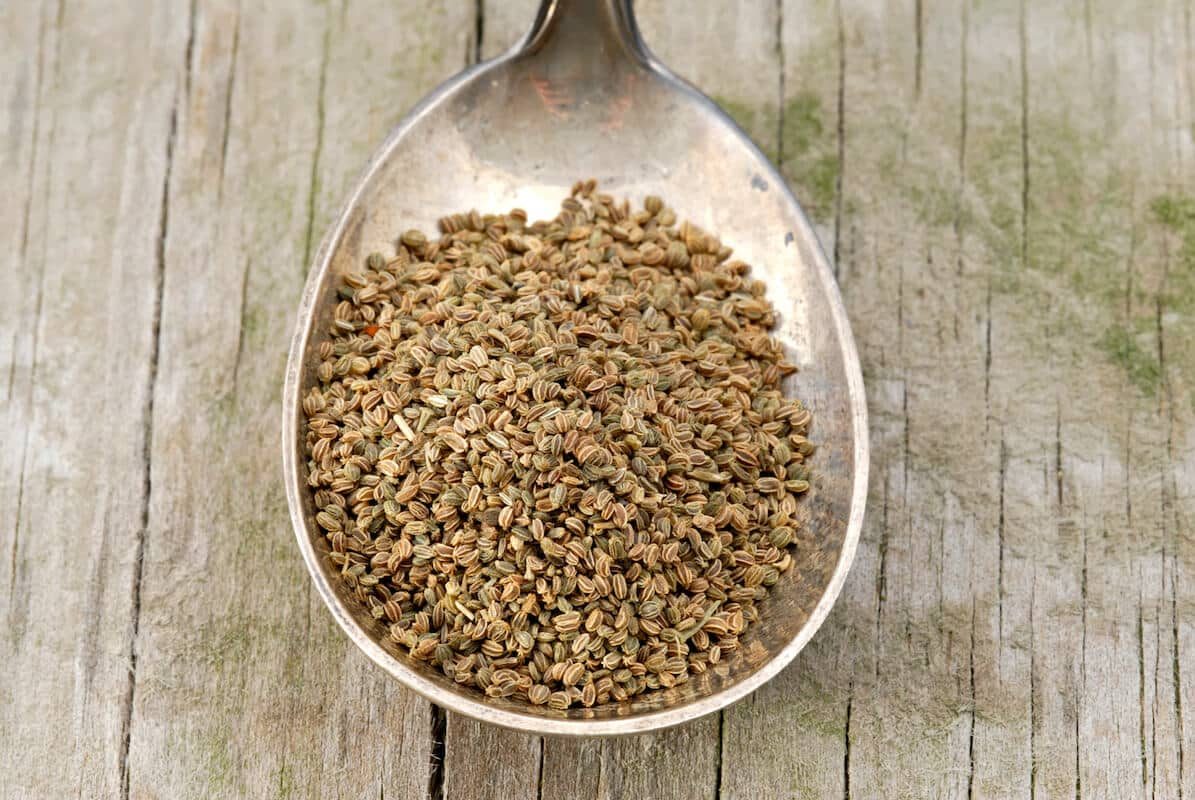
Out of celery seed? Reach for another form of celery first. In a soup or stew, minced celery tops do the job, though you’ll need a lot of them: The Spice House uses 2 tablespoons for every 1/2 teaspoon of seed.1 In a rub, dressing or brine, celery salt works as long as you cut the recipe’s other salt. And for the flecks in coleslaw or potato salad, caraway makes a good stand-in.
Quick answer
| What celery seed is doing | Best substitute | Starting amount, per 1/2 tsp celery seed | Treatment |
|---|---|---|---|
| Celery flavor in a cooked dish (soups, stews, stuffing, braises) | Minced fresh celery tops | 2 tablespoons | Attributed |
| Celery flavor in a dry or no-cook mix (rubs, dressings, brines) | Celery salt, with the recipe’s salt cut | About 1/2 tsp, cutting about 1/4 tsp table salt | Method (flavor), Computed (salt) |
| A visible, savory seed in slaw, potato salad or pickles | Caraway seeds | About 1/4 tsp, then taste | Method |
How the ratios on this page are labeled
- Computed: based on a measurable physical relationship.
- Attributed: a named source publishes this ratio. We quote it as theirs.
- Disputed: named sources give different answers to the same swap. You get each one, side by side.
- Method: our starting point, based on how the two compare. Taste and adjust.
McCormick’s advice on celery seed itself is a good guide: its pungent, somewhat bitter flavor “goes a long way,” so start with a pinch.2
If celery seed is flavoring a cooked dish
In soups, stews, stuffings and braises, The Spice House says the seed’s job is to give you celery flavor without the stalk’s stringy texture. Here the plant itself is your best stand-in, as long as you don’t mind a little texture and moisture.
1. Fresh celery tops (the leafy ends)
Ratio (Attributed): The Spice House says to use 2 tablespoons of minced celery tops for every 1/2 teaspoon of celery seed.1 That’s 1/4 cup of tops per teaspoon of seed. Mince them fine and add them early enough to soften.
That’s a lot of leaves, and it tells you how concentrated the seed is. Katzer calls the seed’s smell much stronger than the leaf’s.3
2. Dried celery or celery flakes
The Spice House lists dried celery as a celery seed substitute but doesn’t give an amount.1 McCormick’s celery flakes are dried celery stalk, suggested for soups, sauces and stuffings.4
Ratio (Method): Flakes are milder than seed, so start with about 1 teaspoon of flakes per 1/2 teaspoon of seed in a simmered dish. Taste once they’ve softened, and add more if you need it.
If celery seed is flavoring a dry or no-cook mix
Rubs, dressings, pickling brines and Bloody Mary mixes don’t give fresh celery any time or liquid to soften, so you need a dry, concentrated form.
1. Celery salt
The Spice House calls celery salt a great substitute since it’s made of celery seed and salt, and says to cut the salt elsewhere in the recipe.1 McCormick’s celery salt lists just “Salt & Celery Seed.”
Salt adjustment (Computed): McCormick’s label gives 270 mg of sodium per 1/4 teaspoon,5 about 1,080 mg per teaspoon. The FDA says 2,300 mg of sodium is about 1 teaspoon of table salt.6 So a teaspoon of this celery salt carries a little under half the sodium of a teaspoon of table salt. For every teaspoon of celery salt you add, cut about 1/2 teaspoon of table salt from the recipe. Check your own brand’s label, since it may differ.
Celery flavor (Method): Start with an equal amount, cut the recipe’s salt as above, and taste. Don’t double up for flavor: 2 teaspoons of McCormick’s celery salt would carry about 2,160 mg of sodium, close to the FDA’s Daily Value of less than 2,300 mg.56
2. Celery powder made from seed
Some celery powder is just ground celery seed. Others are ground dried celery. Read the label.
Ratio (Method): For seed-based powder, start with a little less powder than the whole seed the recipe calls for, and taste.
If celery seed is a visible seed in slaw, potato salad or pickles
Here the seed adds flecks, a little crunch and a savory note. Other parsley-family seeds can give you the look and the bite, though the flavor will shift.
1. Caraway seeds
The Spice House calls caraway seeds “an excellent substitute” for celery seed in coleslaw, and says they work in potato and pasta salads too.1 Caraway brings its own smell, reminiscent of anise, with a warm, slightly sharp taste.
Ratio (Method): Start low: about half as much caraway as celery seed, then taste.
2. Dill seed
The Spice House lists dill seeds as a substitute. Dill seed is a classic pickling spice, used for pickled cucumbers, onions and vinegar. Its flavor is warm, slightly sharp and a bit like caraway. Expect something closer to dill pickle than celery.
Ratio (Method): Start with the same amount or a little less, and taste.
3. Fennel seed
The Spice House also lists fennel seeds. Fennel brings a sweet, anise-like note that celery seed doesn’t have. Use it where a little sweetness suits the dish.
Ratio (Method): Start with about half as much fennel as celery seed.
4. Lovage seed, if you have it
Lovage is a separate plant with a sweet, celery-like flavor.
Ratio (Method): Start with the same amount and taste.
Not recommended: nigella
You’ll sometimes see nigella seed suggested as a celery seed substitute. Its taste is aromatic and slightly bitter, with a vaguely oregano-like scent when ground or chewed. We found no source that recommends it in place of celery seed.
What isn’t known
- None of the sources we read publish the salt-to-seed ratio of commercial celery salts, so any celery salt amount for celery flavor is only a starting point.
- We didn’t find a whole-to-ground volume figure for celery seed.
Related
- Celery seeds and celery seed uses
- Celery seed vs. celery salt and celery seed vs. celery powder
- Celery salt, celery powder, celery flakes and celery leaves
- Caraway seeds, dill, dill seed vs. dill weed, fennel seed, lovage and nigella seeds
- Celery salt substitutes and celery powder substitutes
Footnotes
-
Celery Seed Substitute, The Spice House. thespicehouse.com · Merchant ↩ ↩2 ↩3 ↩4 ↩5
-
McCormick Whole Celery Seed, product page, McCormick & Company. mccormick.com · Merchant ↩
-
Gernot Katzer, Celery (Apium graveolens), Gernot Katzer’s Spice Pages. gernot-katzers-spice-pages.com · Reference work ↩
-
McCormick Celery Flakes, product page, McCormick & Company. mccormick.com · Merchant ↩
-
McCormick Celery Salt, label ingredients and Nutrition Facts as listed by Stop & Shop. stopandshop.com · Merchant ↩ ↩2
-
Sodium in Your Diet, U.S. Food and Drug Administration. fda.gov · Regulator ↩ ↩2
Also drawn on
- Anethum graveolens (PROSEA), Nguyen Thi Tâm, C.C. de Guzman & P.C.M. Jansen, Plant Resources of South-East Asia, via Pl@ntUse. uses.plantnet-project.org
- Dill (revised and updated by Melissa Petruzzello, updated 30 Sep 2026), Encyclopaedia Britannica. britannica.com
- Caraway, Encyclopaedia Britannica. britannica.com
- Foeniculum vulgare (PROSEA), Purwaningsih, Harmida & M. Brink, Plant Resources of South-East Asia, via Pl@ntUse. uses.plantnet-project.org
- Lovage (Britannica Editors; revised by Melissa Petruzzello), Encyclopaedia Britannica. britannica.com
- Nigella (Nigella sativa L.), Gernot Katzer’s Spice Pages, Gernot Katzer's Spice Pages. gernot-katzers-spice-pages.com