Blog · Dish guide
Christmas Spices: The Eight That Define Holiday Baking and Mulled Drinks
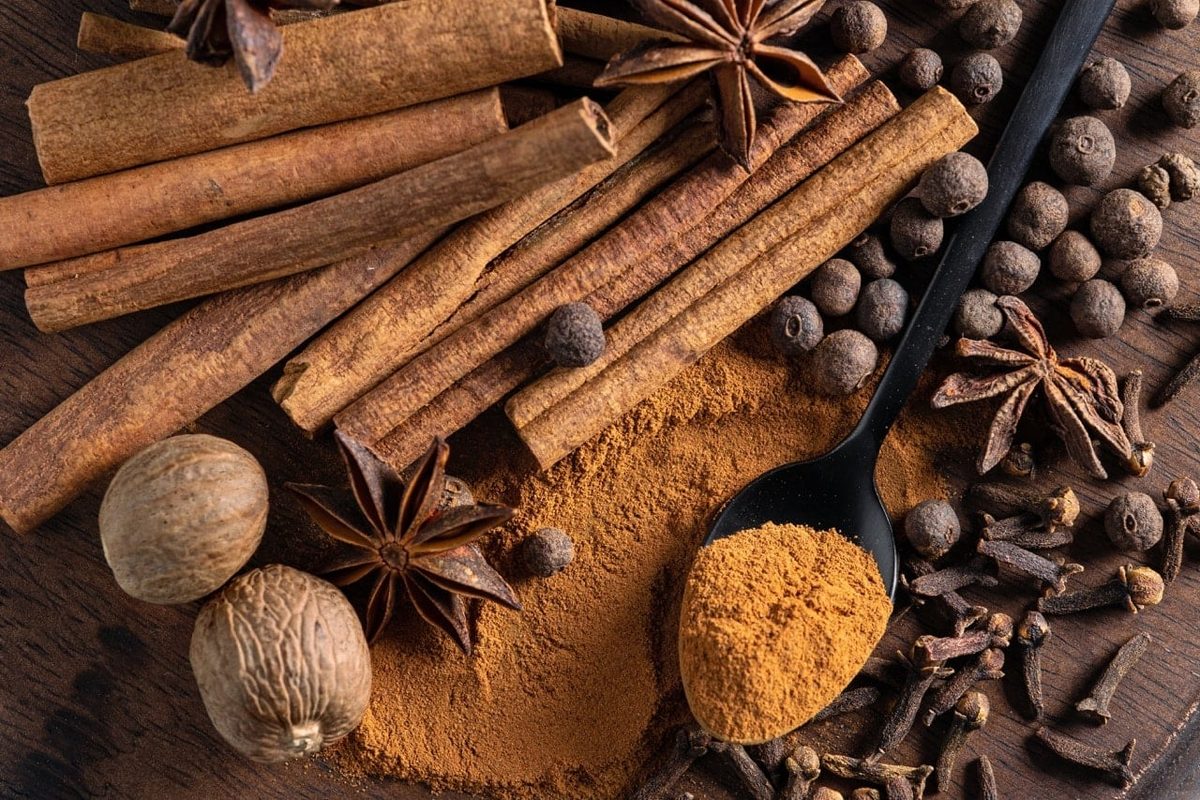
European Union law even names two of the Christmas spices: Glühwein and Nordic vinglögg are defined as wine drinks flavored mainly with cinnamon and/or cloves.1 Nutmeg, ginger, allspice, cardamom and star anise fill out the season’s drinks and baking. An American cookbook printed in 1796 was already spicing its gingerbread with ginger, cinnamon, nutmeg, coriander and allspice,2 and its one Christmas cookie leaned on a spice hardly anyone links to the holiday now. Below: what each spice does, and three safety points to know before a season of heavy baking.
At a glance
| Spice | Where it shows up at Christmas |
|---|---|
| Cinnamon | Mulled wine, gingerbread12 |
| Cloves | Mulled wine, baking, ham13 |
| Nutmeg | Eggnog, gingerbread42 |
| Ginger | Gingerbread2 |
| Allspice | Baking, gingerbread52 |
| Cardamom | Scandinavian Christmas breads6 |
| Star anise | Mulled drinks |
| Coriander seed | 18th-century Christmas cookies2 |
The core spices and what each one does
Cinnamon: the backbone of mulled wine
Cinnamon is one of the two spices EU law names for mulled wine. Its definition of Glühwein is a wine drink “flavoured mainly with cinnamon and/or cloves”, and the Nordic vinglögg gets the same spice wording. On the baking side, Amelia Simmons’s 1796 American Cookery puts a tablespoon of cinnamon in her molasses gingerbread.2
Most cinnamon sold in North America is cassia, not Ceylon, according to NCCIH,7 and that matters for holiday baking (see Safety below). Sticks are the usual pick for steeping in wine or cider, ground cinnamon for doughs; see cinnamon sticks vs. ground cinnamon and Ceylon vs. cassia.
Cloves: mulled wine’s other half, and the ham
Cloves share the EU mulled-wine definition with cinnamon. They’re strong in aroma and hot and pungent in taste, and they’re used especially for meats and baked goods. Studding a holiday ham with whole cloves is a familiar move, though these sources don’t document it.
Cloves are strong, so use whole ones in liquids where you can fish them out. See ground vs. whole cloves, cloves vs. star anise and too much clove.
Nutmeg: eggnog and gingerbread
The FAO’s handbook on nutmeg lists eggnog first among its dairy uses.4 Nutmeg has a distinctive pungent fragrance and a warm, slightly sweet taste, and Simmons grates a whole nutmeg into her butter-and-sugar gingerbread cakes. You’ll usually be told to grate it fresh; see fresh vs. ground nutmeg and allspice vs. nutmeg.
Ginger: the reason gingerbread is called gingerbread
Simmons’s 1796 gingerbreads measure ginger by the ounce: two ounces in one, four in another, a quarter pound in a third.2 Ground dried ginger is the baking form; see fresh vs. ground ginger.
Allspice: one berry, several flavors
Allspice is a single spice, a dried berry, not a blend. It tastes like a combination of cinnamon, nutmeg and cloves, which is how it got its name, and it’s widely used in baking. Simmons offers “coriander or allspice” in her molasses gingerbread.2 See allspice vs. cloves.
Cardamom: the Scandinavian Christmas spice
Cardamom is a favorite in Scandinavian pastries. K-State Research and Extension names three holiday breads built on it: the Scandinavian Yule bread julekake, the Swedish cardamom bun kardemummabullar, and Finnish pulla.6 America’s Test Kitchen reports, citing UN data, that Sweden eats 18 times more cardamom per person than the median country.8
How cardamom got to Scandinavia is disputed:
| Account | Source |
|---|---|
| Vikings found it in Constantinople and brought it north | Repeated by K-State’s writer;6 ATK notes many Swedes believe it8 |
| Little evidence of imported spices in the Viking Age; the Moors are a likelier route, and a 13th-century cookbook is the first mention | Culinary archaeologist Daniel Serra, quoted by ATK8 |
Star anise: the licorice note
Star anise has an anise-like smell and sweet flavor. It often goes into mulled wine and cider, though the EU definitions name only cinnamon and cloves.1 Whole pods look great in a punch bowl, and they’re easy to pull out. See star anise uses.
Coriander seed: the forgotten Christmas cookie spice
The one Christmas recipe in Simmons’s 1796 book, “Another Christmas Cookey”, is flavored with a teacup of finely powdered coriander seed.2 Hardly anyone calls coriander a Christmas spice today, but in this American record it got there first. See coriander.
Gingerbread spice: no single recipe
Gingerbread spice has no fixed formula. The four gingerbreads in American Cookery show the range even within one book:2
| Simmons recipe (1796) | Spices named |
|---|---|
| Molasses Gingerbread | Cinnamon, coriander or allspice |
| Gingerbread Cakes (No. 1) | A grated nutmeg, two ounces ginger |
| Soft Gingerbread (No. 2) | 4 ounces ginger |
| Gingerbread (No. 4) | A quarter pound of ginger, rose water |
Modern blends sold as pumpkin pie spice cover similar ground; see pumpkin pie spice and apple pie spice.
Safety: three things worth knowing
Cassia and coumarin. Cassia cinnamon contains coumarin. Germany’s BfR estimates that a 60 kg adult hits the tolerable daily intake by eating about 2 g a day of cassia with average coumarin content.9 The EU caps coumarin in traditional and seasonal bakery products labeled with cinnamon at 50 mg/kg.10 Occasional holiday baking isn’t the worry. Heavy daily use of cassia is. See Ceylon vs. cassia cinnamon and too much cinnamon.
Nutmeg in large amounts. The National Capital Poison Center notes that nutmeg tastes great in cookies and eggnog but too much can cause hallucinations, while kitchen spices aren’t dangerous used as recommended.11 The Tennessee Poison Center puts reported effects at 15 to 20 grams, about two to three tablespoons of ground nutmeg, far beyond any recipe amount.12 See too much nutmeg.
Japanese star anise. A related plant, Japanese star anise, is toxic, according to the FDA. In 2003 the agency linked teas made with star anise to illnesses in about 40 people.13 Buy star anise from a food supplier, not as a decorative item.
Related
- Thanksgiving herbs and spices
- Cranberry sauce spices
- Cloves vs. star anise
- Too much cinnamon
- The master list of herbs and spices
Footnotes
-
Regulation (EU) No 251/2014, Annex II, EUR-Lex. eur-lex.europa.eu · Regulator ↩ ↩2 ↩3 ↩4
-
Amelia Simmons, American Cookery, 1796, Project Gutenberg. gutenberg.org · Reference work ↩ ↩2 ↩3 ↩4 ↩5 ↩6 ↩7 ↩8 ↩9 ↩10 ↩11
-
“Clove”, Encyclopaedia Britannica. britannica.com · Reference work ↩
-
G.B. Marcelle, Production, handling and processing of nutmeg and mace, Section VII, FAO, 1995. fao.org · Regulator ↩ ↩2
-
“Allspice”, Encyclopaedia Britannica. britannica.com · Reference work ↩
-
Nancy Honig, “Cardamom at Christmas”, K-State Research and Extension, 2021. k-state.edu · Reference work ↩ ↩2 ↩3
-
“Cinnamon: Usefulness and Safety”, NCCIH, 2024. nccih.nih.gov · Regulator ↩
-
Steve Dunn, “Cardamom: How Did It Become Scandinavia’s Favorite Spice?”, America’s Test Kitchen, 2021. americastestkitchen.com · Publication ↩ ↩2 ↩3
-
“Cassia cinnamon with high coumarin contents to be consumed in moderation”, BfR. bfr.bund.de · Regulator ↩
-
Regulation (EC) No 1334/2008, Annex III Part B, EUR-Lex. eur-lex.europa.eu · Regulator ↩
-
Rose Ann Gould Soloway, “Kitchen surprises and cautions”, National Capital Poison Center. poison.org · Reference work ↩
-
Nena Bowman, “Nutmeg, a Potentially Uninvited Holiday Guest?”, Tennessee Poison Center, 2020. vumc.org · Reference work ↩
-
“Teas Made from Star Anise Were Associated With Illnesses Including Seizures”, FDA, 2003. fda.gov · Regulator ↩
Also drawn on
- Cardamom (Gregory Lewis McNamee, updated 20 Aug 2026), Encyclopaedia Britannica. britannica.com