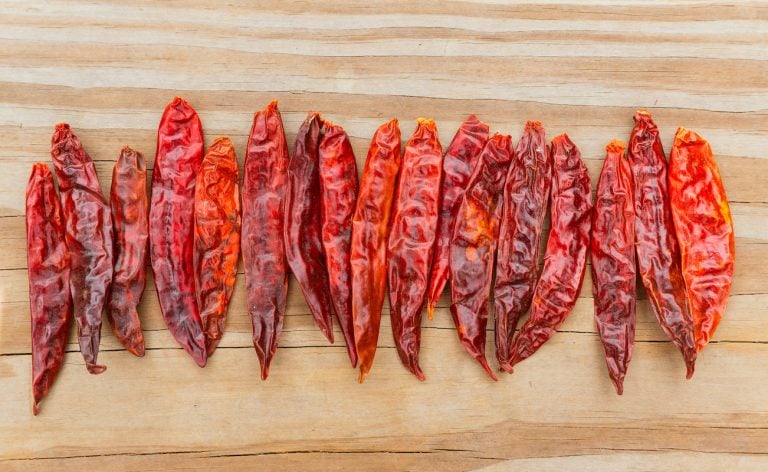
Chile de arbol

Chile de Arbol Powder: Cayenne Pepper’s Mexican Cousin

Like all other chili peppers, chile de arbol originated in what is now Latin America. Christopher Columbus found out about chili peppers while seeking a route to Asia for the black pepper trade. It is believed that chili peppers were being cultivated by Mesoamericans as early as 5000 BC. Along with using them as a seasoning for food, they used chilies to fumigate their houses. Portuguese trade routes are to be credited for the spread of hot peppers throughout the world including in Asia.

Chile de arbol was first documented by a naturalist named Francisco Hernandez, who was also the King of Spain’s court physician. Sent to study the New World, Hernandez compiled 16 volumes on the plants found in Mexico. According to his writings, the name chile de arbol comes from a Nahuatl word and translates to treelike or woody and refers to the fact that the trees have thick stems and branch upward.
Read more

what can you make with cocoa powder

What Can You Make With Cocoa Powder?

Cocoa powder is one of the two main ways to add chocolate flavor to dishes. Not only is chocolate flavor one of the most popular in existence, it is a versatile one as well. The food items you can make with it range from extremely simple desserts that can be thrown together in a few minutes to complex ones recommended only for the most serious home cooks. Consider some excellent ways to use cocoa powder below.

Read more

lilac

Lilac: A Flower With True Flavor

Lilacs have as long a history as the histories of roses and tulips. The lilac plant belongs to the same family as the olive. According to Greek mythology, this flowering plant originated from a nymph who turned herself into a lilac bush to escape the attention of Pan. The first varieties of lilac came from Europe and Asia and were first introduced to Vienna in the 16th century. They were afterward brought to the new world by colonists who wanted flowers that reminded them of their homes in Europe. Lilacs could be found all over the eastern side of North America by the time the revolutionary war was fought. Both George Washington and Thomas Jefferson mention planting them in their writings.

Today, there are more than 20 different lilac species. You can find lilac growing wild in abandoned lots and old homesteads.

Read more

shawarma spice

Shawarma Spice: A Spice Blend For Middle Eastern Fast Food

As with other specialized seasoning blends like taco seasoning or fajita seasoning, shawarma spice is all about convenience. It is an easy way to add the right balance of all the spices that are traditionally used on shawarma.

While the origin of shawarma is not well documented, it is probably Turkish in origin and was most likely invented in the city of Bursa at some point in the 17th century. It was called doner kebab in Turkey but took on the Arabic name shawarma when it spread throughout the Levant. Shawarma is made by placing marinated slabs of meat and fat on a vertical spit and roasting them slowly while turning the spit. The Arabic name shawarma actually has to do with the turning action of the spit. It comes from the Turkish word cevirme, which means turning.

There are versions of shawarma all throughout the Middle East and Mediterranean region. One of the many similar food items is the Greek gyro. The Mexican dish tacos al pastor is also said to be a New World descendant of shawarma, brought to Mexico by Middle Eastern immigrants.

Read more

Jamaican curry powder

Jamaican Curry Powder: The Taste Of The British Empire

It is often reported that the concept of curry powder arrived in Jamaica via Indian indentured workers who emigrated to Jamaica and other parts of the West Indies in the 19th and early 20th century. While there is probably some truth to this (they may have brought the ingredients for curry powder with them) it is more likely that they simply adopted British curry powder once in Jamaica. At that time, Jamaica was a colony of the British Empire and its cuisine was influenced by the British. Separated from the land of their birth and the food culture there, they latched onto the closest thing they could find—the British version of Indian flavors.

It is worth noting that Indian food culture did not remain entirely separate from other food cultures on the island. Much like Creole and Cajun seasoning, Jamaican curry powder would become representative of multiple disparate immigrant and indigenous communities. Jamaican curry powder typically includes allspice, thyme, and other ingredients not included in most classic British curry powder blends and is often used to flavor some very non-British foods.

Read more

rose petals

Rose Petals: A Persian Spice

Rose petals were used in Ancient Egypt, but rose plants are thought to have originated in Asia and were first cultivated by the Chinese 5,000 years ago. The petals were also popular in Rome and Greece with the oil produced from them being used as both a medicine and as a perfume for wealthy Romans. The Romans also used them as adornments at weddings where they were made into crowns to be worn by the bride and the groom. In addition, the Romans believed that adding rose petals to wine helped to prevent drunkenness.

Roses have been used in Persian cuisine for 3,000 years. In fact, the use of rose petals in Middle Eastern cooking is largely the product of Persian influence. Rose petals (along with other Persian staples) were adopted throughout the Middle East after Persia’s conquest by Arabs and would eventually be used in many cuisines throughout the world including Indian and Chinese food. While many Persians adopted various aspects of Arab culture, they retained their unique cuisine with few changes. It was allowed to remain the same because the Arabs enjoyed Persian food.

Read more

white peppercorns

White Peppercorns: A Milder Version Of Pepper

The history of the white peppercorn is deeply interwoven with that of the black peppercorn since they are both from the same fruit. Black and white peppercorns come from the drupes of the Piper nigrum plant. They differ in that white peppercorns have had the dark skin removed, which alters both the flavor and the appearance of the spice. To make white peppercorns, the drupes are allowed to ripen before being soaked so that the skins can be rubbed off.

For much of human history, pepper has been one of the most important spices. In fact, it could be said that its value is second only to salt. The history of the spice trade is mainly the history of the peppercorn, which includes both black and white pepper. The Piper nigrum plant is native to Southeast Asia and peppercorns were being used by Indian cooks as early as 2000 BCE. The Ancient Egyptians used pepper in when mummifying corpses; peppercorns were stuffed into the mummy of Ramesses II and it is believed to have been used as currency in Ancient Rome.

Read more

licorice root

Licorice Root: The Source Of Much Love…And Hate

Licorice has been used as a medicine since the time of the Ancient Egyptians who chewed it and made tea with it. The Greeks would learn of licorice root from the Scythians and referred to it as Scythian root. Licorice root was used by the Romans as well. The Roman author and naturalist Pliny recommended licorice for clearing the voice and claimed that it could alleviate thirst and hunger. Dioscorides would instruct troops of Alexander the Great to use licorice root for relieving their thirst when they had limited access to water.

It is said that Buddha consumed licorice. Hannibal’s troops enjoyed licorice as they marched over the Alps and it is what blackened the teeth of Ivan the Terrible. The Chinese have used it for thousands of years to treat a variety of ailments. Later on in history, Napoleon would be a fan of licorice root and chewed so much of it that it blackened his teeth.

Read more