Spice Comparisons · Comparison
Celery Seed vs. Celery Salt: Same Seed, Very Different Sodium
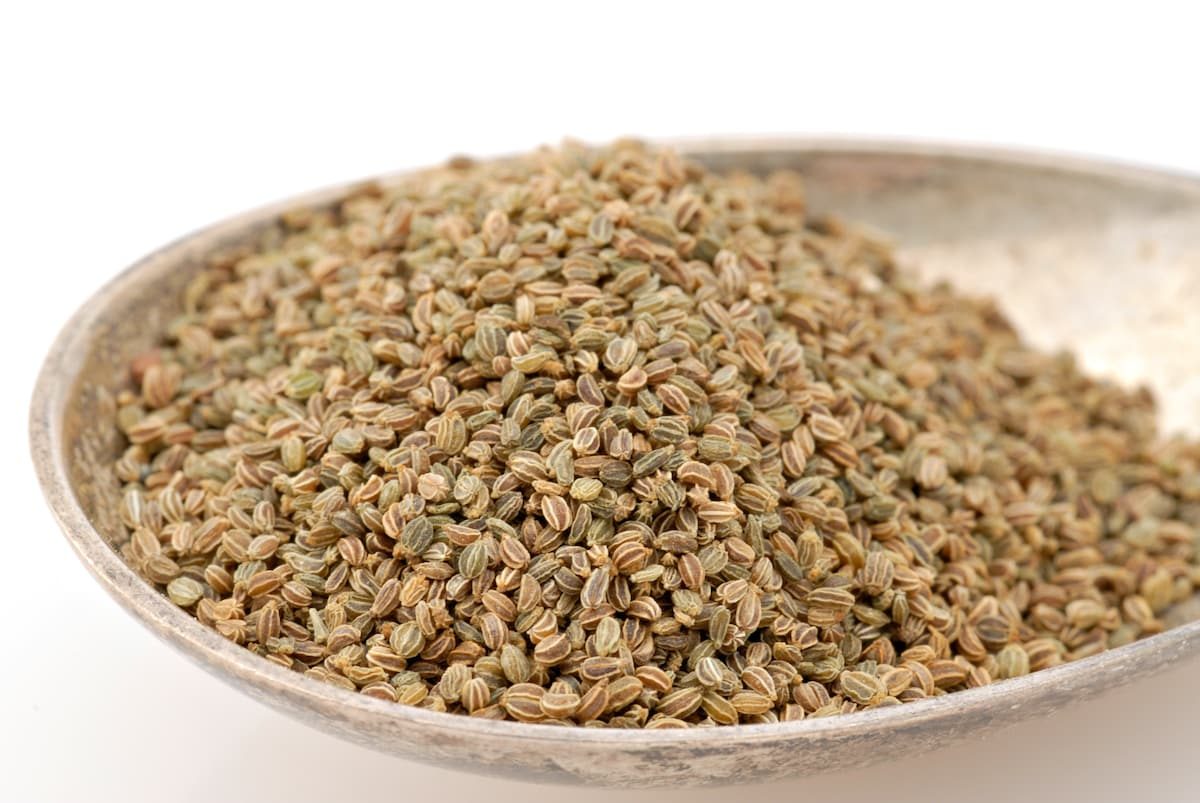
Here’s the whole ingredient list for McCormick’s celery salt: salt and celery seed. So the flavor comes from the same seed, and the real difference is sodium. By McCormick’s label, a teaspoon of its celery salt carries about 1,080 mg of sodium;1 a teaspoon of celery seed carries about 3 mg, by USDA’s figures.2 Reach for celery seed when you want celery flavor you can control, and celery salt when you want salt and celery in one shake.
Both come from celery, Apium graveolens, a biennial in the parsley family (Apiaceae).
Side by side
| Celery seed | Celery salt | |
|---|---|---|
| What it is | The dried fruit of celery, sold as seed, whole or ground | Salt plus ground celery seed (McCormick: “Salt & Celery Seed”)1 |
| Plant | Apium graveolens, Apiaceae | Same, for the seed part |
| Key aroma compounds | Phthalides, which give celery oil its smell; seed oil is about 3% of dry weight3 | Same seed, diluted by salt |
| Flavor | Similar to the leaf and root but much stronger, and slightly bitter (Katzer) | Salty first, then celery |
| Sodium per teaspoon | About 3 mg (USDA: 160 mg per 100 g, 2 g per teaspoon)2 | About 1,080 mg (McCormick: 270 mg per 1/4 teaspoon)1 |
| Salt-to-seed ratio | Not applicable | Not published by McCormick; A Couple Cooks puts purchased blends between 1:1 and 2:14 |
| Forms | Whole, ground | Fine blend |
| Classic uses | Pickles, slaws, dressings | Bloody Mary, Chicago-style hot dog |
| Allergen labeling | EU: celery is a listed allergen5 | Same5 |
| Price | No dated, sourced comparison found | No dated, sourced comparison found |
We worked out both sodium figures ourselves: the seed figure from USDA’s per-100 g value, the salt figure from one brand’s label. Other celery salts may differ.
The differences that change the dish
Sodium. The FDA says 2,300 mg of sodium is about one teaspoon of table salt.6 By that yardstick, a teaspoon of McCormick’s celery salt carries a little under half the sodium of a teaspoon of table salt.1 Two teaspoons carry about 2,160 mg. That’s close to the FDA’s Daily Value of less than 2,300 mg, and over the WHO’s recommendation that adults stay below 2,000 mg a day.7 The 1/4 teaspoon serving on McCormick’s label, 270 mg, comes to about 12 percent of that Daily Value, by our math.
Celery intensity. Celery salt is seed plus salt, so a spoonful holds less seed than a spoonful of ground seed. How much less depends on the blend, and we found no source that publishes a commercial ratio. A Couple Cooks’ homemade version uses 1 1/2 parts celery seed to 1 part kosher salt. The same page says store-bought blends run between 1:1 and 2:1, but doesn’t say which ingredient is the bigger part.4 Bottom line: if you want more celery flavor out of celery salt, you get more salt too.
Texture. Whole seed gives you visible flecks and a little crunch. Celery salt disappears into food like salt. McCormick says celery seed’s pungent, somewhat bitter flavor “goes a long way” and suggests starting with a pinch.8
What’s in the seed
USDA’s analysis of celery seed, per 100 g, lists 1,770 mg of calcium, 44.9 mg of iron and 6.93 mg of zinc, with 3.52 g of linoleic acid.2 A teaspoon is only 2 g, though. By our math, that gives you about 35 mg of calcium (about 3 percent of the FDA’s 1,300 mg Daily Value) and about 0.9 mg of iron (about 5 percent of 18 mg).9 Celery salt gives you less of each per spoon, since part of every spoonful is salt.
A 2019 review of the Apium genus reports that the fatty acids in celery seed oil are mostly petroselinic acid (64.3%), with linoleic acid at 18%. It names coumarins and the furanocoumarin bergapten among the main constituents of the seed’s essential oil.3 The same review’s flavonoid figures, luteolin among them, are for the leaves. It gives none for the seed.
Health claims. A 2025 meta-analysis of 10 randomized trials with 511 adults found that celery preparations lowered blood pressure, fasting blood sugar and triglycerides, but had no effect on total, LDL or HDL cholesterol. The trials used several forms of celery, not just seed, and the authors flag small samples and big differences between studies.10 We found no regulator or systematic review backing claims that celery seed reduces inflammation or protects the liver. None of this applies to celery salt, where sodium is the number that matters. We’re not claiming either one treats or prevents any condition.
Can one stand in for the other?
Yes, either way, as long as you deal with the salt. Our substitute pages go into detail; here’s the short version.
- Celery salt for celery seed. The Spice House calls celery salt a great substitute for celery seed and says to cut the salt elsewhere in the recipe.11 Salt (Computed): cut about 1/2 teaspoon of table salt for each teaspoon of celery salt you add, going by McCormick’s label and the FDA’s teaspoon of salt.16 Celery (Method): Start with an equal amount and taste. See celery seed substitutes.
- Celery seed for celery salt. Salt (Computed): add about 1/2 teaspoon of table salt per teaspoon of celery salt you’re replacing.16 Celery (Method): Start with 1/4 teaspoon of ground celery seed per teaspoon of celery salt, taste, and add more. Ratio (Attributed): To make a jar of your own, A Couple Cooks grinds 1 1/2 tablespoons of celery seed with 1 tablespoon of kosher salt.4 See celery salt substitutes.
- For a lower-sodium Bloody Mary. The International Bartenders Association’s recipe calls for celery salt, Tabasco and pepper, to taste.12 Ground celery seed with a smaller pinch of salt gives you the celery note with less sodium. Season to taste.
When to reach for each
- Celery seed for pickles, slaws, potato salad and dressings, and anywhere you want celery flavor without the stalk. The Spice House says the seed gives you strong celery flavor without the stalk’s stringy, fibrous texture.11 The rest of those uses are just everyday cooking.
- Celery salt where salt and celery go on together at the end: the Bloody Mary and the Chicago-style hot dog, which gets finished with it.
What isn’t known
- None of the sources we read publish the salt-to-seed ratio of commercial celery salts, and the one that gives a range doesn’t say which way round it runs.
- The sodium figure for celery salt comes from one brand’s label.
Related
- Celery seeds, celery seed uses and celery seed substitutes
- Celery salt and celery salt substitutes
- Celery powder vs. celery salt and celery seed vs. celery powder
- Celery powder and celery flakes
Footnotes
-
McCormick Celery Salt, label ingredients and Nutrition Facts as listed by Stop & Shop. stopandshop.com · Merchant ↩ ↩2 ↩3 ↩4 ↩5 ↩6
-
“Spices, celery seed,” FDC ID 170920, USDA FoodData Central. fdc.nal.usda.gov · Regulator ↩ ↩2 ↩3
-
Salehi et al., “Apium Plants: Beyond Simple Food and Phytopharmacological Applications,” Applied Sciences, 2019. mdpi.com · Peer-reviewed ↩ ↩2
-
Sonja Overhiser, “Celery Salt,” A Couple Cooks. acouplecooks.com · Publication ↩ ↩2 ↩3
-
Regulation (EU) No 1169/2011, Annex II, EUR-Lex. eur-lex.europa.eu · Regulator ↩ ↩2
-
Sodium in Your Diet, U.S. Food and Drug Administration. fda.gov · Regulator ↩ ↩2 ↩3
-
Sodium reduction, World Health Organization fact sheet, 2026. who.int · Regulator ↩
-
McCormick Whole Celery Seed, product page, McCormick & Company. mccormick.com · Merchant ↩
-
Daily Value on the Nutrition and Supplement Facts Labels, U.S. Food and Drug Administration. fda.gov · Regulator ↩
-
Liu, Zhao, Xu and Hu, “Effects of celery (Apium graveolens) on blood pressure, glycemic and lipid profile in adults,” Frontiers in Nutrition, 2025. public-pages-files-2025.frontiersin.org · Peer-reviewed ↩
-
Celery Seed Substitute, The Spice House. thespicehouse.com · Merchant ↩ ↩2
-
Bloody Mary, International Bartenders Association. iba-world.com · Standard ↩
Also drawn on
- Apium graveolens L., Plants of the World Online, Royal Botanic Gardens, Kew. powo.science.kew.org
- Celery (Apium graveolens), Gernot Katzer’s Spice Pages, Gernot Katzer. gernot-katzers-spice-pages.com
- Chicago-Style Hot Dogs with ‘the Works’ (Howard Yoon), NPR. npr.org
- Organic Ground Celery Seeds (product page), Spices, Inc.. spicesinc.com